

Honda's 2026 Civic Hybrid Is A Genuinely Great Car With One Number That Sinks It | Review
The new Honda Civic e:HEV LX has plenty to like, but justifying the price tag is difficult
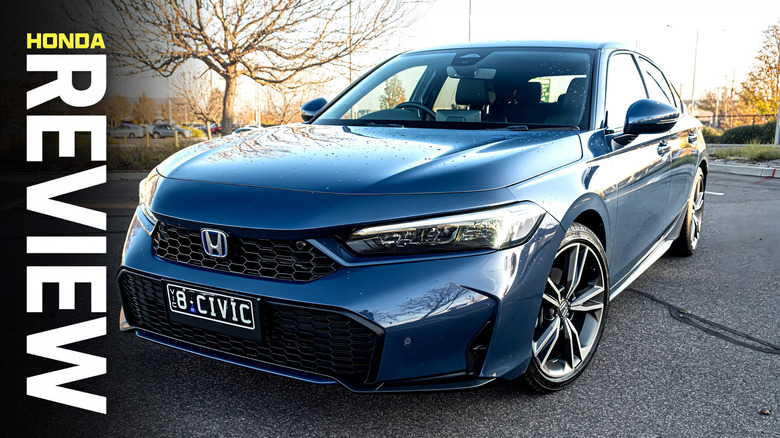
Up until the introduction of the eleventh-generation Honda Civic in 2022, what was once a mainstay of Australia's budget-friendly sedan market has morphed into a niche product that you'll barely ever see out on the road.
Much of this is because, several years ago, Honda Australia decided to position the Civic as a more premium product. Aside from the flagship Type R, it's now available only as two well-equipped hybrids. Prices climbed, and sales fell off a cliff.
Review: The Honda HR-V e:HEV X Is Small In Size Yet Big Where It Counts
I've long been intrigued by the new Civic, keen to explore how it fits into the market and compares to its now much cheaper rivals. In some areas, it stands head and shoulders above the pack, but the price will be hard to justify for some, if not most.
QUICK FACTS
| Model: | 2026 Honda Civic e:HEV LX |
| Starting Price: | AU$55,900 (US$39,000) including on-road costs |
| Dimensions: | 179.5 x 70.9 W x 55.7 in H (4,560 x 1,802 x 1,415 mm) |
| Wheelbase: | 107.6 in (2,735 mm) |
| Curb Weight: | 1,497 kg (3,300 lbs) |
| Powertrain: | 2.0-liter four-cylinder / two electric motors |
| Output: | 181 hp (135 kW) / 232 lb-ft (315 Nm) |
| 0-62 mph | ~8 seconds |
| Transmission: | eCVT |
| Efficiency: | 5.2 l/100 km (45.2 US mpg) |
| On Sale: | Now |
Priced Out Of Its Own Segment
As recently as 2020, the old Honda Civic was available in Australia for as little as AU$22,590 (US$15,700), plus on-road costs, making it a perfect competitor to the ever-popular Toyota Corolla. Now, the Honda Civic starts at AU$49,900 (US$34,800) for the base e:HEV L model and AU$55,900 (US$39,000) for the e:HEV LX.


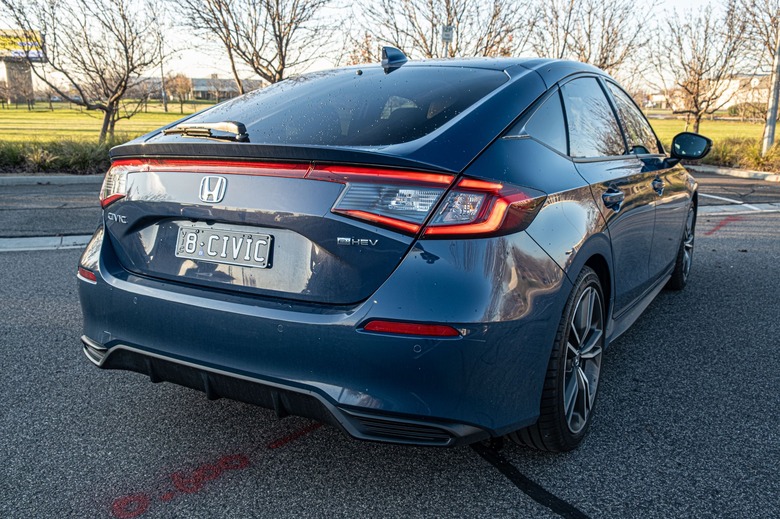
Keep in mind, over in the States, prices for the current-gen Civic have stayed relatively consistent over its predecessor, starting from $25,745, ensuring that it's still a legitimate rival to the Corolla, which starts at a couple thousand dollars less.
Given the Aussie price changes, it's hardly a surprise, then, that sales have tanked in recent years. As recently as 2019, when the tenth-gen model was approaching the end of its lifecycle, 10,531 examples were sold. This was down from a peak of 14,672 in 2017. By comparison, just 933 of this new model were sold in 2025, and 966 found homes across the country in 2024.
While the overall market has certainly swayed towards SUVs and crossovers in recent years, the Toyota Corolla still sells comparatively well in Australia, with 9,860 sold last year.
Perhaps part of the price spike can be attributed to the fact that the current Civic is sold with a fancy hybrid powertrain, whereas its predecessor was only offered in a more conventional combustion guise. It consists of a 2.0-liter naturally aspirated four-cylinder engine working alongside a 1.05 kWh lithium-ion battery pack and a pair of electric motors. This engine works alongside an e-CVT to send power through the front wheels.


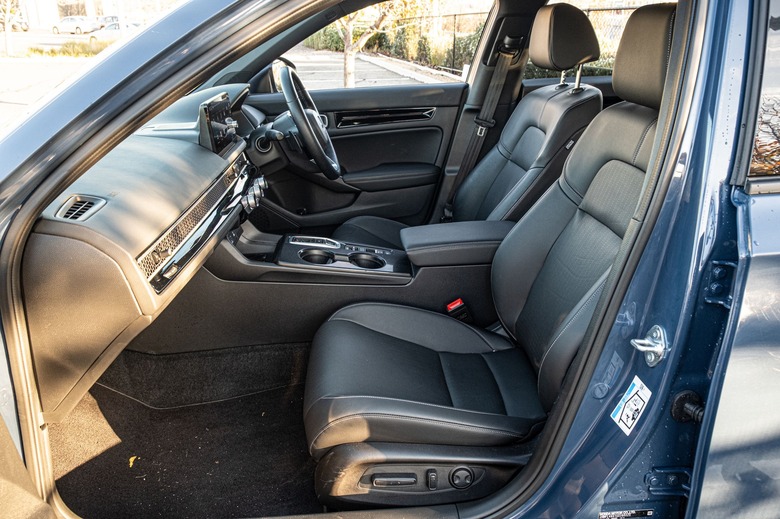
The cabin of the Civic e:HEV LX will be familiar to anyone who has driven another current Honda model, as it shares many of its parts with others in the line-up.
The steering wheel feels excellent, wrapped in leather and having plenty of physical buttons and toggles. Positioned behind it is a relatively small 10.2-inch digital instrument cluster that, despite being crystal clear, offers little customization, which is a shame.
Perched atop the dashboard is a 9-inch infotainment display with wireless Apple CarPlay and Android Auto. However, for the first couple of days I spent with the Civic, Android Auto refused to open, whether I wanted to use it wirelessly or wired. The only way I was able to connect was by performing a full system reset on the infotainment system. After that, my phone connected seamlessly.
A lovely honeycomb mesh design has been incorporated into the dash, hiding the air vents from view, which are controlled with some lovely stalks poking out from the dash. The transmission tunnel is covered in gloss plastic, but fortunately it's not piano black, so it isn't a fingerprint or scratch magnet. I wasn't a huge fan of the gear selector buttons; I found them a little annoying to use during 3-point turns compared to a more traditional shifter, or even a column-mounted one.
There's no denying that the fit and finish of the Civic is great, as it should be given the price tag. It's definitely more premium than a much cheaper Corolla, although I'd argue it's not as nice as the flagship Mazda3 Astina, priced from a touch over AU$47,000 (US$32,800).
The Civic's cabin also lacks pizazz and is already starting to feel a little outdated, although the same can be said about many of its competitors.


Beyond the overall feel of the cabin, the seating position in the Civic is excellent, just as it is in the Type R. The driver's seat can be adjusted very low and the addition of a standard panoramic sunroof gives the cabin a sense of space that's often lacking in small hatchbacks like this, which can feel cramped and claustrophobic.
It's also worth noting that the Civic sold in Australia is a little different to the one sold in the US. You see, Australia only gets the hatchback version, while in the US, the Civic is sold in sedan and hatch configurations. I'd argue the hatch is the better of the two, as opening the tailgate reveals an expansive cargo area that can be extended to 1,187 liters (41.9 cubic feet) with the rear seats folded flat.
The downside of the hatch is that it has a slightly sleeker roofline than the sedan, and headroom is a little tight in the rear for passengers over 6 feet tall.
Feeling Like A Mini-Accord
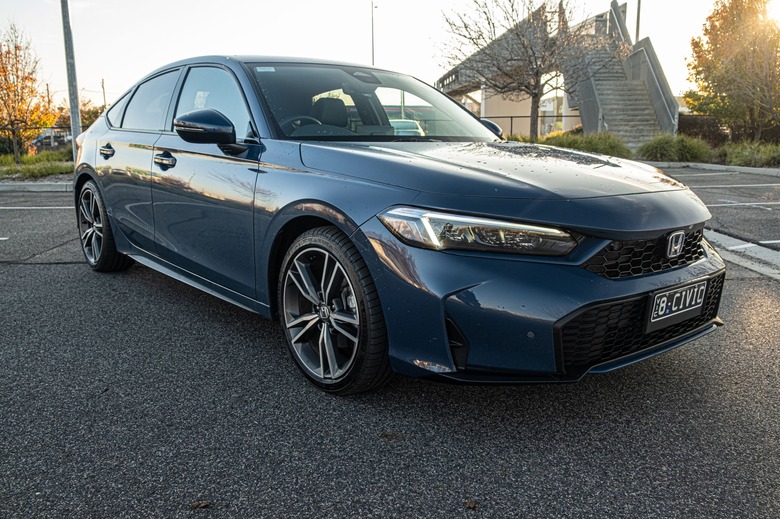
Driving the Civic e:HEV LX is a serene experience. For those seeking a smooth, quiet, and refined driving experience, the car's hybrid powertrain works brilliantly – most of the time.
With combined power figures of 135 kW (181 hp) and 315 Nm (232 lb-ft), the Civic offers more than enough grunt for daily driving duties, and the e-CVT works well in the background and is completely unobtrusive, free from any lurching. This is mostly because it's not a CVT at all. Instead, depending on driving conditions, the engine serves as either a generator for the electric motor or provides direct drive to the front wheels via a clutch. There are simulated shifts, and it all feels very natural, as we've discovered with other Honda models, like the HR-V.
Overall efficiency is good, although we fell short of Honda's claim of 4.2 l/100 km (56 US mpg). I ended up averaging 5.2 l/100 km (45.2 US mpg) over more than 650 km (404 miles) of driving, the majority of which was down on highways, and was slightly higher than the 4.9 l/100 km (48 US mpg) I averaged in a Honda Accord e:HEV a couple of years ago over similar conditions. Perhaps more inner-city driving, where the car's regenerative braking system can work, would have further improved efficiency.


Often, the Civic's 2.0-liter four-cylinder works almost silently in the background, as the car is happy to run primarily on electric power at low speeds. However, there are times when the engine will start randomly revving to what sounds like 2,500 rpm as it eagerly tries to top up the small battery. It's not a big concern, but something prospective customers would be wise to take note of.
Although the standard Civic has not been designed to be a driver-focused machine quite like the Type R, it does share some common traits with its hot hatch sibling. The steering is beautifully precise and well-weighted, and it feels significantly more natural than some of the overly-assisted systems found in other new hybrids and EVs.
Honda has also nailed the Civic's ride. It's pillowy soft when you want it to be, like over speed bumps and through potholes, while somehow still remaining taut, responsive, and reactive when you want to have a little fun across a mountain road. However, the six-year-old Mazda3 feels equally as well-versed in all conditions as the Civic, and it costs a whole lot less.
Verdict
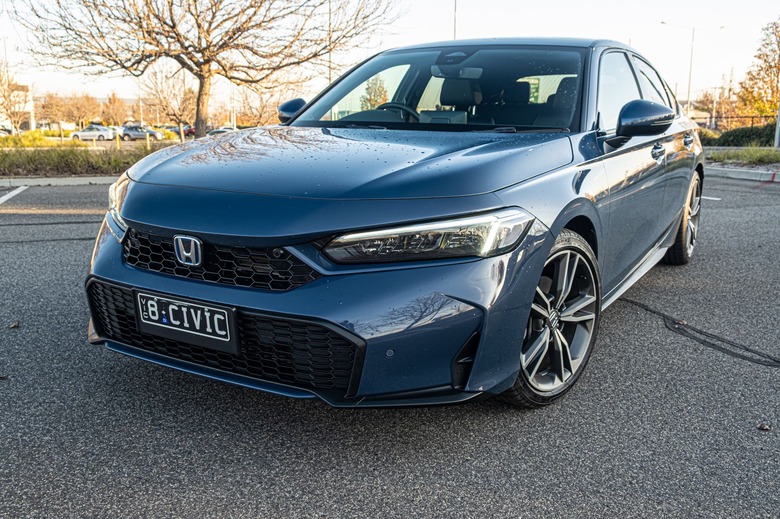
Ultimately, the Honda Civic e:HEV LX is very solid. It has all the same appeal as its predecessors, is practical, looks good, and should be reliable, happily pottering along for decades.
However, the price tag is hard to justify. Compared to the aforementioned Mazda3 G25 Astina, the Civic is reasonably good value for money, but Australia's line-up desperately needs a cheaper, non-hybridized version priced in the mid-AU$30,000 (US$20,900) mark. As it stands, you can buy an HR-V hybrid for around AU$15,000 (US$10,500) less, and even the larger and much more practical Honda CR-V, also with a hybrid, from AU$49,900 (US$34,800).


