


- This is reportedly the first Auburn 851 Speedster produced.
- Its dashboard claims it reached 100.1 mph before delivery.
- RM Sotheby’s estimates it could sell for $850,000–$950,000.
There are beautiful cars, and then there is the 1935 Auburn 851 Supercharged Speedster. Long, low, and almost offensively glamorous, it looks like something a comic-book billionaire would use to escape his wedding. This particular example is even more special, as it is reportedly the very first 851 Speedster ever produced. It’s a classic by every definition.
That pedigree could make it seriously expensive. RM Sotheby’s is offering the Auburn at its Hershey auction that closes today, and it’s expected to sell for between $850,000 and $950,000. Designed by Gordon Buehrig, the 851 combines a towering grille, pontoon-style fenders, external chrome exhaust pipes, a sharply raked windshield, and one of the finest boattail rear ends ever fitted to an automobile. It is extravagant from every angle without looking remotely clumsy.
More: Ford’s 1964 Concept Predicted Today’s Cars Better Than You’d Expect
Under that enormous hood is a supercharged 4.6-liter Lycoming straight-eight producing 150 hp (112 kW). Power reaches the rear wheels through a three-speed manual and a Columbia dual-ratio rear axle, effectively giving the driver high and low ratios for each gear. The best detail, however, might be the plaque mounted to the dashboard. Bearing the engraved signature of racer Ab Jenkins, it declares that the car had “been driven 100.1 miles per hour before shipment.”
That works out to 161.1 km/h, which was a serious number in 1935. Unfortunately, RM Sotheby’s describes the individual testing claim as “fanciful.” Jenkins genuinely exceeded 100 mph in a stock Speedster at Bonneville, but that doesn’t necessarily mean someone personally wrung out every customer car before handing over the keys. Still, it is a magnificent bit of theater. Frankly, it’s not all that different than modern buyers who want a vehicle for its top-end abilities even if they’ll never take them to that speed.
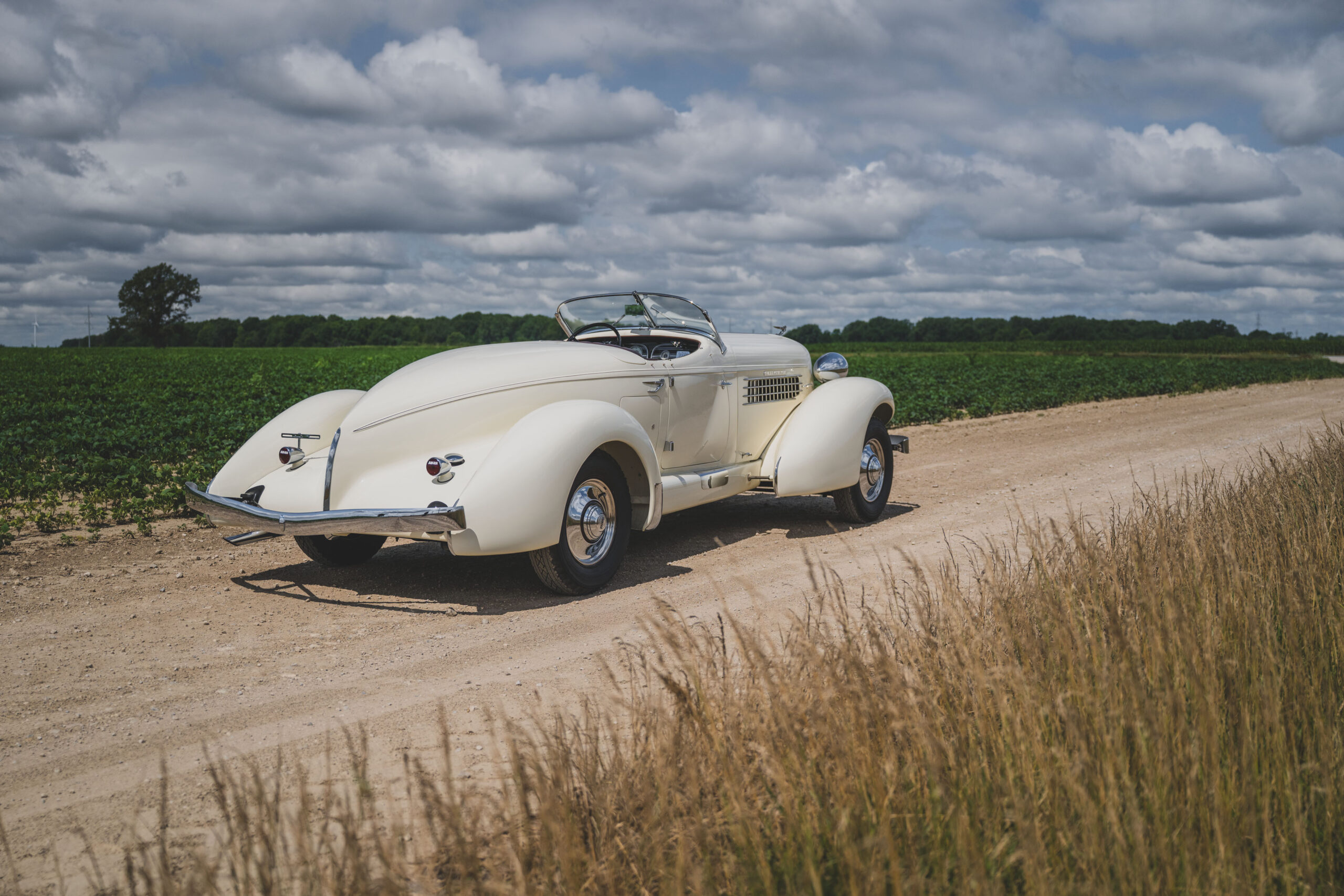
This particular example carries body number U47-200 and supercharger number 1001. It also has unusual early-production details, including more enclosed front fenders and exhaust pipes emerging through the hood louvers.
Its known history dates to the early 1950s, when it was reportedly bought after an accident for just $200. A replacement frame was installed during an amateur restoration, and RM Auto Restoration later completed a full restoration in 1994. More than $15,000 was spent freshening its mechanicals and cosmetics between 2025 and 2026. That’s a small amount for a car potentially worth nearly seven figures. Of course, not all seven-figure cars look this good.