











CONS ›› No brand recognition, slow, average range
A few years ago, Australians looking for a mid-size, all-electric SUV had very few options. Now, there’s never been more, and it seems as though a new option arrives every few months.
The Tesla Model Y still moves more units than any of the competition. Still, other models, including the Kia EV5, Hyundai Elexio, BYD Sealion 7, GAC Aion V, and Zeekr 7C, have opened up many options for buyers. Deepal is one of the newer Chinese automakers to launch locally and, backed by Changan, its S07 aims to upset the establishment.
Read: This Chinese SUV Is Like A Cut-Price Xiaomi YU7, Except For What’s Under The Hood
Sporting a coupe-inspired exterior, premium features, and an interior that feels genuinely considered, it seems promising. But is this enough to pull buyers away from the names they already trust? We recently spent a week living with the Deepal S07 to find out.
QUICK FACTS



Photos Brad Anderson/Carscoops
Sold in a single configuration and offered with either 19- or 20-inch wheels, the S07 is currently available from AU$47,990 (US$34,400), including all on-road costs, or roughly AU$10,000 (US$7,200) less than when it initially launched locally in early 2025. This is very competitive, making the Deepal AU$2,000 (US$1,400) cheaper than a base Kia EV5, and more than AU$15,000 (US$10,800) less than a Tesla Model Y.
For a brand that has absolutely no heritage in Australia, nailing price is extremely important, so Deepal has at least done a good job in that regard.
The S07 has a 79.97 kWh ternary lithium battery pack, driving a rear-mounted electric motor with 160 kW (214 hp) and 320 Nm (236 lb-ft) of torque, roughly on par with other electric SUVs in this segment. One crucial area where the S07 lags the competition is charging, with a peak DC rate of just 92 kW, meaning it takes 35 minutes to charge from 30 to 80 percent. AC charging peaks at 11 kW. Notably, the S07 includes a 3.3 kW vehicle-to-load function, which is a nice addition.


Photos Brad Anderson/Carscoops
Changan designed the S07 at its facility in Turin, Italy, and it stands out from much of the competition thanks to the coupe-SUV roofline and sporty lights. By comparison, the interior is typical of many current electric SUVs from China. For what it lacks in originality, it makes up for it with its material choices.
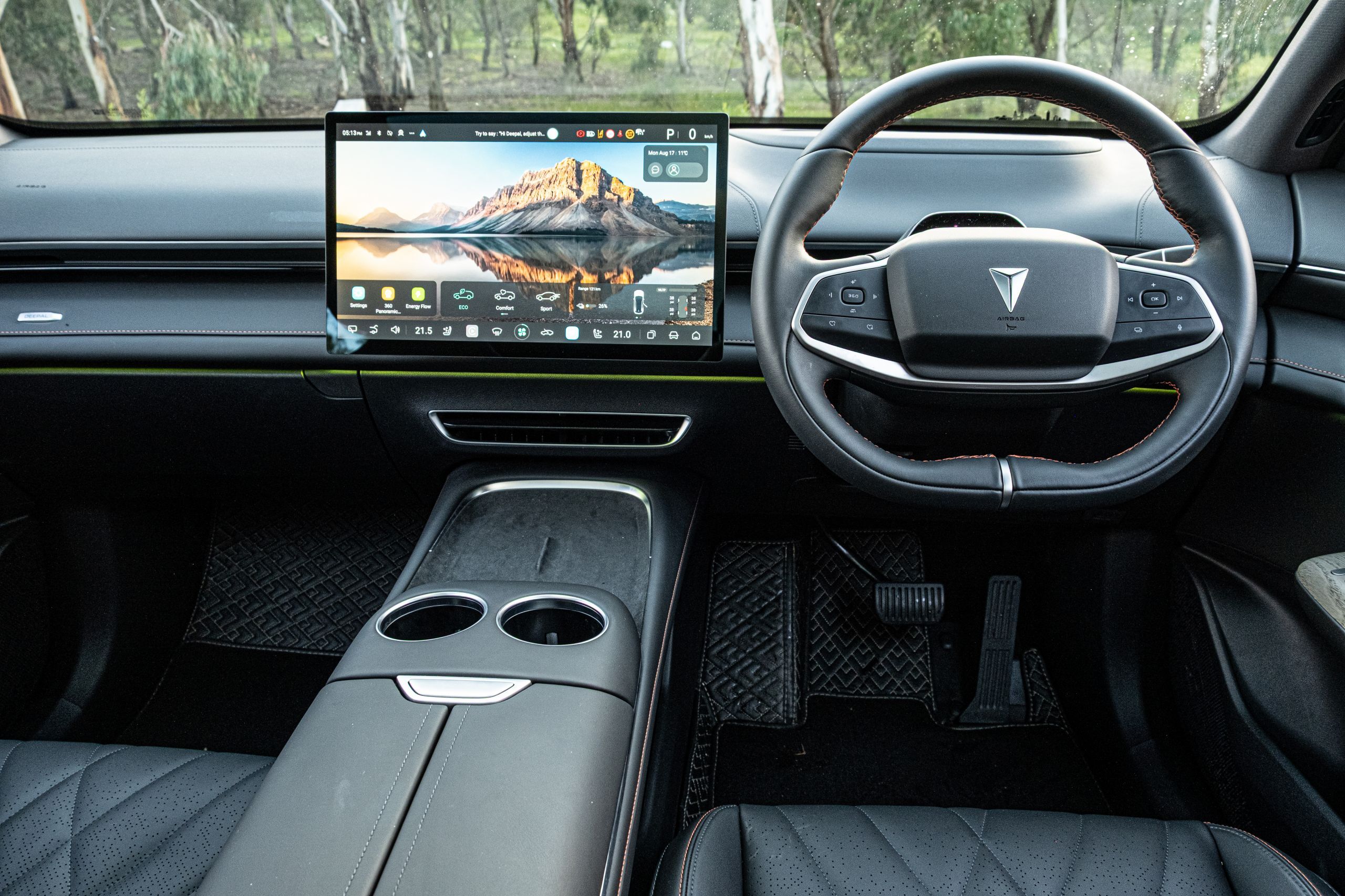
A 15.6-inch central infotainment display comes standard across the range and supports wireless Apple CarPlay and Android Auto. Like a Tesla Model Y, but unlike many of its competitors, the S07 doesn’t feature a separate digital instrument cluster, which is unfortunate. It somewhat makes up for this with a large, augmented-reality head-up display, but I would prefer a cluster.
The party piece of the S07’s cabin is that the central screen can sit centered or be angled toward the driver or passenger. It may only sound like a small thing, but it’s a great idea. After driving the Deepal for a week with the screen directed at me, it felt odd to step into another car with the screen centered. Several BYD’s have screens that can be positioned in portrait and landscape modes, but Deepal’s idea is better.


Photos Brad Anderson/Carscoops
Diving deeper into the screen reveals a tablet-like software package that’s easy to navigate, if a little overwhelming because of all the different controls and settings. The graphics are clear, and the responsiveness is excellent. Swipe down from the top, and you can configure several shortcut controls. You can also operate the climate control through the screen. It works okay, but I often had trouble turning the different vents on and off, as well as directing the air.
An annoying AI-powered voice assistant is also featured, greeting the driver every time they sit inside. Thankfully, you can turn it off.
The driving position is good, although it’d be nice if the seat could be lowered and there were more steering wheel adjustments. Soft-touch synthetic black leather adorns most interior parts, including the wheel, seats, center console, dashboard, and door panels, giving the cabin a premium feel. At the same time, the orange contrast stitching added some sporty flair. Our tester also had the same synthetic leather on the floor mats, which felt a little cheap.
At the rear, there’s enough space to fit two large adults with ease, plus separate climate controls and toggles to move the front passenger seat forward and back. Practicality is respectable, but far from class-leading. With the rear seats upright, you can fit 445 liters (15.7 cubic feet) in the rear, or 1,385 liters (48.9 cubic feet) with the seats folded down.
Smooth But Soulless
There’s a lot to like about the S07, although there are certainly elements that could be improved.
When the S07 first launched, it drew fierce criticism for feeling unfinished and having poorly calibrated safety systems. Several software updates over the past year have improved things, and they seem to have mostly worked.
When I first stepped into the Deepal, I was relieved to see that the overzealous driver monitoring system can be easily disabled through the swipe-down menu and, importantly, it remains off even after the S07 is turned off and switched back on. When I did use it, I found it overbearing, frequently telling me I was distracted no matter how focused I actually was.


Photos Brad Anderson/Carscoops
The S07 isn’t particularly quick, not that you’d expect, given it has a single motor. It takes about 7.9 seconds to reach 100 km/h (62 mph), and although this won’t get your heart pumping, it’s more than adequate for everyday driving.
Read: Avatr 07 Revealed As Yet Another Chinese EV Looking To Shock Tesla Model Y
The rear-wheel-drive setup also means the S07 avoids the torque steer found in some front-wheel-drive competition, like the Kia EV5 and Hyundai Elexio. The lighter front end also gives the S07 a pointy, direct feel when turning, while staying surprisingly flat through sweeping corners and tight hairpins.
The level of regenerative braking is highly customizable, which is welcome, but what’s not so welcome is the lack of a one-pedal driving mode, which seems like a silly exclusion in this day and age. Compounding that, the transition from regen to the mechanical brakes isn’t as smooth as it could be. It also doesn’t use steering wheel paddles for regen adjustments on the fly.

Ride comfort is good, and the S07 walks the fine line between sportiness and plushness well, quickly responding to imperfections in the road without sending too many thumps into the cabin. I think it could be a little softer, but that’s really clutching at straws.
Deepal quotes a combined efficiency of 18.6 kWh/100 km and says the S07 gets up to 475 km of range, roughly on par with similarly priced competition. I averaged 17.8 kWh/100 km, so that claimed range is certainly achievable in the real world. It’s just a shame that using a public DC fast charger gets a little annoying given the slow peak speeds.
The automated driving functions need further improvement. While things like adaptive cruise control and lane-centering work relatively well, the S07 often hugs freeway lane lines rather than sitting in the center of a lane.


Photos Brad Anderson/Carscoops
Verdict
The Deepal S07 isn’t the best vehicle in the class, but at the current price point, it is a compelling package. Buyers eager for an EV that makes a statement on the road will find that in the S07, particularly in bright colors like Cosmic Yellow or Sunset Orange.
Sales data in Australia shows the S07 is performing reasonably well, with 522 examples sold through the end of June, making it more popular than something like a Leapmotor C10 and roughly on par with the Hyundai Elexio, although well down from the more than 3,000 Kia EV5s sold over the same time. For now, it’s not the best choice in the market, but it’s a solid option if you want something a little different. You’ll just have to live with the fact that you’ll be telling people you drive a Deepal.