

Why Do Some Highway Stripes Alternate Between Black And White?
There's more to it than you think
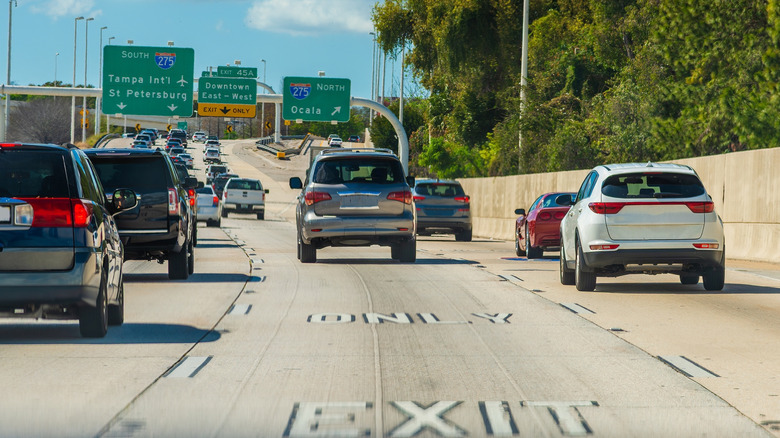
If you have driven on highways across the United States, you may have spotted an unusual detail on the road surface. Instead of the traditional white lines, lane dividers sometimes feature a two-tone pattern. At first glance, one could easily dismiss the alternating black and white stripes as a correction over older markings, but in reality they are a deliberate design known as contrast pavement marking.
The main reason behind the pattern stems from the road material. The Portland Cement Concrete (PCC), which is widely used on U.S. roads, might be known for its durability and lower heat retention, but suffers from heavy glare under bright sunlight. This means it doesn't provide enough visual contrast with white paint as the traditional dark asphalt does, increasing the risk of accidents.
To solve the glaring issue without the immense cost of replacing concrete surfaces, civil engineers proposed the application of contrasting black markings next to the white stripes. As a result, the lines can be either half-white and half-black, or solid white bordered by black outlines. In both cases, the darker portion creates high contrast with the white stripes, making them clearly visible to approaching motorists.
Proven benefits and nationwide adoption
The idea is not new, with the black and white markings already in use for over two decades. Their effectiveness was proven by a recent study, conducted by the Illinois Center for Transportation (ICT), the Illinois Department of Transportation (IDOT), and the Federal Highway Administration (FHWA). Researchers analyzed 70 miles of roadways across Illinois, California, Texas, Iowa, Virginia, and Pennsylvania. They examined a total of 1,774 road departure accidents and found that high-contrast markings deliver measurable crash reductions across every road configuration.
According to the results, eight-lane highways showed the most dramatic safety improvement with contrast markings reducing road departure crashes by 29%, fatal and injury crashes by 19%, and property-damage-only crashes by 5%. On six-lane and four-lane highways the total crashes fell by 16%.
From a financial standpoint, the investment in contrast striping yields significant returns. The ICT research calculated the monetized value of preventing road departure crashes, valuing a single prevented fatal crash at $1,459,479, a disabling injury crash at $78,637, an evident injury crash at $28,761, a possible injury crash at $16,346, and a property damage crash at $709.
Installing grooved contrast tape costs between $5 and $8 per lane foot, whereas non-grooved painted contrast markings cost under $2 per lane foot. Because preventing a single fatal or severe injury crash saves millions, the benefit-cost ratio of installing contrast pavement markings is overwhelming.
According to the report by Michael Williamson and Sumit Singh from Indiana State University, 75% of surveyed state transportation agencies use contrast pavement markings — at least in some capacity. More specifically, 77% applies the bi-tone stripes specifically to Portland Cement Concrete, and 55% deploys them on major interstates and freeways.
Nationwide preferences break down into 45% using bordered markings, 40% using lead/lag designs, and 15% employing both.
A vital upgrade for ADAS

Beyond assisting human eyes, contrast markings play an important role in making it possible for vehicles to offer advanced driver assistance systems (ADAS). These high-tech safety systems are found in most modern vehicles, and they include lane departure warning, lane-keeping assist, adaptive cruise control, and more. The systems can vary based on the automaker, but they often rely on cameras to track lane boundaries.
Because algorithms detect lines by identifying sharp pixel contrast between light markings and dark pavement, washed-out lines on pale concrete can cause camera systems to temporarily lose tracking. By contrast (quite literally), black borders around white lines make it easier for ADAS sensors to spot them, independently of the lighting conditions. Furthermore, some contrast tapes incorporate raised profiles and embedded glass or ceramic optics to reflect the headlight beam during wet nighttime conditions. The bottom line is that high-contrast road markers are easier to detect for both human eyes and in-car safety cameras.