

No Other Engine Has Powered More Cars Than This V8
From family wagons and iconic sports cars to custom hot rods, see how one unstoppable V8 design became the most produced engine in history.
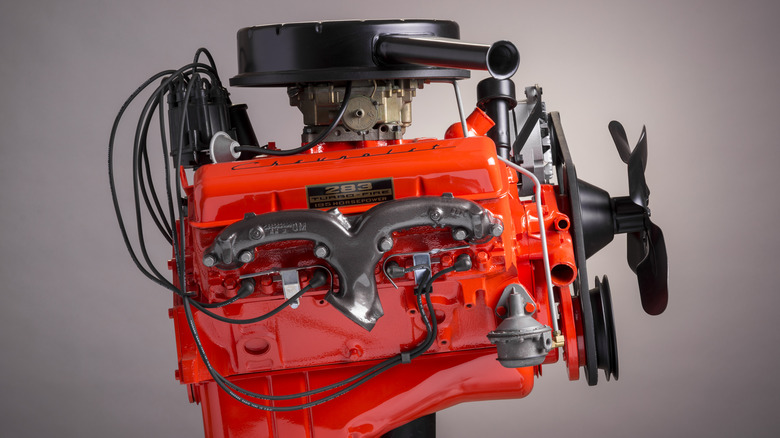
Presidents and diet fads come and go, but the small-block Chevrolet V8 rumbles on. The SBC has powered more vehicles than any other engine in a history that stretches back seven decades and to over 100 million units made. In that time, it has been fitted to everything from humble sedans to working trucks and sports cars. And that just covers the vehicles GM built. Because hot rodders, engine swappers and low-volume sports car brands have also turned time and again to Chevy's legendary V8.
The small-block story starts in the fall of 1954, when Chevrolet unveiled a brand new 265 cu in (4.3 liter) V8 for its 1955 cars. Thin-wall casting and hollow pushrods made the block lighter even that Chevy's own Stovebolt inline-6, stamped steel rocker arms cut production costs, and the resulting engine was compact enough to slot under even the Corvette's hood.
Horsepower numbers for its debut 1955 model year ranged from 162 hp (measured using the generous pre-1972 gross measurement protocol) to 195 hp. But there was plenty more to come. A Rochester fuel injection option and a capacity boost to 283 cu in (4.7 liters) in 1957 delivered 283 hp, the then magic 1 hp per cubic inch.
GM opened up the SBC many times in the '60s, first to 327 cu in (5.4 liters) in 1962, before settling on its most famous configuration in 1967: 350 cu in (5.7 liters). Ask Chevy fans, enthusiasts, and collectors to name the greatest SBC of all time, and they'll probably mention the 1970 LT-1 350. Available exclusively in the Corvette and Camaro Z28, it leveraged a hot cam, monster 11.0:1 compression, strong four-bolt mains, and noisy solid valve lifters to generate up to 370 hp gross.
The LS Legend Is Born
Real horsepower addicts knew there was even more muscle to be had from Chevy's big-block V8s, which by 1970 measured 454 cu in (7.4 liters) and as much as 450 hp. But the small-block revved higher and put less weight over the nose, making it the smart choice for Corvette and Camaro buyers who wanted to go fast through curves, and not just between them.
Not that every SBC was a performance weapon. In the smog-era 1970s, shrunken versions like the 262 cu in (4.3 liter) V8 in the Chevy Monza put out just 110 hp net. And strangled by a single exhaust and feeble 8.5:1 compression, even the L48 350 in 1975's base Corvette couldn't muster more than 165 hp.
But power did grow through the 1980s as GM learned how to use technologies like electronic fuel injection to replace the muscle that emissions equipment had taken away. And by 1992, the new Gen II LT-1 350 was making 300 hp — almost as much as 1970's mighty pre-smog LT-1.
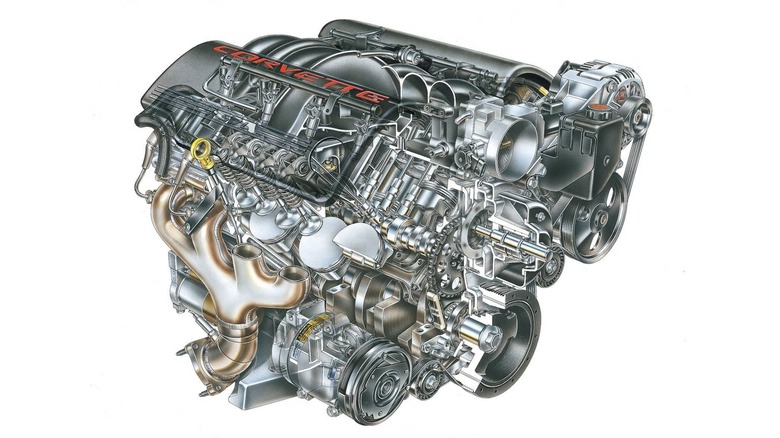
Bigger changes were still to come. In 1997, the LS revolution began. That year the C5 Corvette showcased a clean-sheet Gen III redesign of the SBC with an aluminum block, six-bolt mains, individual coil packs for each cylinder and cylinder heads, a new firing order, and ports that just loved to move air. It pumped out 345 hp in its original LS1 configuration, but 405 hp as an LS6 in 2002's Corvette Z06, far more than any stock small-block Chevy ever did. That's why LS fans swear it's better than the original SBC, and why it has supplanted the earlier 350 as the go-to engine swap.
SBC Goes Hybrid
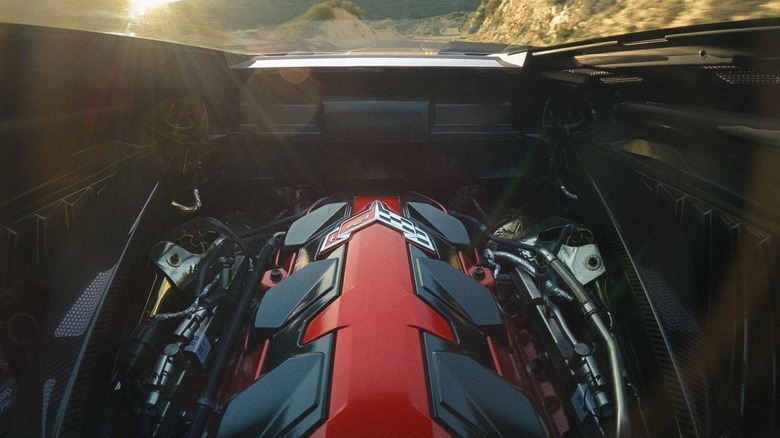
And still Chevy wasn't finished. The Gen IV revamp delivered the biggest factory SBC ever, a 7.0-liter beast created for the 2006 C6 Corvette Z06 that came with race car tech like dry-sump lubrication and titanium internals, and made 505 hp. But even that looked like a shopping motor when 2009's ZR1 landed, complete with a supercharged, 6.2-liter LS9 V8 and 638 hp. Fast forward 10 years and the LT5 ZR1 was torturing its tires to the tune of 755 hp. It's still the most powerful stock overhead-valve small-block Chevy has built for the street.
The lastest C8 Corvette ZR1 really pushes the envelope with 1,064 hp, and the ZR1X even embraces hybrid assistance to make its 1,250 hp, though their DOHC layouts lead some Chevy fans to regard the V8s in the current Z06, ZR1 and ZR1X as an entirely new family of engines. Maybe we'll see plenty of DOHC-swapped restomods in time, but right now the aftermarket focus is on the earlier SBCs and LS engines, with tuning parts and entire crate engines (including from GM) freely available.
GM hasn't moved all its V8 cams upstairs though. It unveiled its Gen V SBC this year, first in 6.7-liter configuration for the Corvette, and then as a 5.3- and 6.2-liter displacement for the 2027 Silverado truck. Just like the original SBC from 1955, all of these engines feature overhead valves and a cam buried in the block, and even after 72 years of this engine design, GM is showing no signs of slowing down.