

China's Biggest Automaker Is In More Than Just The Car Business
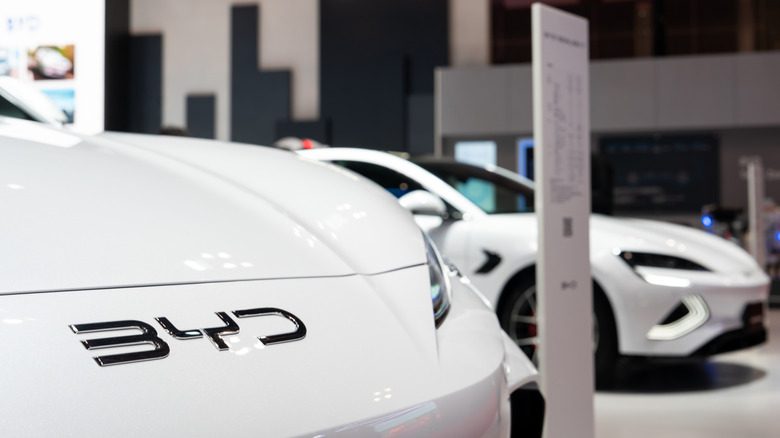
As the automotive industry is facing its largest shift in recent memory, there's a lot of talk surrounding BYD: China's biggest carmaker. It's not just down to the fact that its automotive offerings are becoming more commonplace, but it's also from rival automakers and government officials who are worried about the threat Chinese cars pose to existing automotive business models. In addition to being China's biggest automaker (based on sales volume), the company also sits at No. 6 in the global rankings. BYD currently sells cars in over 120 countries around the globe, with a range of models sold under the BYD, Denza, Yangwang, and Fang Cheng Bao nameplates.
As a company, BYD was founded in 1994. The three letters stand for the phonetic pronunciation of the Chinese company's original name in Pinyin: Bijiadie. As it entered global markets, it adopted the backronym "Build Your Dreams." However, while we best know them for its cars, dig a little deeper, and you'll find a range of products that span a number of industries.
With all that experience in multiple sectors, you may be wondering why those of us in the U.S. can't buy these products. Well, for BYD's cars, even though they're China's largest automaker, tariffs implemented by the U.S. government of 100% on all Chinese-made EVs mean that, if imported to the States, they simply wouldn't be price-competitive. And, from 2027, U.S. legislation bans the sale of vehicles using Chinese software, while in 2030 a ban will be enforced on Chinese-sourced hardware. Will that ever change? Watch this space!
What Products Does BYD Make?
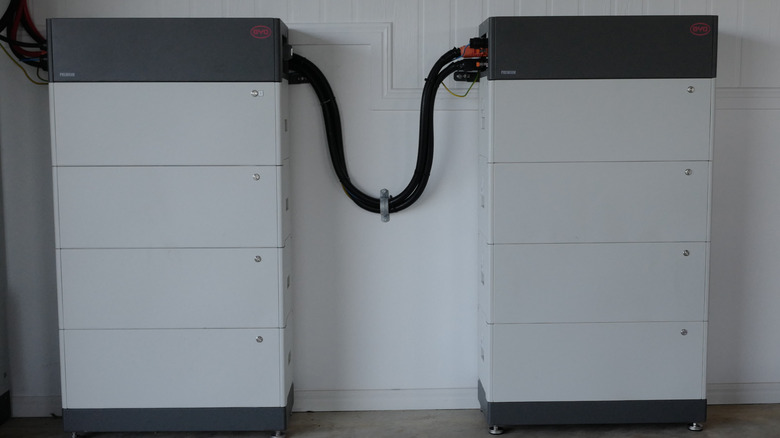
In addition to being China's biggest carmaker, BYD is well known for its batteries — specifically, its Blade battery. While a Blade battery can be found in every BYD EV, the company crosses the streams as not just a car manufacturer, but also as an OEM supplier. One of the most notable adopters of BYD's batteries has been Tesla, which, according to regulatory filings, has used BYD batteries in the Model Y. Also, with a Blade Battery underneath it is the Toyota bZ3, a China-only sedan that was co-developed with the Chinese automaker.
But that expertise in batteries extends far beyond the automotive sector. In fact, BYD claims to be a leader in the new energy sector, and BYD Energy Storage was founded in 2008. Its specialization lies in energy storage solutions and, according to its website, have delivered both industrial and residential projects across 110 countries.
Another sector that BYD plays in, again away from the automotive sphere, is electronics. BYD Electronics is its own company, and was listed on the Hong Kong stock exchange in 2007. Describing itself as "the world's leading provider of high-tech and innovative products," BYD Electronics supplies some of China's most well-known companies, including Xiaomi, Huawei, Lenovo, and TCL. As of 2025, as with many companies in the electronics sector, focus has shifted to developing AI computing infrastructure. This is all in addition to supporting BYD Auto with automotive semiconductors for the advanced chips used by China's biggest carmaker.
Rail And Transport
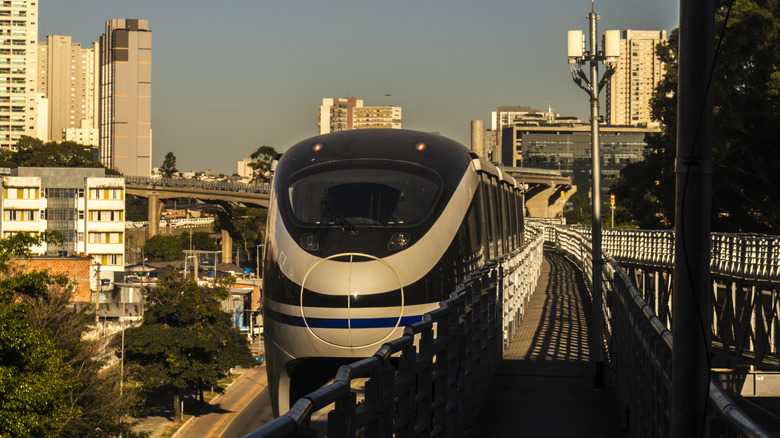
Sticking with the transport theme, but just a bit adjacent, China's biggest carmaker is making its foray into rail. The company has two offerings in this space: SkyRail and SkyShuttle. BYD has invested over $1 billion in its SkyRail ambitions, with over 1,000 engineers employed. Despite its success in other sectors, BYD's SkyRail has been plagued with issues, and an initial planned rollout in over 200 cities in China was drastically scaled back when Beijing sought to rein in local government debt.
Essentially, the company is attempting to tackle the perennial problem of urban congestion and has developed its own take on the electric monorail. SkyRail uses prefabricated track to cut down on construction times and, to its credit, it's successfully present in a few cities in China, including Shenzhen (where BYD is headquartered), where BYD is headquartered. It also has successfully launched a line in Sao Paulo, Brazil.
BYD also has a range of heavy-duty commercial vehicles, from vans to full-scale trucks. Its forthcoming ETT44 looks like it may be a match for the Tesla Semi, and it has an electric motor capable of delivering over 1,000 hp (750 kW) with a range of over 373 miles (600 km).