

Why Automakers Put Two Batteries In Diesel Trucks
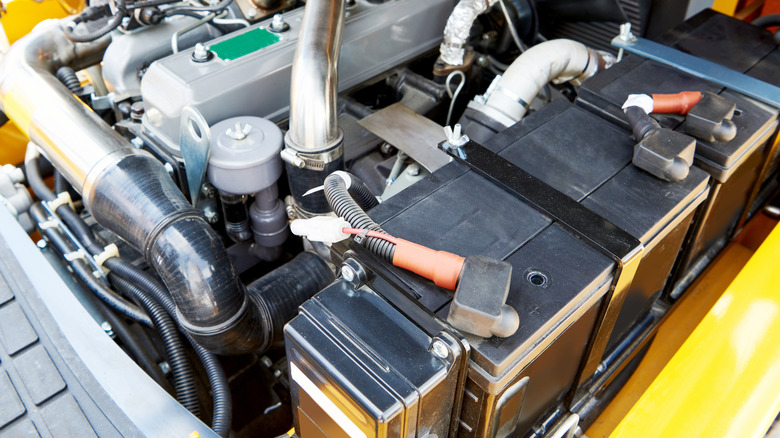
New or old, pop the hood on a diesel truck, and you're likely to find two batteries in the engine compartment. Compare that to your average passenger vehicle that has just one battery under the hood — although these days, the battery might not be under the hood at all. While it might seem like overkill to have a pair of batteries, there are logical explanations as to why a truck would need the extra electricity.
In the case of diesel trucks, the additional battery power is needed for cranking duty as well as other power-sucking, diesel-specific devices such as glow plugs and grid heaters. That being said, dual batteries come in handy for upfitting, which can also be beneficial for non-diesel trucks. So, if you've ever peaked under the hood of a diesel truck and wondered why there are two batteries, we're here to enlighten you.
Why diesel engines need more cranking power
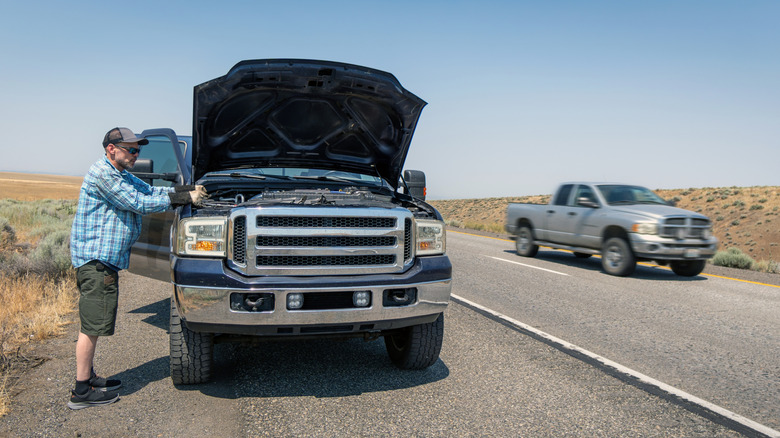
There's a reason why 12-volt batteries are rated in cold cranking amps. That's because cranking the engine is the hardest job a battery performs. And on a high-compression diesel engine, that cranking becomes even more of a challenge. Before you crank up a cold diesel engine, you need to wait for the glow plugs to do their job, which requires even more battery juice.
To overcome this need for extra amperage, diesel trucks run a pair of batteries in a parallel connection. That means both batteries have their positive terminals connected to the electrical system — not to each other, as we saw in the series configuration. However, their negative terminals are both still hooked up at the same point to the vehicle's body. In this configuration, you get the same voltage, namely 12 volts. But you now have access to twice the peak current capacity that a single battery could provide. Doing this with, say, two 400-ampere batteries can give you a whopping 800 amperes of current at peak.
And that's very useful, especially for diesel engines. The starter motor needs added muscle to turn the engine over since diesels use what's called compression ignition. Squeeze the fuel-air mixture hard enough, and it becomes hot enough to combust and make power. But you've got to do a lot of squeezing. Hence, to crank, the starter motor has to be Herculean in comparison, far beefier than what a gasoline engine would need.
What is compression ignition?
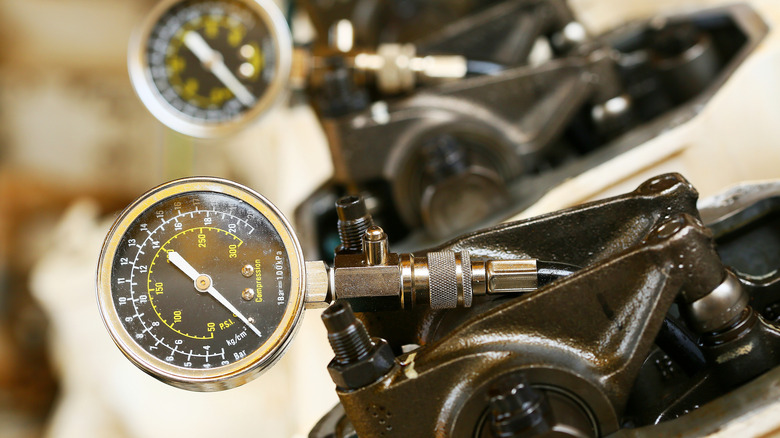
Due to compression ignition, the typical diesel engine can have a compression ratio from 15:1 to well over 20:1, and in most cases, may be turbocharged as well. In comparison, your typical gasoline engine rarely exceeds 12:1 in high-compression applications, dipping to as low as 8:1 in under-stressed, naturally aspirated applications. So, you can imagine how hard a diesel truck's starter motor has to work in comparison to the gasoline cars.
Furthermore, a diesel engine doesn't only need to power its starter motor with loads of electrons the moment you hit the start button or crank the key. Diesel engines use glow plugs, which are essentially electric heating elements that provide warmth to each cylinder, ensuring that it's nice and toasty inside to aid compression ignition.
While the glow plugs typically engage on every cold start, they're particularly useful in cold weather. In the Winter, the engine block itself may be too chilly for compression alone to get things going. Naturally, these plugs consume a significant amount of electricity, which is where having two batteries can really help.
Do all diesel trucks have two batteries?
Of course, not all diesel trucks have two batteries. Smaller trucks with lower-displacement diesel engines can get by on a single, albeit beefy, battery. This may be particularly true for engines with fewer cylinder counts and natural aspiration rather than turbocharging.
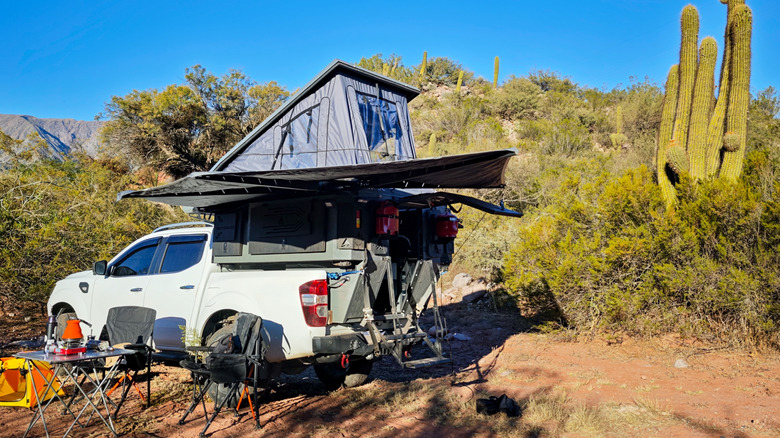
You may also encounter such trucks with aftermarket dual battery set-ups. In this case, the dual battery set-up has been installed due to increased power needs. Campers, overlanders, and specially outfitted work trucks are prime examples. Remember, if you're changing a truck from single to dual battery operation, you also need to upgrade the alternator and charging system to match.
At a very basic level, you should be aware of whether your diesel truck is using one or two batteries for its electrical system. If your truck is unmodified and maintained to factory specifications, you should be aware of the type and rating for each 12-volt battery, since in a dual battery set-up, they will typically be identical. This is particularly crucial at replacement time.
Conversely, if you've got a need to convert your single battery truck to a dual-battery setup, or have acquired a diesel truck with an aftermarket set-up with two batteries, you'll need to be aware of whether the alternator and charging system have been upgraded to match. Remember, the electrical system plays a crucial role in keeping your truck rolling along, and the battery is in charge of it all — literally!