

The Toyota RAV4 Vs. Its Competitors: What Do You Get For Your Money?
The Toyota RAV4 is popular for a reason, but how does it stack up against its competition?
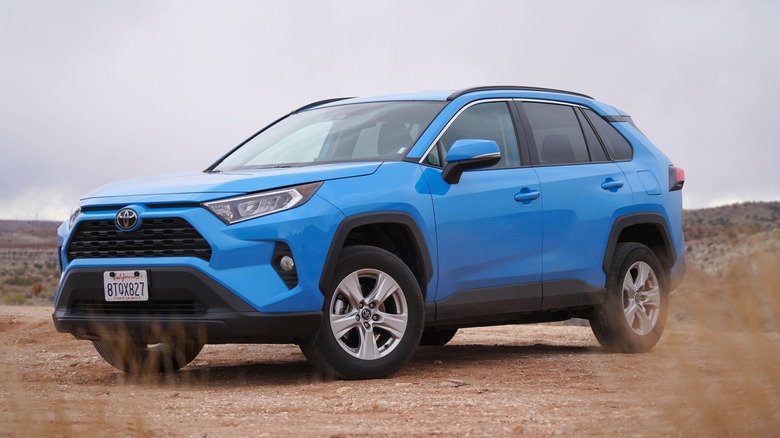
Toyota's RAV4 is one of the most popular compact SUVs in the US, but how does it fare versus its competitors, and what exactly do you get for your money? In our experience, the RAV4 offers sturdy build quality, a family-friendly ethos, and a well-equipped interior, all of which make for an excellent package in terms of value, as well as longevity. It's also a dependable name. Now in its fifth generation, the RAV4 has been around since 1994.
This year saw the entry of the sixth generation, code-named the XA60. However, it goes up against a slew of worthy competitors, and we've picked five of the most formidable. These are the Honda CR-V, Mazda CX-50, Hyundai Tucson, Kia Sportage, and Subaru Forester; all in hybrid guise.
The RAV4's MSRP is $31,900 for the base LE at the time of writing. Further up, one can find the SE at $34,700, the XLE Premium at $36,100, and the Woodland at $39,900. Things start to get pricey with the XSE, which starts at a base MSRP of $41,300, while the Limited starts at $43,300. You also get options for front-wheel or all-wheel drive, as well as either a hybrid or plug-in hybrid drivetrain.
Sixth generation RAV4 – The key stuff
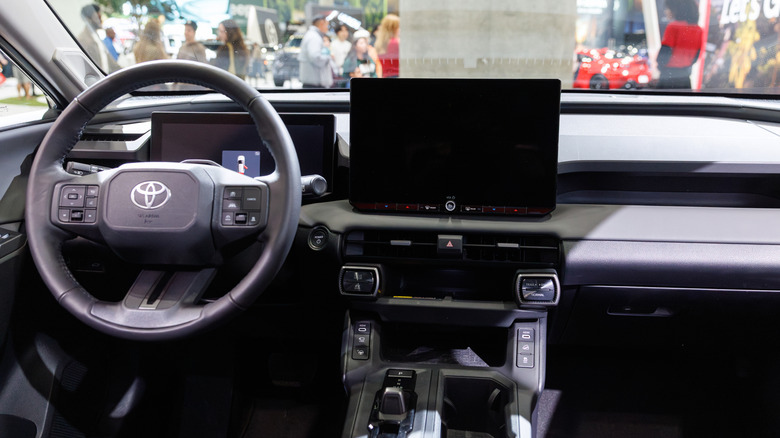
If you're in the market for a new RAV4, then you might already know that the XA60 is nearly all-new, despite sitting on a similar platform to the XA50. It's broadly the same size too, making it easier to drive and park in tight urban environments. Under the hood, you've only got hybrid power — no more gas-only variants. The regular front-drive hybrid has a 2.5-liter Atkinson-cycle four-cylinder and two electric motors for 226 horsepower. If you opt for the all-wheel-drive version, you get 236 horsepower. Meanwhile, the plug-in hybrid is purely all-wheel drive and offers 320 horsepower. This one can drive all-electric for up to 50 miles or hit 0-60 in the low 5-second range.
Toyota offers a Woodland trim for mild off-roading. This comes with all-terrain tires, more ground clearance, and some rugged exterior elements. Meanwhile, the GR Sport trim is for enthusiasts. It brings firmer GR-tuned suspension as well as retuned power steering for sharper response. It doesn't offer a power upgrade, though.
2026 Toyota RAV4 vs. 2026 Honda CR-V Hybrid
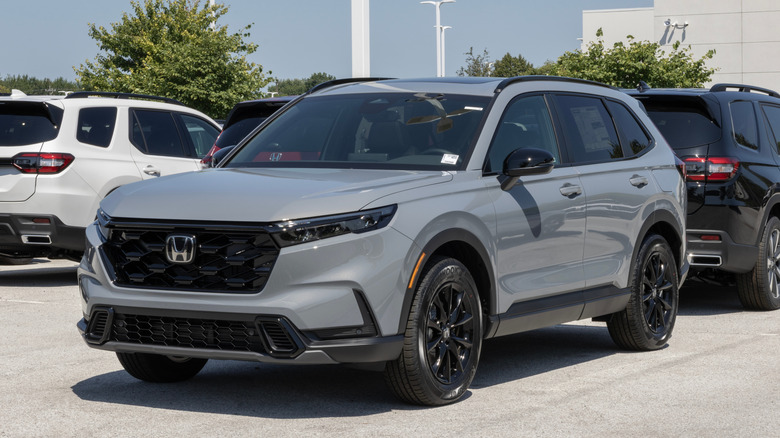
We're diving straight into the RAV4's longest-running and fiercest competitor — the Honda CR-V in Hybrid form. We're ignoring the gas-only CR-V in the interests of fairness. The CR-V's base Hybrid trim starts dearer at $36,030 MSRP but tops out at just $42,950 for the all-singing, all-dancing Sport Touring trim.
There's a TrailSport trim that is broadly similar to the 2026 RAV4's Woodlands trim, with all-terrain tires and exterior enhancements. But the 2026 CR-V Hybrid provides you with just 204 horsepower and a 0-60 time of over 7 seconds. A RAV4 PHEV should be able to smoke it in the traffic light grand prix.
The interior of the 2026 CR-V Hybrid looks nicer, and it even features some interesting retro design cues. However, lower trims get a 7-inch digital gauge cluster, while higher trims get a 10.2-inch unit. The 2026 RAV4, meanwhile, gives you a 12.3-inch unit across the range. The same goes for the driver's screens: the 2026 RAV4's 10.5-inch / 12.9-inch offerings soundly beat the 2026 CR-V Hybrid's 9-inch unit. However, the 2026 CR-V Hybrid includes a wireless phone charger as standard, while the 2026 RAV4 offers it only on higher trims.
In terms of cargo space, the 2026 CR-V Hybrid sits in the middle. It's got 36 cubic feet of cargo capacity with the rear seats in place, compared with 34 for the 2026 RAV4 PHEV but less than the regular RAV4 Hybrid's 38 cubic feet. With the rear seats folded, the CR-V Hybrid extends its advantage to 72 cubes versus 64 for the RAV4 PHEV and 70 for the RAV4 regular hybrid. Plus, the 2026 CR-V Hybrid's passenger cabin is 5 cubic feet roomier than the 2026 RAV4.
In terms of safety, the 2026 RAV4 has Toyota Safety Sense 4.0, which adds things like front cross-traffic assist and predictive curve speed control to the vehicle's already impressive arsenal. The 2026 CR-V fights back with the latest Honda Sensing suite and nearly matches the 2026 RAV4, though it falls just short.
2026 RAV4 Hybrid vs. 2026 Mazda CX-50 Hybrid
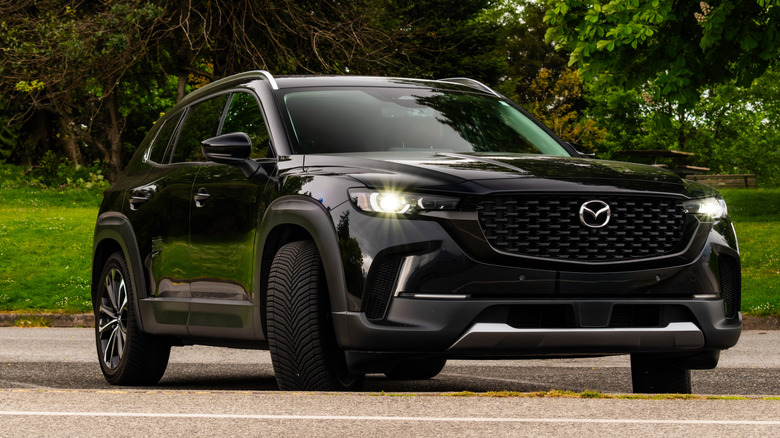
With its standard all-wheel-drive layout, the 2026 Mazda CX-50 Hybrid certainly seems like a solid choice for those who need extra traction and signature Mazda flair. It also has an appealing price range, starting at $34,750 and going up to $40,450 for the Premium variant.
On the inside, the Premium brings a lovely red interior with leather upholstery, contrast stitching, and a nice Bose speaker system. Lower trims come with an unbranded 8-speaker sound system, in contrast to the 2026 RAV4's 6-speaker offering for cheaper variants. You get a 10.3-inch infotainment display as well as a wireless phone charger for all trims.
Under the hood is a powertrain that's virtually identical to the 2026 RAV4 regular hybrid, putting out 219 horsepower. With standard all-wheel drive, it can do 0-60 in 7.6 seconds, which is actually slower than the 2026 RAV4's 7.2-second time in regular hybrid guise.
In terms of cargo space, the 2026 RAV4 has the 2026 CX-50 licked. The Mazda can pack just 29 cubes into its trunk with the rear seats in place. That rises to a still-underwhelming 56 cubes if you fold them down. So, if you and your family don't know the meaning of the term 'pack light', the Mazda isn't for you. It also has a decent suite of safety features, but it doesn't quite match the Toyota Safety Sense 4.0 suite in the 2026 RAV4.
2026 RAV4 Hybrid vs. 2026 Hyundai Tucson Hybrid
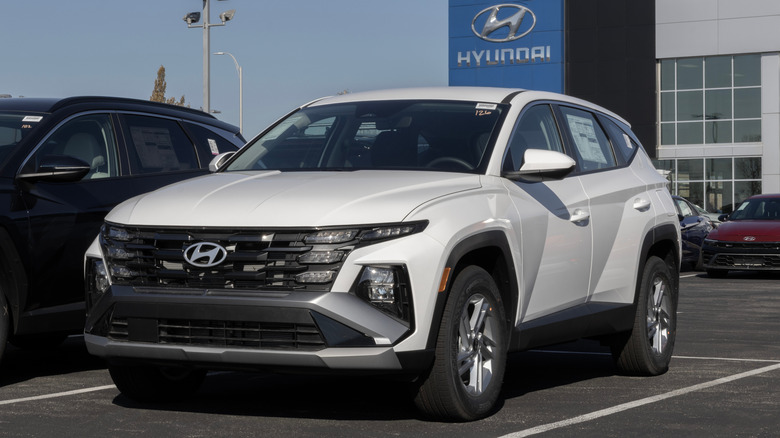
Another long-term competitor for the RAV4, Hyundai's solid Tucson has won its share of fans. The 2026 Tucson Hybrid range starts at $31,300 for the SE variant, rising to $48,900 for the Limited PHEV AWD variant.
Hyundai offers the Tucson Hybrid in regular or PHEV forms, with 231 horsepower or 268 horsepower, respectively. But unlike Toyota's CVT gearbox, Hyundai uses a 6-speed automatic transmission, which will appeal to enthusiasts. Front-wheel drive and all-wheel drive configurations are available, just like in the 2026 RAV4 range. However, the PHEV can manage only 7.1 seconds in the 0-60 benchmark, unlike the 2026 RAV4 PHEV's 5.2-second time. Furthermore, the Tucson PHEV's all-electric range is 32 miles, versus 50 miles for the RAV4 PHEV.
However, the 2026 Tucson Hybrid's interior is a far nicer place to be. You've got a confluence of light and dark shades, twin 12.3-inch displays for gauge cluster and infotainment functions on higher trims, and a healthy dose of physical switchgear. Available options include a Bose speaker system and Hyundai's Digital Key feature that allows you to use your phone as a key fob, including remotely starting it.
Plus, the 2026 Tucson Hybrid's cargo capacity ranges from 32 to 39 cubic feet depending on trim choice, with rear seats in place. It also has a roomier passenger cabin, and the lighter shades make it feel airier overall. In terms of safety features, it lags a bit, with some systems such as adaptive cruise control being only provided for higher trims. In contrast, the Toyota Safety Sense 4.0 suite endows the 2026 RAV4 range with the feature as standard.
2026 RAV4 Hybrid vs. 2026 Subaru Forester Hybrid
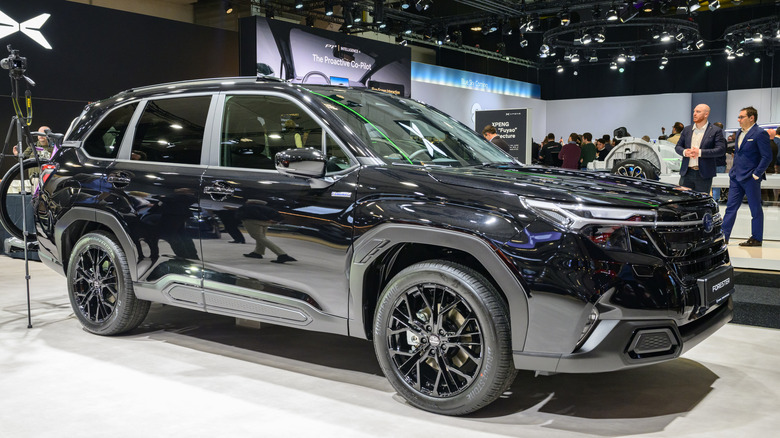
Ah, Subaru, with its rumble-y boxer engines and standard all-wheel drive. Ranging from $34,730 for the base Premium all the way up to $41,545 for the Touring, the Forester remains a compelling choice for those who want a Japanese, but not mainstream Japanese, option for their compact SUV. A 2.5-liter flat-four and an electric motor combine for 194 horsepower but take a yawning 8.6 seconds in the 0-60 sprint.
Inside, the Forester definitely looks more interesting than the RAV4, especially with its spacious 11.6-inch vertical touchscreen. It's also got a 12.3-inch digital gauge cluster. Higher trims can be outfitted with ventilated front seats and a 11-speaker Harman/Kardon sound system.
However, while its passenger cabin is similarly roomy to the RAV4's space, the cargo capacity is just 28 cubic feet. This makes the Forester Hybrid less ideal for families who pack everything, including the kitchen sink. Moreover, the Forester Hybrid lacks an off-road or performance-oriented trim, unlike the RAV4 lineup.