

How Long Should You Let Your Car Idle After A Jump Start?
Is it ok to remove the leads right after the car starts or should you wait?
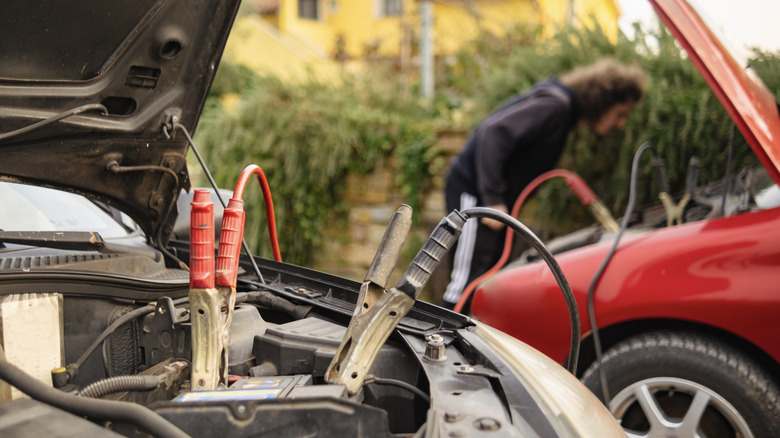
A flat battery is downright annoying, seriously stressful, and hard to fix without the right help or equipment. Older, lighter, manual-transmission cars can be bump- or push-started by dropping the clutch to force the engine to spin, once you've built up enough speed with the help of a hill, or a friend to push you along. Reviving a heavier car on flat ground, or an automatic, though, will require jumper cables. But how long should you leave the engine running once you've brought it back from the dead?
The answer depends on several factors, including the battery size, how flat it was when you jumped it, and how much load you'll put on it in the minutes after restarting. A car's battery is charged by its alternator, a small generator driven by a belt off the engine's crankshaft. But an alternator generates only a small current when the engine is idling, enough to run a car's ignition, fuel injection, dashboard and electric power steering (where fitted), but not enough to meaningfully charge a dead battery.
You can boost the alternator's output by increasing the engine revs a little while still parked up, but your best plan is to get driving once you're sure the engine is running properly. Battery experts generally recommend driving at highway speeds for around 30 minutes while using no electrical accessories, to put enough charge in a battery to ensure it'll start again safely once you've switched it off. But if it's dark and rainy, and you're running the headlights, wipers, AC, and blasting music from your custom 36-speaker, four-amp sound system, you're going to need to put some more miles under your wheels.
How do you even jump a car, anyway?
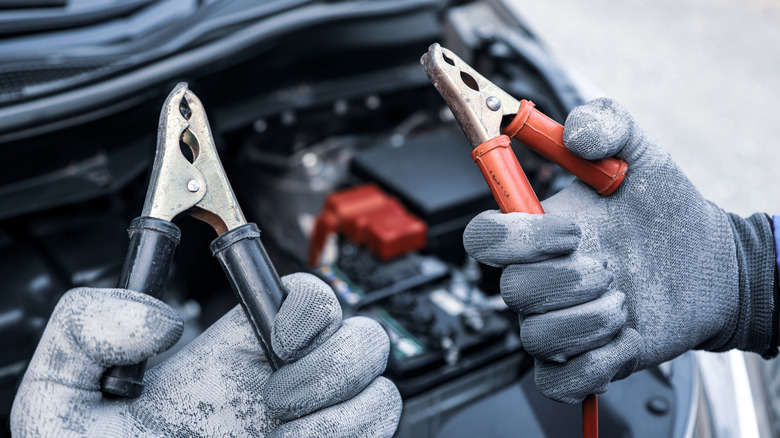
Modern cars are much more complicated beasts than their ancestors, and while they can still be jump-started, the method is probably a little different from the one your dad learned years ago. But the starting point is the same. You need a donor "jumper" car that you can park near enough to reach cables between it and the dead car.
The traditional jump method was to connect each end of the red cable to the positive terminal on each car's battery. Then connect the negative cable to the donor car's negative terminal, then snap the jaws from the other end around the dead car's negative terminal. That's bad news for modern vehicles, because a sudden spike in current can fry their engine control unit (ECU) brain.
So the modern advice is to connect the positive cable as before, and one end of the negative lead to the donor car's battery, but to clip the other end to an earth point in the dead car's engine bay. Some cars have dedicated earth points, but if not, you'll usually find some other metal fitting that will work.
With the cables secure, wait a couple of minutes, then start the working car's engine and leave it running for another minute or two. Now try to start the dead car. If it fires, great. If not, wait a few more minutes, then give it another go. Once the car with the flat battery is up and running, the temptation is to whip the leads off right away. But don't. Leave the leads in place for a few minutes with both cars running before taking them off in the reverse order.