

Could Your Car Actually Outlive Its Software Support?
Other than a house, buying a car is one of the largest purchases you'll make. And, just like housing, car prices are continuing to increase. Last year, the average new-car price climbed to over $50,000 — a sharp rise from 10 years ago, when it was just $34,000. Predictably, that means that people are holding on to their cars longer than ever before – 12.8 years on average, according to Mobility Global.
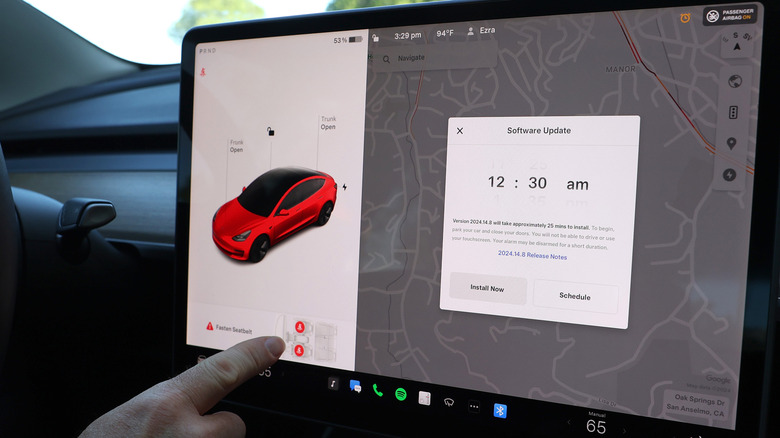
There's just one problem, though. As more cars bury features and user experiences in software, there's a chance that support for said software could expire long before the car itself. Known as a software-defined vehicle, these features are maintained and updated, like a smartphone, using over-the-air (OTA) updates. It's a double-edged sword, because this means the user doesn't have to rely on a technician to flash the software, but on the other hand, it also means that all that tech could need regular updates as it ages — if not, certain features may become obsolete.
Not so planned obsolescence
While the likelihood of your brand-new vehicle getting bricked because updates stop is unlikely, a very real possibility is an owner loses a key feature. Perhaps that feature is one of the reasons the car was selected in the first place.
It's already happening. In 2024, Nissan deactivated key features from early Leafs, including the ability to schedule charging times in the app (key to getting off-peak electricity rates). It happened because the U.K. was turning off its 2G data network, which was utilized by those early Nissan EVs. Similar happened back in 2022 in the U.S. when AT&T switched off its 3G network, leaving millions of cars without things like SOS response and other software-related features.
It's not just external factors that impact this. Earlier this year Elon Musk confirmed that Teslas built with older Hardware 3 wouldn't be able to run its unsupervised "Full Self Driving" semi-autonomous tech as the hardware can't handle it. He had previously assured owners that it could. Options for upgrading or a discounted trade-in were offered instead.
What does this mean for the future?
Industry experts are now debating what this will mean for the future of cars. For example, will second-hand values fluctuate depending on whether a manufacturer still offers software support? What does this mean for future used and classic car owners who want to continue using potentially out–of-date cars?
But with owners holding on to their cars for longer, what can be done to protect new car purchasers? The EU and some nations already regulate how long phones and tablets need to be supported by manufacturers. Could they do the same with cars? At the moment, the United Nations has two regulations on automotive cybersecurity and updates. But while that pertains to how manufacturers manage updates, not to how long they must be supported for.
Another way to help extend the life of software-defined vehicles is the introduction of regulations to mandate that automakers release the ability to update software to third parties, rather than just arbitrarily turning the lights out. Just like Right to Repair laws, these concepts have the ability to gain momentum. But as of now, there's nothing on the cards to help owners who have been left in the lurch due to the march of technology.