

The Reason Subaru Still Builds Cars With Boxer Engines
Exceptional balance and low-slung performance make the boxer engine a Subaru hallmark, but tight packaging and tricky repairs are the price you pay.
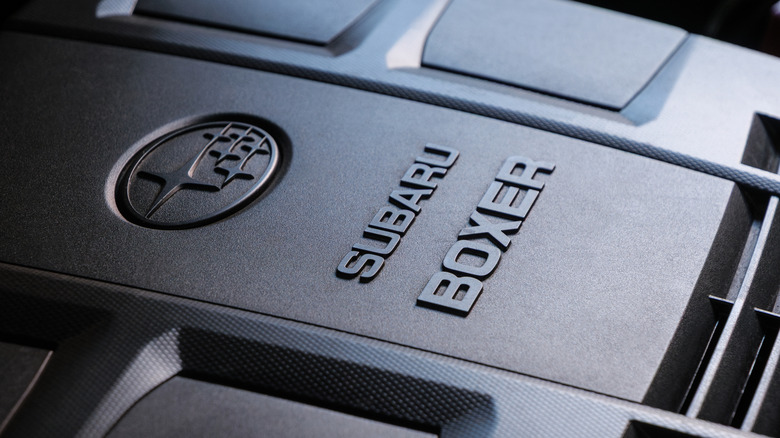
You might know that Subaru still builds cars with boxer engines, but have you ever wondered why? The off-beat burble you may know and love Subaru for may have been toned down since the days of the rally-winning GC8 Impreza, but when it comes to what's under the hood, you're still going to find a horizontally opposed engine.
First off, what is a boxer engine? Well, simply put, it's an engine with horizontally opposed cylinders, the movement resembles a boxer jabbing at their opponent. Because the cylinders of a boxer engine are horizontally placed, you may also know them as being referred to as "flat" engines. Now, Subaru didn't invent the boxer engine; The first one appeared in 1896 by Benz & Cie, a forefather of the company we now know as Mercedes-Benz.
Even without a historical connection per se, there's a reason why Subaru continues to employ them in its latest cars. According to Subaru, the symmetrical design of boxer engines reduces friction and vibration, resulting in smoother ride characteristics. Having driven my fair share of Subaru's, they really do have a unique character to them. Since a flat engine is, well, flatter than a conventional inline-four cylinder, it can be placed lower in the engine bay, enabling the vehicle to enjoy a lower center of gravity. Couple that lower center of gravity with Subaru's signature symmetrical all-wheel drive system, and you have a pedigree of cars that are great for performance driving.
What are the downsides of a boxer engine?
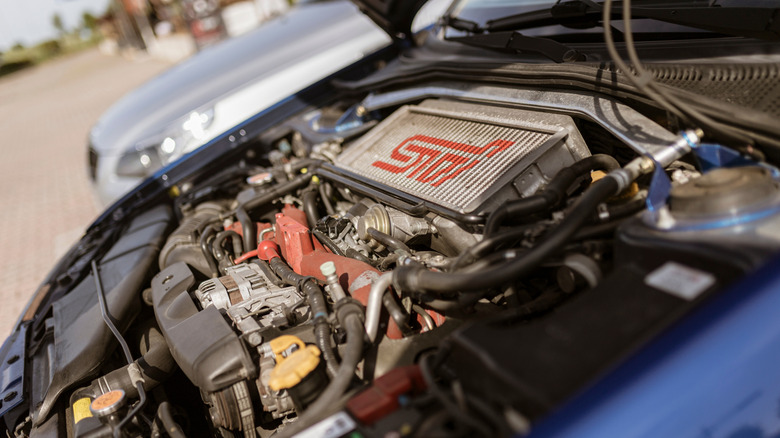
While there are many advantages that boxer engines have over conventional inline engines, there are a few notable downsides. The first being the overall footprint. Sure, the flatter size helps lower the center of gravity, but they are notably wider and more complex than an inline or V-configuration engine, meaning that they offer automakers less flexibility with packaging.
Another drawback with boxer engines is accumulation of oil at low points, which, due to their configuration, can mean part of the cylinder heads. This means they may require more frequent head gasket replacements, and they are prone to oil starvation if revved from a cold start before the engine's oil has had a chance to properly circulate. For the same reason, the correct oil level must always be maintained in a boxer engine. Oil starvation was also why a lawsuit was filed in 2024 against the boxer-engine BR-Z and Toyota GR86. Maintenance cost is yet another drawback. For starters, you've got two cylinder heads, which means two head gaskets and related components. Plus, due to the low-slung layout of the engine, something as trivial as a spark plug change will be more labor-intensive.
So has Subaru ever made a non-boxer engine? Well, while boxer engines have made up much of Subaru's line-up, this famous automaker has also made non-boxers. Perhaps the most commonplace of these are the in-line three-cylinder units used in Subaru kei cars and vans. Subaru also made a larger EF-series 1.2-liter engine for use in its Justy economy car of the '80s. While most of Subaru's four-cylinder portfolio remains horizontally opposed, the automaker did produce a straight four. Called the EN-series, it was also used in their R-2 and other kei cars up until 2012.
What are common problems with Subaru boxer engines?
If you're seriously considering a Subaru, then it's important to know what some of the issues may be down the road. Subaru's boxer engines have a generally straight rep if maintained right. However, like all unusual and slightly quirky powerplants, and in my own experience, they may become fussy if ill-treated. One common flaw with many Subaru boxer engine series is oil consumption. This is because of low-tension piston rings that were fitted to improve fuel efficiency. Faulty crankcase ventilation systems can also cause this.
If unchecked, this can lead to the next issue, which is oil starvation. When the oil level is low and the engine experiences high G-forces such as during spirited or hard driving, the oil pickup tube can be left sucking air — and your engine loses its precious lubricating lifeblood as a result. This can also happen due to oil leaks that go unchecked. Oil starvation could be an issue when you're driving on the track too, and warranty claims in those cases have been denied in the past.
Finally, some older Subaru flat-fours were prone to head gasket failure due to composite head gaskets. These didn't fare well under repeated thermal cycling. Newer flat-fours have resolved this due to better materials, and older ones can be retrofitted with upgraded head gaskets to mitigate this. Leaving it unchecked can result in what's known as "chocolate milkshake" – a sludgy, pudgy mix of oil and coolant that we don't need to tell you, does nasty things to your engine.