

Can Leaving A Car Battery On Concrete Actually Damage It?
The truth behind this car myth
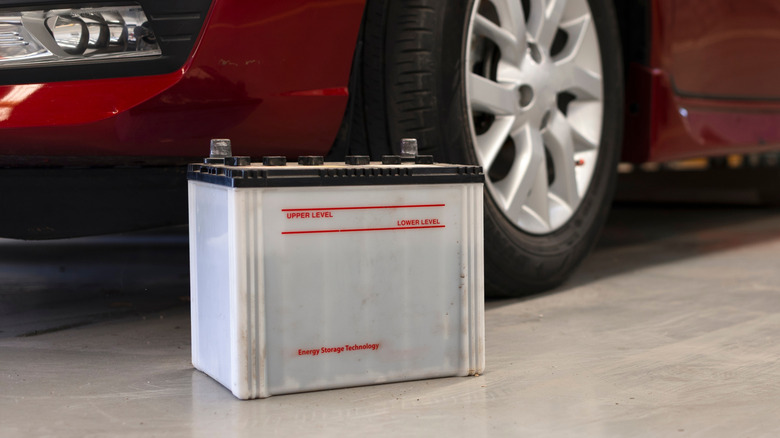
If you're into cars, and particularly driving and wrenching on older cars, you'll have doubtless come across old wives' tales about driving and running them. Examples include older vehicles being safer, even though they lack modern safety equipment like airbags, because they're made of thicker steel. Or that filling up with high octane fuel will boost the horsepower of even the most ordinary engine. Both are generally untrue, but what about the one that says leaving a car battery on concrete can damage it?
Like those other two examples, the battery myth is just that. You won't hurt a battery by leaving it on a concrete floor. But also like the safety and octane stories, there's a grain of truth to it. Modern cars are designed to crumple to absorb impacts, and that can make them look less safe after a relatively small accident. And some performance cars, or tuned cars, do deliver more output with higher octane fuel. Which is why, by the same token, even today, you might hear the concrete floor battery warnings repeated by folks who have more experience in looking after cars than you do.
Battery casings have come a long way

Cars have changed a lot in the last 70 years, but their 12-volt batteries — with the exception of lightweight packs like the lithium-ion unit in the Porsche 911 GT3 — look mostly the same. They're still heavy, 12-volt lead-acid batteries, they're still encased with tough, injection-molded plastic, and can still be charged without unhooking the terminals.
But before then, batteries looked quite different, and this is partly responsible for the concrete floor myth. Early car batteries, which put out just 6 volts, were usually encased in wooden boxes, often containing a glass jar full of acid. In the 1920s, battery makers switched to hard rubber cases, which resisted corrosion from the acid inside, and were more durable than glass. But over time they could crack and split due to heat and vibration, and if these batteries were placed on the ground, yes, they could discharge.
That's not a problem with modern plastic cases, which are far more durable, though it's worth remembering that any battery will naturally discharge over time, no matter what the outer case is made from. And that's possibly another source of the concrete myth. How quickly it loses its charge can depend heavily on the temperature of the area its stored. A battery stored in a cold environment will hang on to its charge longer than one stored in a hot space.
Can batteries be an issue for concrete?
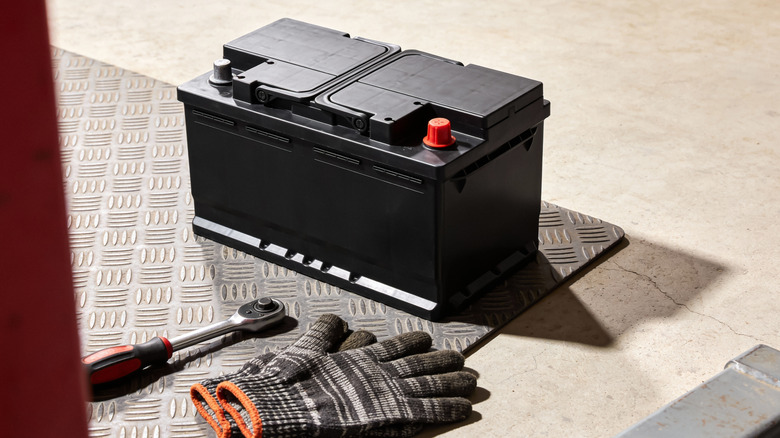
Now you know that storing a battery on your concrete garage floor won't do it any harm, despite what your grandpa told you. But the reverse is definitely not true. Spilling the contents of a car battery on concrete can do the floor real damage. Some modern batteries use Absorbent Glass Mat (AGM) technology, making them effectively spill proof. But many still consist of traditional flooded wet cells that can spill when tipped. The electrolyte solution inside includes a large amount of sulfuric acid.
Concrete, on the other hand, contains alkaline calcium compounds, and when the two meet, they react, eating away at the surface of the concrete floor. If left, the acid can cause pitting, staining, small craters and a chalky, dusty surface. And once the top coating is eaten away, the floor is more susceptible to absorbing future spills and moisture. Flooring experts recommend spills be cleaned up right away, but not just with water, because that can spread the acid. Instead, create an alkaline paste using water and baking soda, leave it to fizz on the floor surface, then scrub gently, and rinse with water. And don't forget your PPE.