

The All-Electric Optiq Marks Cadillac's Return To Australia | Review
Can Cadillac's all-EV lineup out-class the competition from Asia and Europe.
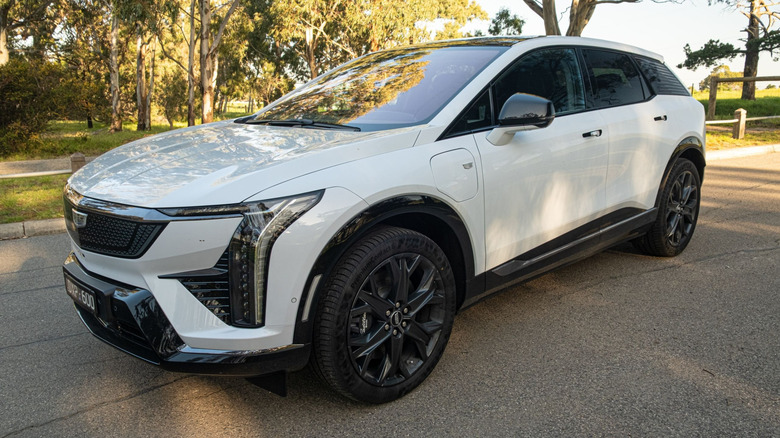
From the early 1930s until 1969, Cadillac was once a household name in Australia. Luxury buyers could sample several of its models made their way Down Under, including the classic Eldorado. After that, the brand disappeared from local shores.
Speaking to a crowd at the Australian launch of Cadillac's new Formula 1 team in Melbourne back in March, which I attended, GM president Mark Reuss said the automaker had come close to relaunching Cadillac in Australia in the early 2000s, but the plan ultimately fell through. In the late 2010s, I even spotted several camouflaged prototypes testing, as the brand again toyed with the idea of returning. Now, Cadillac is officially back, albeit as an EV-only brand.
Rather than selling gas-guzzling models like the Escalade or the CT5-V Blackwing in Australia, Cadillac has launched with the Optiq, Lyriq, and Vistiq. We recently spent a week with the Optiq, eager to see if it has any hope of rivaling competitors from Asia and Europe, and were pleasantly surprised with what we found.
What the local range looks like
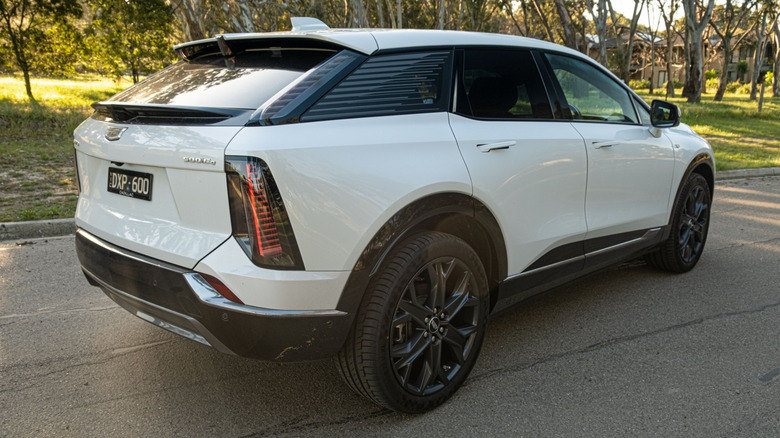
Just a single version of the Optiq is available locally, known as the Sport AWD. It uses a 75-kWh nickel manganese cobalt (NMC) battery and dual motors producing 224 kW (300 hp) and 480 Nm (354 lb-ft) of torque. Like the American version, Australia's right-hand drive Optiq is manufactured in Mexico. The Optiq was updated in the U.S. for 2026 with new powertrains, including a rear-wheel drive model and a more powerful all-wheel drive version, but these versions have yet to arrive in Australia.
Prices start at AU$85,000 ($59,700) before options but including fees. At that price, it sounds like quite a good deal, especially when compared to the smaller, entry-level Audi Q4 45 e-tron, which starts at AU$93,173 ($65,500) including fees. It's also cheaper than the new Volvo EX60 starting at AU$86,000 ($60,500) before fees, and upwards of AU$94,000 ($66,000) with fees. Unsurprisingly, the Optiq does struggle on price when compared to some premium Chinese offerings like the Zeekr 7X, priced from AU$79,749 ($56,000) for the far more powerful and better-equipped Performance AWD.
An interior to remember
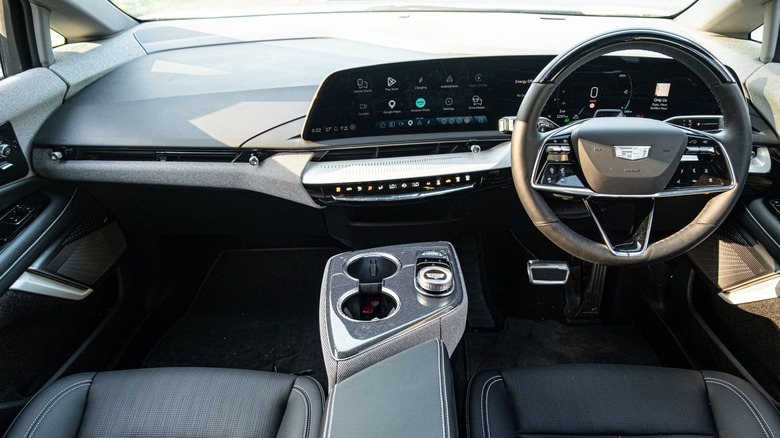
The Optiq's highlight is definitely the interior. Ever since Tesla released the game-changing Model 3 a decade ago, many other brands have adopted similar ultra-minimalistic philosophies when designing the cabins of new models. The Chinese are especially fond of this approach, resulting in cars from different brands that seem to have almost identical interiors. The Cadillac is different.
First are the screens, or should I say, the single 33-inch curved display found in other Cadillac models. It's a welcome reprieve from the tablet-like screens we've grown accustomed to, looking like a piece of high-end jewelry compared to them. The screen doesn't only look the part, but it performs exceptionally well, too, and includes wireless Apple CarPlay and Android Auto. It also includes Google Built-in with the Google Assistant and Google Maps.
Cadillac also deserves praise for the materials used throughout the cabin. There's plush leatherette upholstery on the seats and parts of the doors, as well as a lovely fabric material on the doors and the floating center console, made from recycle polyethylene. The Optiq also includes metal AKG speaker grilles, knurled metal around the cupholders, and volume dial, as well as metal toggles for the climate control. The choice of materials distinguishes the Optiq from its competitors and gives it the high-end feel you'd expect from a Cadillac.
Sleek and stylish
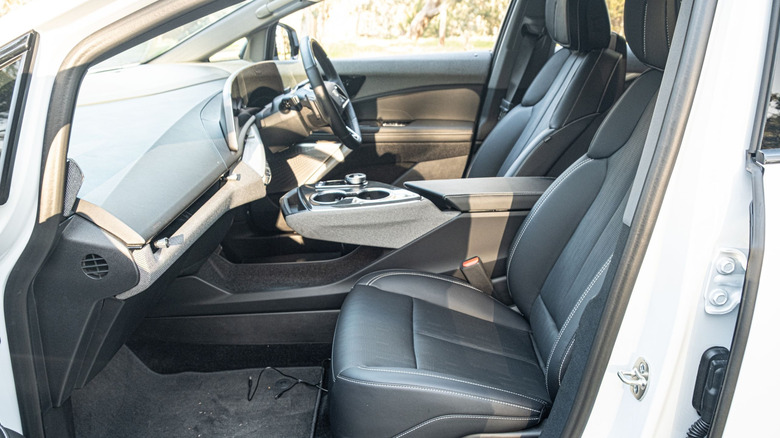
There's more to like about the interior. A large panoramic glass roof comes standard and is equipped with a sunshade. The EV also rocks a digital rear-view mirror, a wireless phone charger, and a superb 19-speaker AKG audio system. Massaging front seats also come standard on Australian-delivered models, and while they're a nice feature, they only apply very light pressure, so they won't be helping out any of the knots you may have in your lower back. There's also no adjustable lumbar support, which seems like a silly omission. A head-up display is also missing.
The second row is reasonably spacious, but headroom is somewhat limited for taller passengers. Cargo space is good. The Optiq offers 774 liters (27.3 cubic-feet) of cargo space with the rear seats up and 1,603 liters (56.6 cubic-feet) with them folded down. There are some annoying quirks with the Optiq's cabin, but more on those in the next section.
How does it drive?
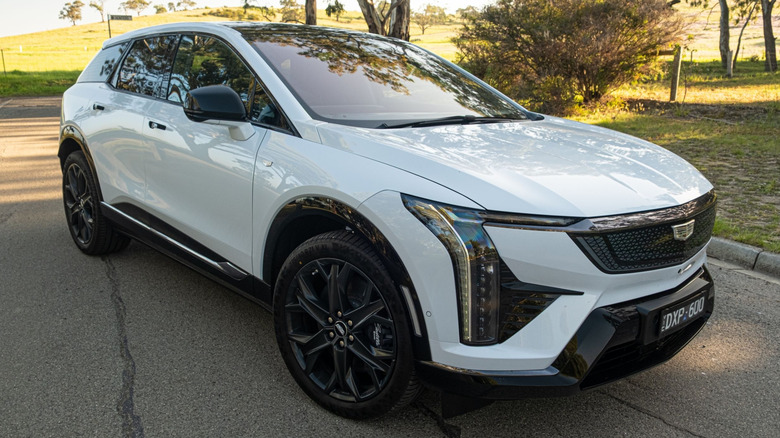
Driving the Optiq certainly feels like an upmarket experience. Cadillac has done a wonderful job developing a luxurious and comfortable SUV, even though it isn't one that'll fill your veins with adrenaline.
The first thing that strikes you while behind the wheel is just how exceptionally quiet the Optiq is. Other than a slight hum from the electric powertrain, the Active Noise Cancellation does a brilliant job of blocking out any obtrusive wind and tire noise. Whether using the Optiq for short drives or long highway cruising, it remains composed and comfortable.
Peak power figures of 224 kW (300 hp) and 480 Nm (354 lb-ft) are solid, though they're not overly impressive when you consider the Optiq weighs in at a portly 2,379 kg (5,244 lbs). As a result, it's not particularly quick by EV standards, needing 6.3 seconds to reach 100 km/h (62 mph). That's not slow by any metric, but some similarly-priced and more powerful alternatives can return times in the 4-second range. The way the Optiq puts its power down also leaves a little to be desired.
The Optiq sold in Australia has the same basic powertrain as the older 2025 model in the U.S., meaning the front motor has more power than the rear motor. This results in a surprising amount of torque steer under hard acceleration, so much so that we almost thought we were driving a front-wheel-drive EV to start with. The newer model sold in North America shifts the more powerful motor to the rear axle and apparently fixes this issue.
A smooth performer, but not perfect
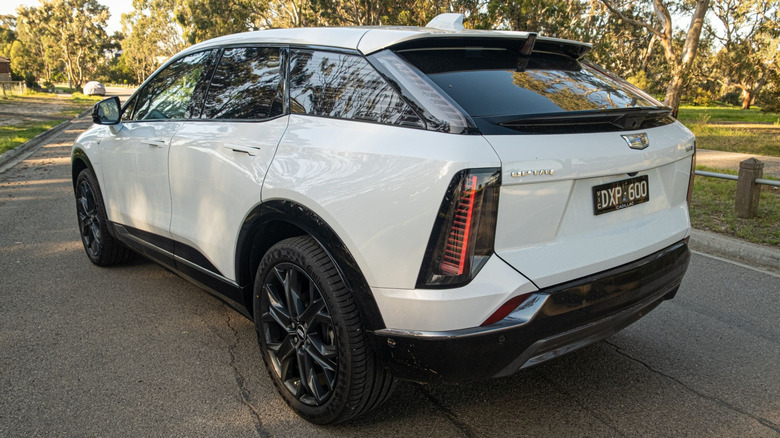
The Optiq Sport's dynamics are worthy of praise, and it handles surprisingly well. The steering, while somewhat vague, has a nice weight to it, and the wheels quickly respond to inputs. The handling is helped by the fact the Optiq isn't the softest-riding EV out there, though it's comfortable enough for everyday driving.
The regenerative braking is also excellent. Two standard levels of regen are available through the infotainment display, and two additional settings are offered for the one-pedal driving mode, both accessible via a fixed button at the base of the infotainment display. The Optiq also uses GM's Regen on Demand paddle, positioned on the left of the steering wheel, to provide additional, on-the-fly regen. Pull it softly and the regen will be subtle. Pull and hold it forcefully and the Optiq will slow surprisingly rapidly. Using the paddle took some getting used to, but we were ultimately able to spend most of the week without ever having to touch the brake pedal. With that being said, it does become rather redundant when using the normal one pedal driving mode.
One annoying quirk about driving the Optiq is the amount of glare kicked up from the cabin — the top of the dashboard, for example, kicks up quite a bit of glare onto the windshield, while the forward collision warning display — consisting of several red lights behind the steering wheel — also produces annoying reflections on the windshield. Other minor gripes include the small blind spot resulting from the surprisingly large A-pillars, the absence of an automatic parking brake, and how the operation of the column shifter — requiring the user to pull it forward and then down to enable drive, or forwards and up for reverse, rather than just up and down like most other EVs.
Verdict
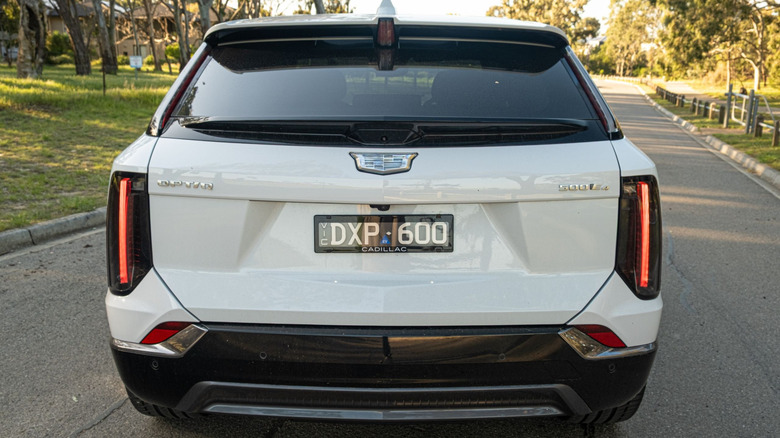
The Optiq's quoted driving range of 425 km (265 miles) on the WLTP cycle is decent but does feel a little last generation when compared to some newer competitors from Europe and Asia. Cadillac says the Optiq averages 19.9 kWh/100 km, and we were able to comfortably average 18.1 kWh/100 km during our time with the Cadillac. DC charging speeds peak at 110 kW which is well below par and down from the 150-kW limit of Optiq models sold in the United States. We tried charging the Optiq at a 150-kW charger and the charging speeds only peaked at around 70 kW.
The Cadillac Optiq is a well-rounded product with a lovely interior and has been well-priced against European competitors. However, as Cadillac is still a new brand in Australia, it doesn't hold the local cache that it does in the U.S., so we remain unconvinced buyers will be willing to pay a premium for a Cadillac over a more affordable and advanced EV from China. The Optiq will feel like a better all-around package if Australia gets the same updated model to launch in the U.S.