

Are There Differences Between Lexus And Toyota Engines?
From shared hybrid fours to a Yamaha-developed V10, the answer depends on which Lexus you’re looking at.
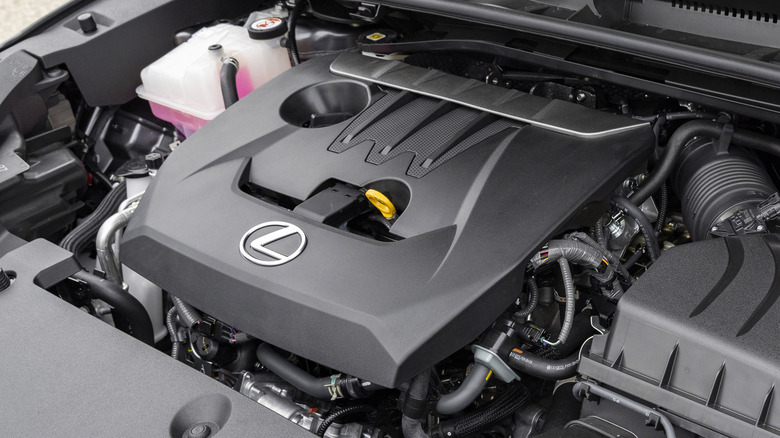
When buyers compare Lexus with Toyota, a recurring question might surface – are you paying extra for a more premium version of the same car, or are there any differences under the skin? Well, the answer depends on the model.
It is no secret that Toyota leverages shared architectures across its brands to maximize efficiency. As a result, most Lexus sedans, crossovers, and SUVs use the same core powertrains as the equivalent Toyota models.
A prime example of a shared mill is the hybrid naturally aspirated 2.5-liter four-cylinder engine that can be found in the Toyota RAV4 and Lexus NX 350h siblings, as well as the Toyota Camry and Lexus ES 350h sedans. Likewise, the more potent turbocharged 2.4-liter four-cylinder engine powers the Toyota Grand Highlander and Lexus TX 350 among others.
Moving up the ladder, the twin-turbo 3.4-liter V6, which is fitted in the full-size Toyota Tundra truck and Sequoia SUV, can also be found in the Lexus GX and LX ladder-frame SUVs. Finally, the long-serving naturally aspirated 3.5-liter V6 spent years beneath the hoods of the Toyota Highlander and Sienna, along with the Lexus IS, ES, and RX.
Still, it is worth noting that these engines feature different ECU calibrations depending on the brand and model, resulting in varying outputs. More importantly, Lexus will spoil you in the back seat, but the refinement goes beyond the cabin. The shared engines are wrapped in a nicer package with improved sound insulation, higher-quality materials, and unique suspension setups, elevating the experience for the driver and the occupants.
Dedicated Lexus-Only Powertrains
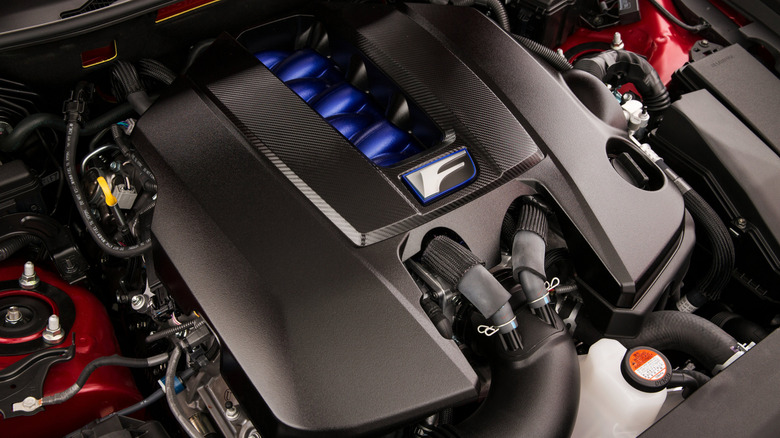
Besides the shared bits, Lexus gets unique engines for its high-performance and halo models, which are not used in vehicles with Toyota emblems.
The ultimate example is the high-revving naturally aspirated 4.8-liter V10 engine of the discontinued LFA supercar. The mill was developed specifically for this application with the help of Yamaha, and was hand-built in Japan with a "Takumi" expert approach. Each of the 500 LFAs got a V10 that one engineer built and personally approved from start to finish, which helped keep quality consistent across the production run.
Another Lexus-specific mill was the recently retired 5.0-liter V8 (2UR-GSE), which powered the IS F, RC F, GS F, and LC 500. Toyota did develop a new twin-turbo 4.0-liter V8 as part of a hybrid setup, but reserved it for the Batmobile-like flagship GR GT supercar, with the Lexus LFA successor going electric.
Still, not all performance engines are make-specific, as the turbocharged 1.6-liter three-cylinder mill found under the hood of the Toyota GR Corolla and the GR Yaris is also powering the Lexus LBX Morizo RR, which is not available in North America.