

What Do All The Flags Mean In Racing?
Some are obvious, while others have different meanings depending on where you see them.
Racing can seem pretty simple on its face. Cars go around a track, and the one in front at the end is the winner. Behind that simple premise are several layers of safety methodology to keep everyone, both drivers and spectators, alive and well. Perhaps the simplest form of that safety strategy comes in the form of flags.
Rather than requiring a driver to read a sign or understand some sort of hand signal or light pattern, a flag is straightforward. It can tell drivers all sorts of things about the race, the track, conditions, or potential hazards just around the corner.
The kicker here is that the flags don't always mean the same thing from one motorsport to another. What might mean "Go" in NASCAR could simply mean the danger is clear in Formula One. Today, we're going to break down the most common flags, what they mean, how they keep drivers safe, and even get into some of the rarer ones you might not ever see.
Controlling the action
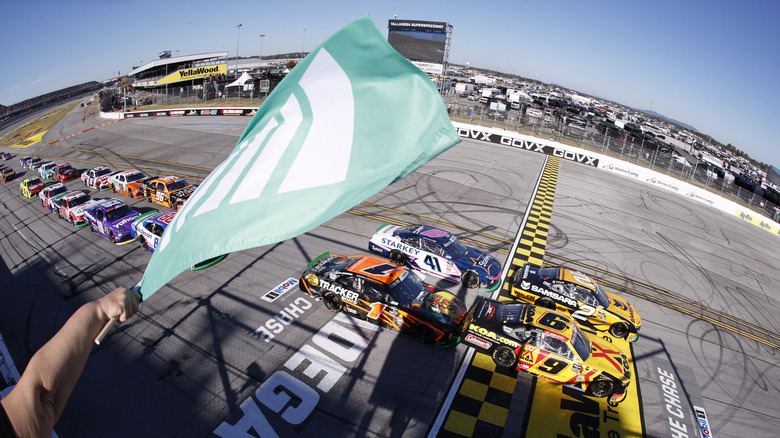
Most race courses use three main colors to denote the most important signals. Green typically means "go." In NASCAR, it's the flag waved at the beginning of the race. In Formula One, the race starts with green lights rather than a flag, but the green does link the two in the event of a caution or accident. When a race needs to be restarted after such an event, both NASCAR and Formula One use a green flag to get things going again.
Yellow flags are common in both series as well. Generally speaking, the yellow flag means "caution." In NASCAR, the field slows down and gathers behind the pace car. In Formula One, things are a touch different. One waved flag requires drivers to slow down, cease overtaking, and be ready to change direction. A second yellow flag in F1 tells the drivers to significantly slow down and be ready to stop. Both only come out when there's a crash or debris on the track. Sometimes drivers will see a "local yellow," where only one section of the track requires drivers to slow down, while racing continues on the rest of the track.
Perhaps most importantly, there's also a red flag. Much like a red light on a roadway tells drivers to stop, a red flag means the same thing. The flag usually tells all drivers to stop where they are. It can also mean to follow the flaggers' instructions and return to the pits slowly and safely. It's the same story in F1.
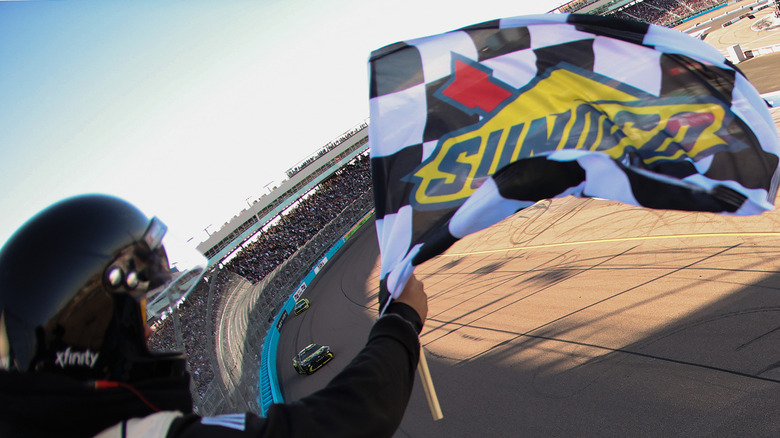
Both series and, frankly, most racing series use the same finishing lap signal: a checkered flag. It's the most well-known flag and tells every driver that the race is over.
Differing flags
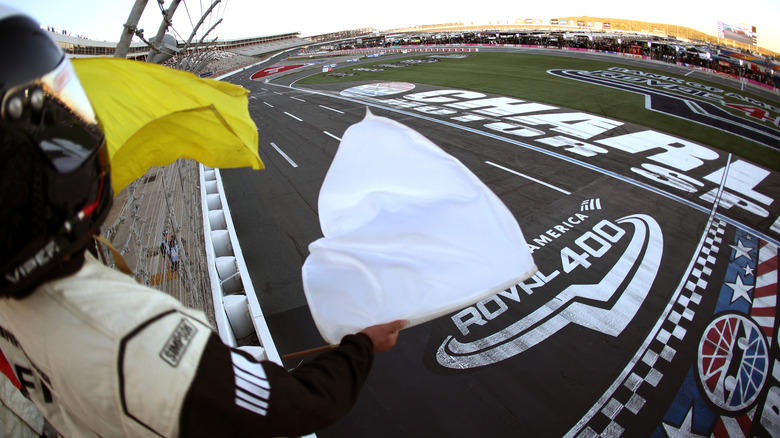
While some flags have similar meanings across the board, different series use other similar flags in very different ways. For example, a white flag in NASCAR tells every driver in the field that they're down to the last lap. Over in Formula 1, the same white flag tells drivers that there is a substantially slower driver ahead. Imagine that a car is damaged or struggling to keep any sort of serious pace. That's when drivers behind them would see a white flag. There's no need for a caution flag at this stage, but clearly there's good reason to let other drivers know what's coming up ahead.
Interestingly, MotoGP uses a white flag for a totally different reason than either of those. When a white flag shows up in that series, it tells riders that they are allowed to pit and switch bikes. That happens most often when weather conditions motivate such a change. Tire swaps are easy in NASCAR and F1 (even in complete darkness), but much more difficult for a motorcycle. It's faster to have an identical bike already equipped with rain tires ready to go, so when the white flag flies, a rider can quickly ditch their racing slicks for rain tires.
Speaking of conditions, the rest of the flags in motorsports mostly deal with different on-track situations. For example, a blue flag only comes out in NASCAR on a road course where there's some sort of trouble ahead that they can't see. Most often, it pops up when one car is about to lap a slower car. F1 uses a similar strategy with blue flags. Rather than warning drivers that are coming up on a potential hazard, the blue flag signals the car that is about to get lapped that they need to move over when it's safe to do so. A blue flag with a yellow stripe signifies this in NASCAR.
Competitor-specific flags
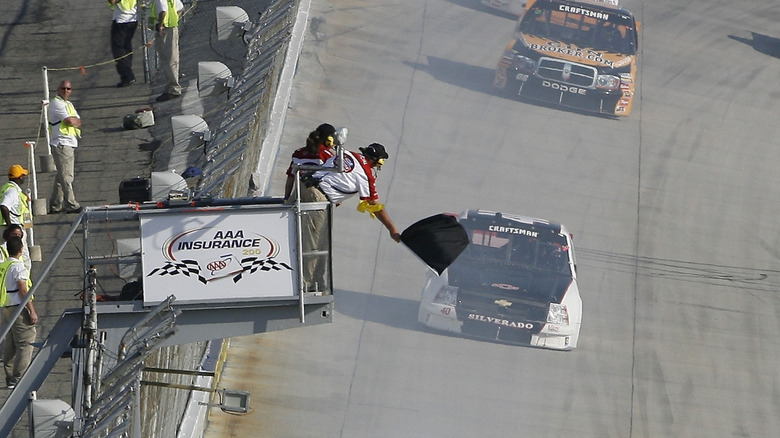
Black flags are aimed squarely at a specific driver. They often come with a specific number displayed nearby so the competitor in question knows who the target is. When a NASCAR driver sees a black flag and their own number, the message is "come back to pit lane immediately." It doesn't automatically disqualify a driver, but it's trying to convey that the driver either committed a rules infraction or that perhaps something on the car is unsafe.
Drivers who fail to follow the direction of a black flag for five laps might see another black flag with two white stripes. This flag tells the driver in question that they're no longer being scored. The driver will probably be disqualified if this flag comes out.
In F1, a plain black flag is actually a disqualification right away. A black flag with an orange disc, sometimes called "the meatball flag," doesn't mean disqualification, but that there's a dangerous safety issue with the car. A diagonally divided black-and-white flag in F1 tells the driver that they did something unsportsmanlike that could earn a penalty if repeated.
Rare flags
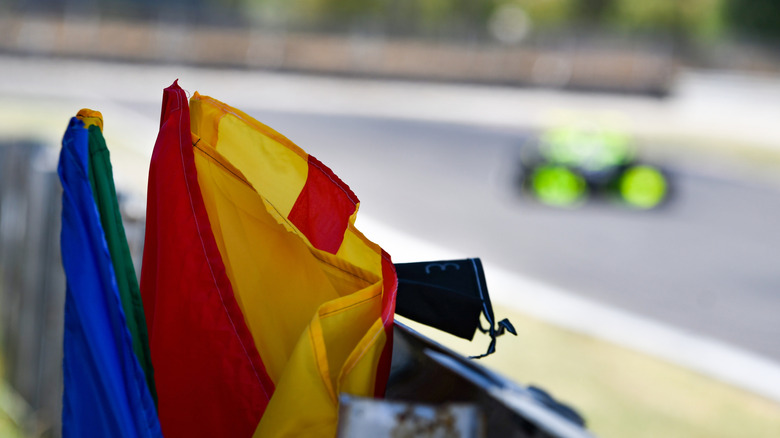
In NASCAR, a yellow flag with red stripes tells drivers that there is debris on the course. In F1, it means that there's oil or water causing a loss of traction on the surface. MotoGP follows F1 closely in this case. The motorcycle series also uses a white flag with diagonal red crosses to warn of rain in a particular section of the track.
NASCAR also has a unique red flag with a yellow stripe that signals to drivers that the pit lane entrance is closed. Simultaneous red and black flags end a practice session. On occasion, NASCAR drivers will see two checkered flags at the same time to signify the halfway point of a race rather than the end. That's not confusing at all.
Ultimately, these are all signals meant to simplify communication with the drivers in question. Sure, it's a lot to learn and keep track of, but the most-used flags become second nature to drivers over time. Of course, drivers might need to study a little harder when they switch from one series to another, because some flags have different meanings.