

Mercedes Stops Investment In German Factories And Weighs Plant Closures
Rough seas appear to be ahead
Mercedes-Benz has issued an alarming statement as it fights to cut costs amid rising industry pressure. The German automaker announced that it will stop all investment in passenger car manufacturing in its home country of Germany. The company also stated that plant closures may be possible, as profits continue to be squeezed, with production potentially being shifted to Hungary.
The announcement is in direct response to a disagreement with its workers' unions, as the company attempts to improve profitability by reducing labor costs across its German factories. The news was broken on Thursday, when an interview with members of the Mercedes-Benz board was released internally. According to a report from the Financial Times, production head Michael Schiebe said that "the current cost structures do not allow us to invest in Germany."
The company is in the middle of ongoing negotiations with Germany's IG Metall union and the Mercedes General Works Council. The workers' unions have vowed to fight any potential closures.
A trying time for the German auto industry
Mercedes-Benz has asked its German plant employees to work for 40 hours a week without extra pay, which is five hours more than the standard for the German automotive sector. Their reasoning is that the labor costs associated with German plants are too high compared to those of Eastern Europe and the US.
Mercedes has been struggling with profitability of late, with expected returns to be just 2%-3% this year, compared to the double-digit projections that they had hoped for. The company made heavy investments in EVs, but adoption had been slower than expected in Europe and the US. Meanwhile, in the company's largest market, China, passenger car sales have continued to falter, with Chinese vehicle sales falling by 31% in the third quarter of 2026.
Mercedes isn't alone, with VW in similar financial trouble, last month pressing pause on ID Golf development. Labor costs in Germany are sometimes as much as five times higher than they would be at other plants in Eastern Europe. Mercedes-Benz already has a passenger vehicle manufacturing facility in Hungary, while outside of Europe it has plants in China, South Africa, and the U.S. Further local assembly JVs exist for complete knock-down vehicles in India, Thailand, Malaysia, Indonesia, and Vietnam.
Possible Gernman plant closures ahead
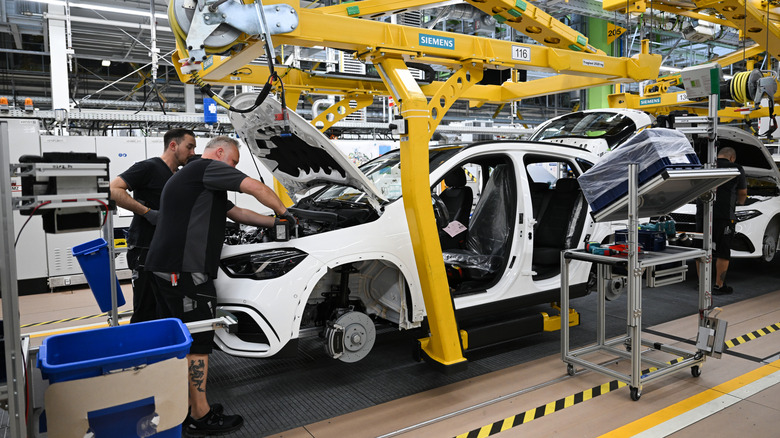
Two German plants are apparently on the chopping block, according to earlier comments made by Michael Schiebe, Member of the Board of Management of Mercedes-Benz Group AG for Production, Quality & Supply Chain Management.
Currently, Mercedes-Benz operates three plants for assembling passenger vehicles in Germany. The largest is its Sindelfingen plant, which has 31,500 employees. Its Bremen plant has 10,500 employees, while the Rastatt plant provides jobs for 7,000 workers. The company also has 7 other German plants, including Untertürkheim (Stuttgart), Berlin, and Hamburg, which assemble drivetrains and components. Düsseldorf and Wörth handle commercial vehicles, while the Kamenz plant assembles lithium-ion batteries, and Affalterbach is home to AMG.
In Eastern Europe, Mercedes has invested heavily in their Kecskemét plant in Hungary. With 5,000 employees, it's one of the largest employers in the region and handles the production of ICE, plug-in hybrid, and electric passenger vehicles, with the current generation of Mercedes-Benz GLB, A-Class, and C-Class electric vehicles originating in Hungary.