

Which Ford EcoBoost Engines Have A Wet Timing Belt?
They were meant to last 150,000 miles, but many fail at less than half that.
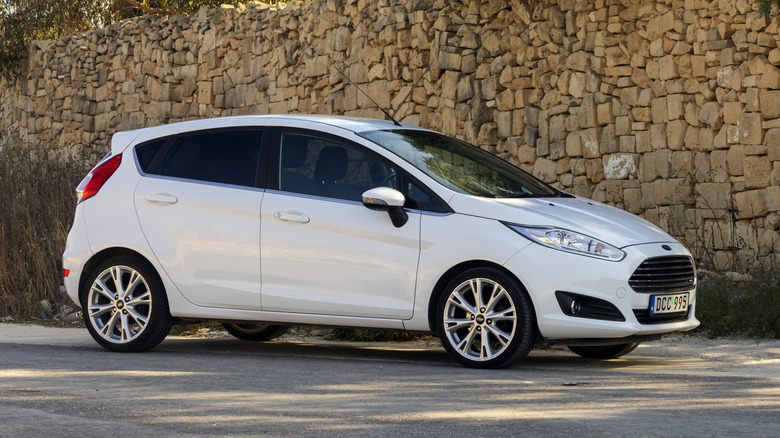
A timing belt is one of the most important parts of an engine. It drives the camshaft and keeps it synchronized with the crankshaft, allowing the valves to open and close at the correct time. Unlike some other engine components, timing belts aren't meant to last the life of the vehicle and must be replaced. Some engines, like Ford's turbocharged 1.0-liter EcoBoost three-cylinder, use what's known as a wet timing belt. If your car has one, you may want to pay close attention to what can go wrong.
This engine was offered on models including the Mk7 and early Mk8 Fiesta, Mk3 Focus, C-Max, Grand C-Max, B-Max, EcoSport, Mondeo, Transit Connect, Transit Courier, Tourneo Connect, and Tourneo Courier. Ford built this engine for about six years before revising it to use a strong timing chain, from around 2018, though the exact changeover varies by model. Unlike a traditional dry timing belt, Ford's wet timing belt comes into contact with engine oil. Ford achieved this by using a special kind of hydrogenated nitrile butadiene rubber belt coated with Teflon that can withstand constant contact with oil. The newer 1.5-liter EcoBoost three-cylinder uses a timing chain, though its oil pump is still driven by a belt running in oil. Although the 1.0-liter is the only EcoBoost with a wet timing belt, it's not the only Ford engine with one.
In 2007, the company introduced an updated version of its turbocharged 1.8-liter four-cylinder diesel engine in the Mondeo and Transit Connect with a wet timing belt. After Ford, rival car manufacturers like Renault, Volkswagen, Peugeot, Opel, and Vauxhall introduced their own wet timing belt systems. Ford also went on to add wet timing belts to other engines, found in a host of different models.
These are the Ford models to look out for
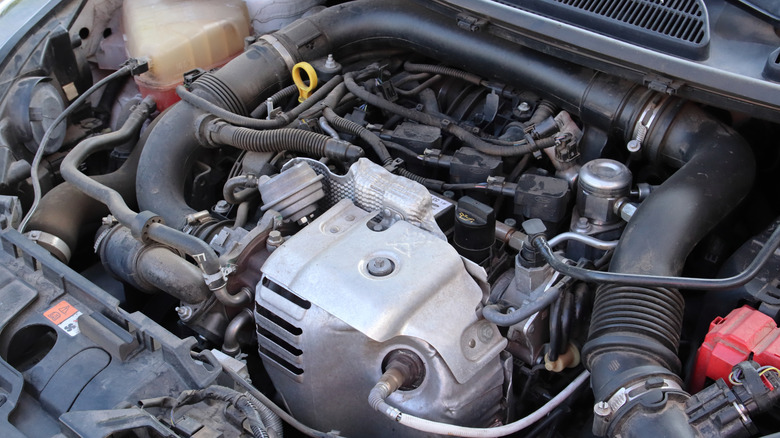
The Ford Fiesta Mk8, sold from 2017 to 2023 and using a naturally aspirated 1.1-liter inline-3, also features a wet timing belt and a separate oil pump belt running in oil. Similarly, Ford has used a wet timing belt on its 2.0-liter EcoBlue diesel engine found in popular models like the Transit, Transit Custom, and Tourneo Custom, as well as the S-Max, Galaxy, Mondeo, Kuga, and Ranger.
Ford originally quoted a service life of 10 years or 150,000 miles for its 1.0-liter EcoBoost with the wet timing belt. By comparison, traditional dry timing belts usually need to be changed every 70,000 to 90,000 miles, although manufacturer recommendations often vary by country and climate. However, as Ford owners started experiencing issues with wet timing belts, the company shortened its recommended replacement interval to six years or 100,000 miles. Similarly, VW, Peugeot, and Citroën now recommend replacing wet timing belts more frequently than initially quoted. In the U.S., Ford also recalled some 1.0-liter Focus and EcoSport models with engines that may seize because of a faulty oil pump drive belt.
What goes wrong with wet timing belts?
Wet timing belts were introduced with the promise of a longer life, quieter engines, and better fuel economy than traditional dry timing belts. As it turns out, wet timing belts can be very troublesome. A common issue with them is faster-than-expected degradation. As the belt is constantly covered in hot oil and contaminants, it can slowly wear down and may start shedding particles into the oil. This can cause sludge to build up and clog oil passages, potentially leading to complete engine failure.
The National Highway Traffic Safety Administration's probe into Ford's 1.0-liter wet timing belt engine began in December 2025, after the safety agency received 44 complaints about 2015-2017 Ford Fiesta and 2015-2018 Ford Focus models. NHTSA recently upgraded its investigation to get to the bottom of these failures. Investigators note that fragments from the wet timing belt can clog the oil pump pickup. This could starve the engine of oil and cause it to seize. As we reported in August, the average reported failure point of these timing belts is roughly 70,000 miles. If you own a Ford with a wet timing belt, it's wise to check when it was last replaced, and if it's aging, have it serviced soon.