

What Made The Buick GNX So Much More Expensive Than The Grand National?
The differences are subtle, but extensive.
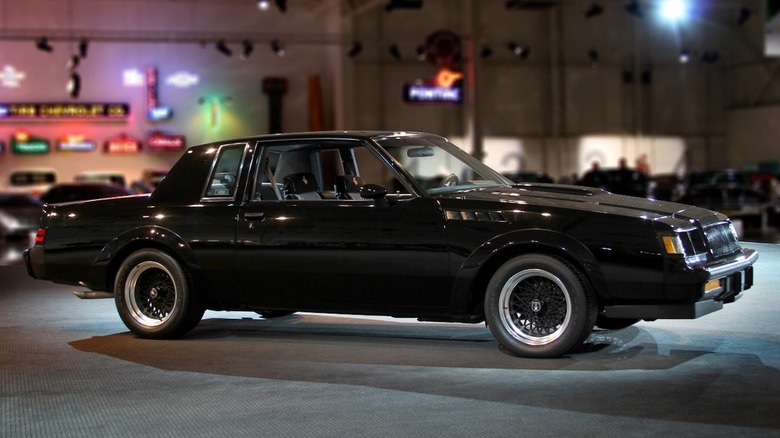
It's hard to believe from a modern vantage point, but in the mid 1980s, staid old Buick built some of the fastest cars in America. The 1984 to 1987 Buick Grand National and its 1987-only GNX spinoff were both built around GM's G-body platform and employed turbocharged V6 power. They looked very similar, yet one cost $11,000 more than the other when new. What made the GNX so special that it could justify that premium? The answer is more than simple brute horsepower. Buick treated the GNX to a ton of aesthetic and performance upgrades to send the Grand National program out with a bang.
The first Grand National appeared in 1982 to celebrate Buick's success in the NASCAR series of the same name. It was based on the brand's Regal coupe. Almost all of the 215 cars from this run came with a naturally aspirated 4.1-liter V6 rated at a puny 125 hp. Every one was painted gray and black. Few remember this early version of the Grand National, unsurprisingly.
The Grand Nationals that we remember, the ones with moody all-black "Darth Vader" paint and tire-frying go, didn't appear until 1984. Equipped as standard with a turbocharged and fuel-injected 3.8-liter V6, the '84 Grand National made 200 horsepower. That was a solid number for the early post-malaise years. Adding an intercooler and aluminum intake manifold boosted output to 235 hp in 1986. It jumped again in 1987 to 245 hp, backed up by 355 lb-ft of torque. By way of comparison, the L98 5.7-liter V8 in 1987's top Corvette only produced 240 hp, and the hottest Camaros and Firebirds were pegged at 225 hp. But Buick wasn't finished yet.
From the Grand National to the GNX
The Grand National was scheduled for retirement at the end of 1987 because the rear-wheel drive Regal was transitioning to a more modern front-wheel drive platform. Buick had already shown that a turbocharged V6 could outperform a V8, and the Grand National could have bowed out there and then, already a hero. But the guys at Flint decided to give the GN one last performance push.
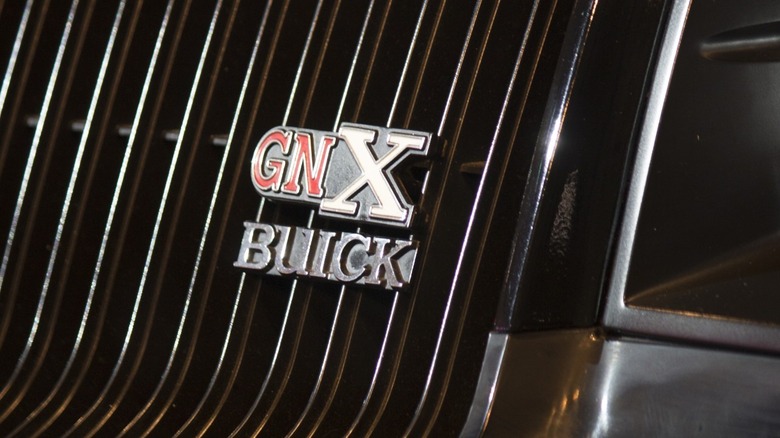
That push resulted in the GNX, which stood for Grand National eXperimental, a nod to the brand's legendary 1970 GSX muscle car. Buick contracted the build work to ASC/McLaren, who added vents and flares for the fenders, 16-inch basket-weave alloy wheels with polished rims, and multiple GNX badges. The Grand National's black paint was compulsory for all 547 cars.
But the changes under the skin were even more important. The GNX gained a stiffer body and was treated to a new rear suspension setup with a Panhard rod, torque bar, and stiffer springs, dampers, and sway bars. Although the Grand National's 3.8-liter V6 and four-speed automatic transmission provided the powertrain base, the GNX got a better exhaust system, an upgraded Garrett turbocharger, and a transmission oil cooler.
Those tricks boosted output to a claimed 276 hp and 360 lb-ft of torque. Some have suggested the reality was much higher. Car and Driver's 4.7-second 0-60 mph time and 13.5-second trip down the quarter mile certainly suggested it.
A Grand National stickered at $18,295 in 1987, but the GNX cost $29,290 the same year. Demand was so high that some dealers added a five-figure markup to the bill, or even kept the cars for themselves. Today, that price gap is even wider. Examples in good condition can sell for almost $200,000. One GNX barn find with nine original miles was even listed for $349,000. Compare that to a price range of about $34,000 to $52,000 for a "standard" 1987 Grand National.