- The Toyota Hilux is getting a hydrogen fuel cell version in 2028.
- The truck targets a 248-mile range and a 5,512-lb towing capacity.
- It will join the mild-hybrid diesel and BEV in European markets.
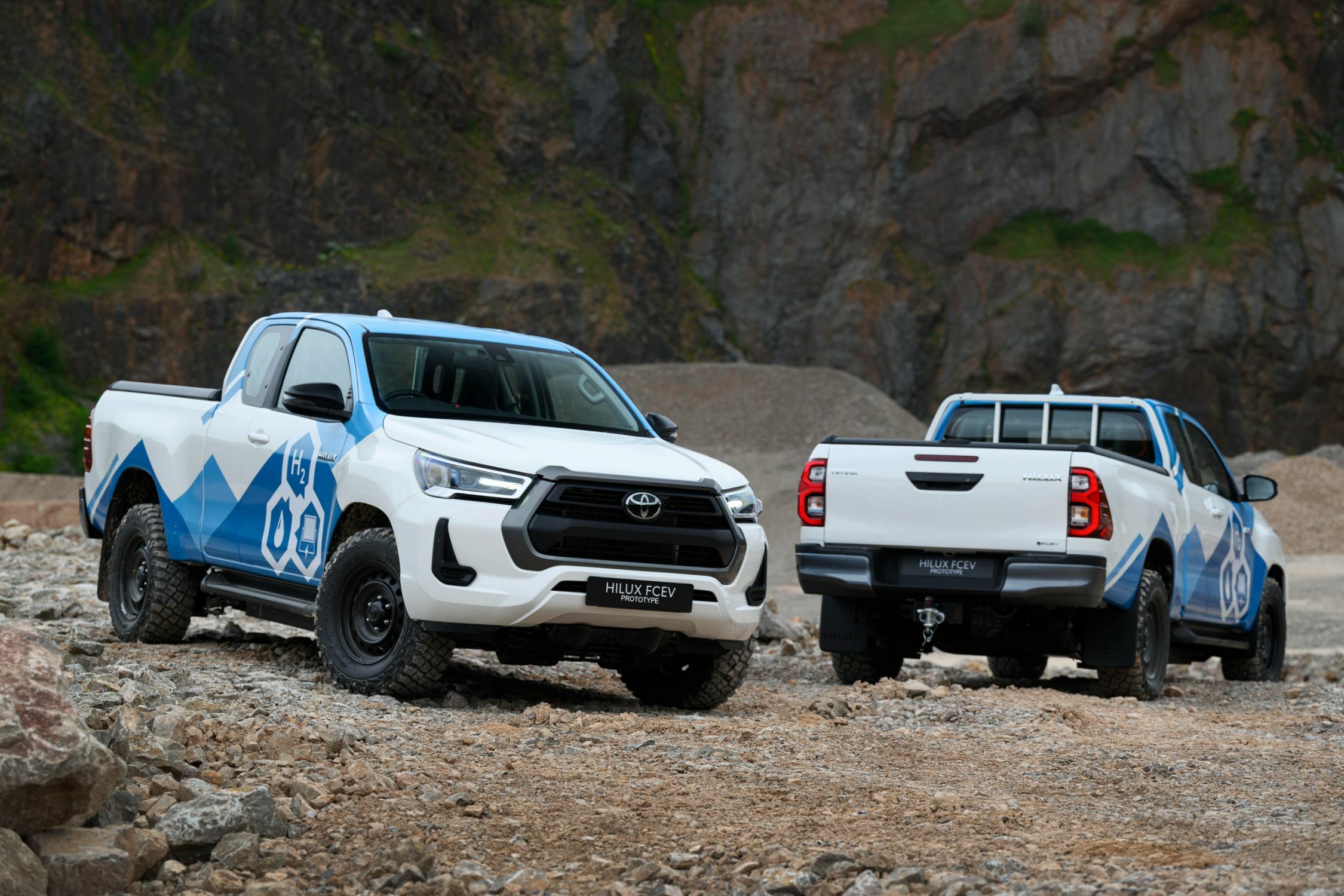
Toyota sticks to its multi-pathway approach and announced a production version of the Hilux FCEV for 2028. The midsize pickup is getting a hydrogen fuel cell powertrain in Europe, and will be offered alongside the existing mild-hybrid diesel and fully electric options.
Following several development prototypes based on the previous generation of the truck, the automaker has shared the first teaser of the new Hilux FCEV.
More: Toyota Says PHEVs Aren’t Ready For Real Truck Work
The model appears to have a unique lighting signature with segmented DRLs. However, the dark teaser doesn’t allow us to spot any styling differences compared to the regular Hilux, or whether it will borrow the bumper and closed-off grille of the BEV.
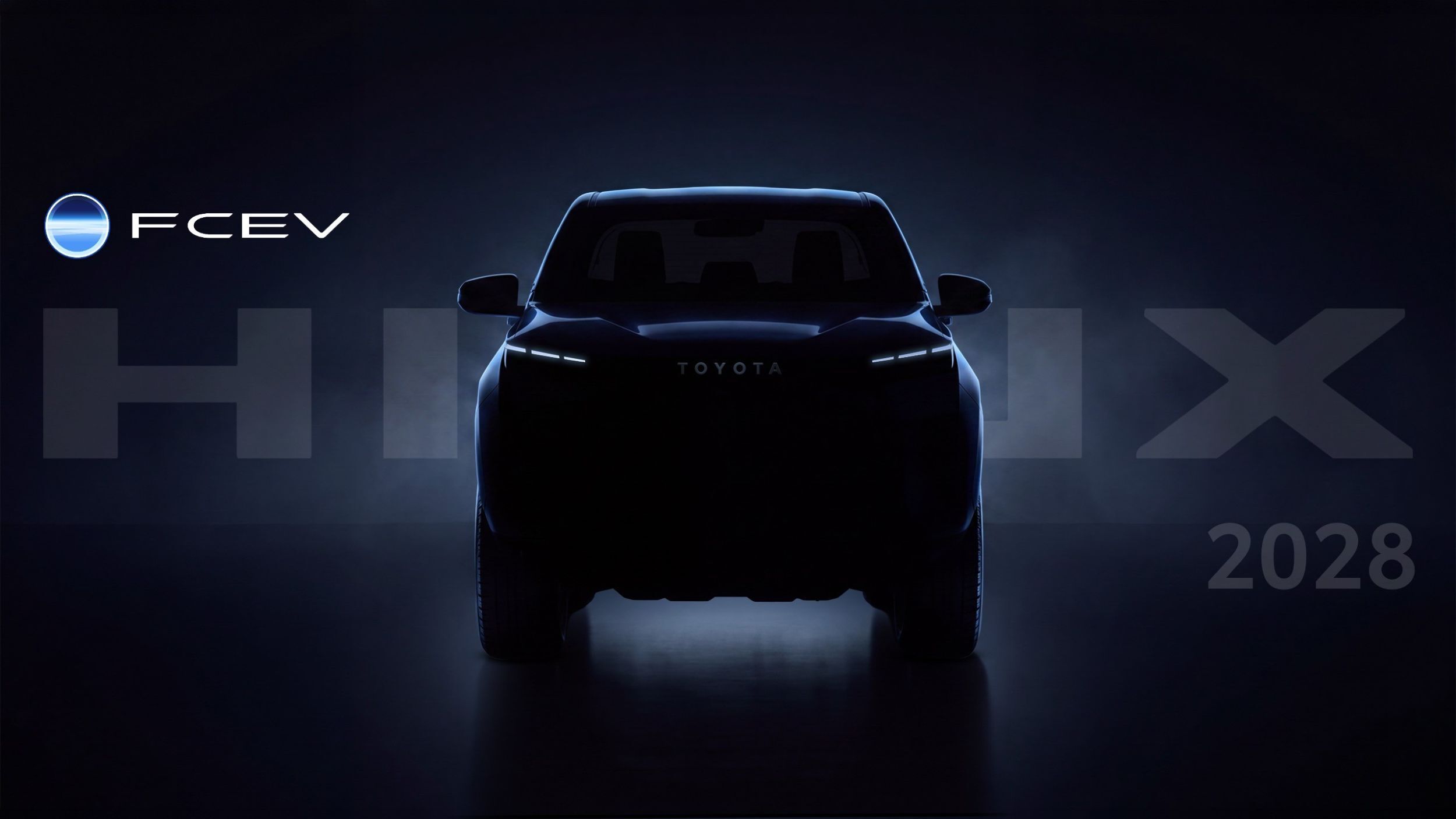
Toyota is keeping the specifications a secret for now, but has mentioned a targeted WLTP range of over 248 miles (400 km) and a towing capacity of 2,500 kg (5,512 lbs). For comparison, the Hilux BEV has a WLTP range of 257 km (159 miles) and can tow between 1,600-2,000 kg (3,530-4,410 lbs) depending on the configuration and the regulations.
More: Toyota’s Electric Hilux Costs $20K More Than The Diesel, And That’s Not Even The Worst Part
The big difference is that hydrogen refueling is much faster than charging, taking as little as five minutes – given you have access to the right infrastructure. According to the European Hydrogen Observatory, there are currently 179 operational hydrogen refueling stations in Europe and the UK, showing that the Hilux FCEV won’t be for everyone.
Another challenge will be pricing, as hydrogen models tend to be significantly more expensive than equivalent ICE and BEV variants.

The first Toyota Hilux H2 prototype was shown in 2022, using the fuel cell powertrain of the Mirai sedan. In 2024, Toyota built 10 prototypes of the FCEV truck for testing in the UK. Those came with three hydrogen tanks integrated within the ladder frame chassis and a lithium-ion battery under the rear bed, offering a generous range of 600 km (373 miles). The truck came fitted with a rear-mounted electric motor producing 180 hp (134 kW / 182 PS) and 300 Nm (221 lb-ft) of torque.
Toyota LCVs By Stellantis
Besides the announcement of the new Hilux FCEV, Toyota has also exhibited its European LCV lineup at the IAA Transportation in Hannover, Germany. Toyota LCV sales in Europe have more than doubled over the past five years, with a projection of over 165,000 units in 2026 and a market share of over 7%. The goal is to reach 200,000 annual LCV sales in Europe by 2030, increasing the market share to 8%.
More: Ford’s Ranger Super Duty Forced Toyota’s Hand And The Hilux Answered. Sort Of
Besides the new Hilux pickup, which is developed in-house, Toyota’s European LCV lineup includes compact, medium, and large Proace vans sourced from Stellantis. This allows the company to offer BEV versions across its entire LCV range, with zero-emission models accounting for 22% of LCV sales, double the market average of 11%.
Still, Toyota “recognizes that a single technology solution cannot address the business requirements, mobility needs or the local operating environments of all customers,” which is why diesel powertrains are still on offer. The latter can also run on renewable fuels such as HVO, reducing carbon emissions.