

4-Link Suspension Vs. Leaf Springs: What You Gain By Upgrading
You can, but it's not easy
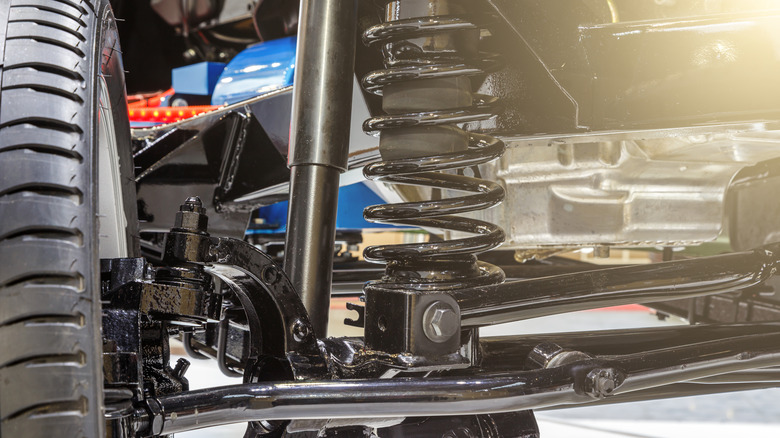
Whether you drive a car, truck, or SUV, the type of suspension it uses has been specially developed for that vehicle's intended purpose. Your vehicle's suspension is one of its most crucial systems because it not only ensures that your vehicle stays roof-up, tires-down, but it's also responsible for myriad things like roadholding, ride comfort, payload bearing, off-road ability, and more. In layman's terms, it makes sure that your tires are in contact with the ground, affording you the traction necessary to move, and it supports your vehicle plus its payload of passengers and cargo. So it's pretty important, then!
While there are many types of suspension setups, today we're going to look at the two most common ones: 4-link (or multi-link as it falls under this broader category) and leaf springs. We'll take you through the pros and cons of each type, including where they shine and where they falter. From there, it's on you to decide what type of vehicle and suspension best meet your needs.
What is a leaf spring?
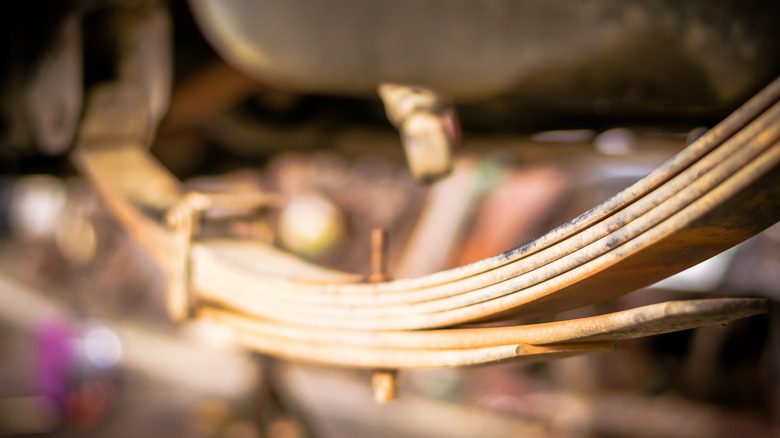
A leaf spring is one of the most basic types of suspension, and remains one of the most durable as well. It's also probably the oldest, having originated on French horse-drawn carriages around the 18th century. As you can imagine, roads back then weren't great. The Aristocracy and the well-heeled who were wealthy enough to own horses and carriages didn't like being jostled around. Hence, the invention of the leaf spring.
In its simplest form, a leaf spring is a bundle of rectangular steel leaves bundled together and attached to the vehicle's chassis at either end via mounting points and bushings. The axle is suspended from the center of the spring and moves up and down in response to the road surface. Accordingly, the leaves bend and bounce back, absorbing some of the shocks before they get transmitted to the vehicle. This basic design hasn't changed much, and can be found on many heavy-duty vehicles today, including off-roaders, pickup trucks, and commercial vehicles. Of course, manufacturers typically pair these with a shock absorber or air suspension bag for added damping, since undamped leaf springs can be pretty bouncy, particularly at higher speeds.
If it's sheer load-carrying capacity and brute strength against impacts that you're after, the leaf spring is ideal. But if you want a comfortable ride, formidable off-road capabilities or tight roadholding during performance driving, there are many other types. Today's opponent to the leaf spring is the multi-link suspension, commonly found in 4-link form.
What is a 4-link suspension?
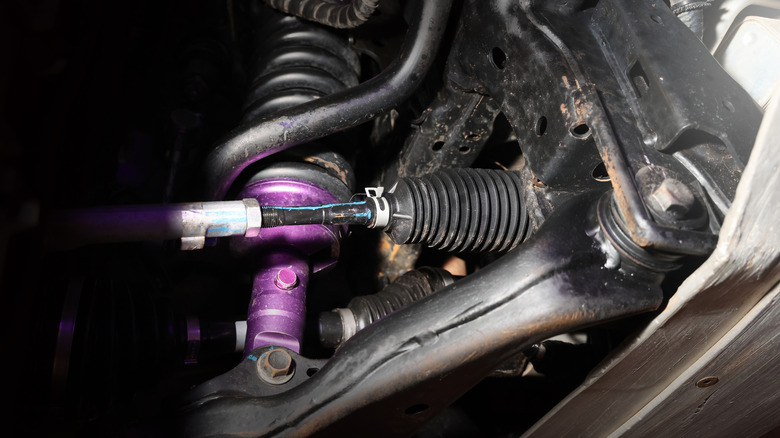
Unlike a leaf spring, which relies on steel springs and mounts the axle to the vehicle body at only two points, 4-link suspension uses a series of arms to mount the axle to the vehicle body at four points. .There are many types of 4-link suspension, including the Parallel 4-Link configuration, the Triangulated 4-Link configuration, and the aptly named Drag 4-Link configuration, which, as you can guess, is best for drag racing. They all use four links, a shock absorber or damper, and a coil spring. This may be in the form of a coilover (where the shock absorber sits within the coil spring) or separately fitted at different points of the suspension.
The advantages of a 4-link suspension over leaf springs are numerous. The most obvious benefit is ride comfort. Leaf springs are well-known for a bouncy and harsh ride, especially in a vehicle that are riding light without a payload. Just take a trip in the rear seat (or cargo bed) of an unladen pickup truck, and you'll know what we mean. In comparison, a 4-link suspension offers a far smoother and plusher ride, regardless of whether the vehicle is loaded or running light. Some modern multi-link setups are so well-designed that you barely notice road imperfections.
There are also performance advantages. A leaf spring severely constrains the movement of the axle and wheel that it is supporting, resulting in less-than-optimal grip under dynamic load conditions. Meanwhile, a 4-link suspension system can ensure that the optimal area of your tire is in contact with the road, even under loads in varying directions, such as when accelerating out of a turn or trail-braking into one.
The benefits when off roading
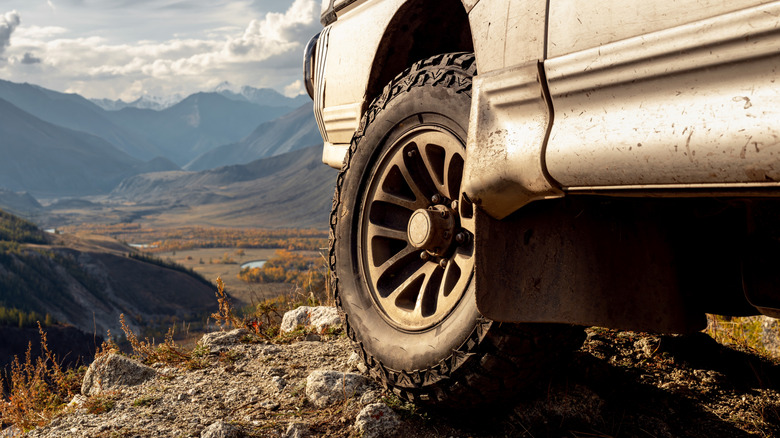
This one may seem obvious because leaf springs are durable, right? Yes, they are for load-carrying, but when off-roading, they can reduce your articulation. Having said that, there are still plenty of serious off-roaders that use leaf springs because of their simplicity and weight. Having a leaf spring means that you've got some extra weight lower down, which helps mitigate the risk of tipping over at extreme angles. Serious off-roaders are also able to somewhat mitigate the approach and departure angle issue through a mix of larger tires and driving skills.
That being said, high-speed off-roading demands more from a suspension due to jumps, and this is where a four-link setup is better. Leaf springs don't offer enough of a cushion in this environment, which affects stability and control. Four-link suspension, with the right shocks and coils, will afford a greater degree of suspension travel, and will be much kinder to the driver's spine.
What suspension gives the smoothest ride?

When it comes to comfort, 4-link suspension is the clear winner. While leaf-sprung suspension can be cushioned to a certain extent with the use of shock absorbers, there are physical limitations as to just how smooth a vehicle's ride can be. One of those limitations is the fact that leaf springs rely on a great deal of mechanical friction in their operation, owing to how the individual leaves are always in contact with each other.
Coil springs don't have this limitation and typically offer a greater level of suspension travel to provide the right amount of cushioning over a greater variance of small road imperfections to larger humps and even jumps.
However, if you want an even comfier ride, then the award for smoothness goes to, air suspension. That being said, many vehicles with both leaf and multi-link can also use air suspension in the form of airbags or air springs, so it's not a conclusive answer. Just remember that air suspension adds a new layer of complexity and requires more frequent maintenance, driving up your overall costs.
Should I change my vehicle's suspension system?

Upgrading an off-roader from leaf spring to 4-link suspension is a common modification, although its complexity and whether off-the-shelf kits exist for your use case will depend on the model of the vehicle. But if it's something available to you, should you go ahead and do it?
In terms of sheer cost-effectiveness, leaf springs take the lead. In most well-maintained leaf-sprung setups, its usually the rubber bushings that need replacement over time, as well as the shock absorber. While the same is true for a 4-link configuration, you've got more bushings. Control arms can also become bent or distorted through impacts, affecting not just alignment but overall vehicle safety. The coil spring is also susceptible to breakage, either from impacts or consistent overloading, and we need not tell you that, if unchecked, this could lead to serious issues.
Changing vehicle suspension isn't a trivial matter either. It requires a lot of engineering and fabrication, and you may need to re-certify your vehicle to be road legal too. In most cases, you might be able to achieve a broadly similar outcome with an upgrade to your existing suspension components such as springs and dampers, as well as fitting stabilizer bars. Changing the entire suspension system from stock should only be a last resort, where you well understand the implications and costs involved. And it's always best to consult a professional here.