

Can You Really Run A Turbo And Supercharger On One Engine?
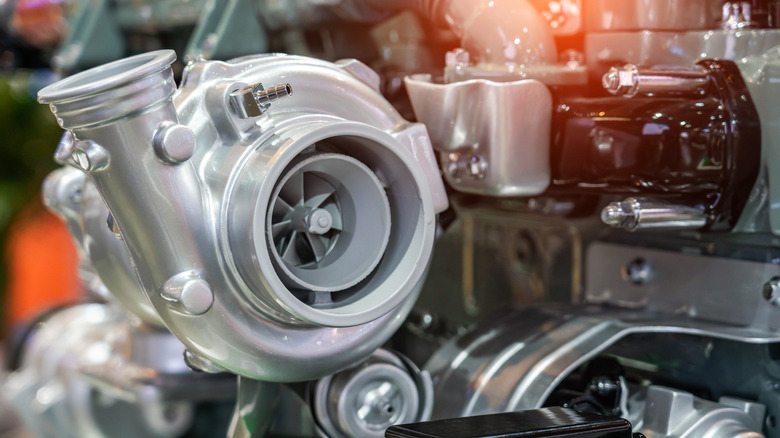
In the automotive world, there's nothing quite like the purity of a high-revving or large-displacement engine that makes its power by simply combining air from the outside world with fuel and a spark. But in the modern world where fuel economy and emissions are equally as important as raw performance, the use of big, naturally aspirated engines is a dying art. While there are outliers such as the V12-powered Aston Martin Valkyrie or the Ford Mustang GT, the use of forced induction is usually an easy and cost-effective option to add power without sacrificing efficiency.
The most common type of forced induction is a turbocharger. These are powered by a car's exhaust, which spins a turbine and an impeller that sucks more air into the engine, creating boost and more power. Turbochargers appear in everything from tiny three-cylinder hatchbacks all the way to million-dollar exotics. Historically, the drawback of them has been turbo lag, as an engine needs to rev past a certain point before the turbo can start working.
Twincharging solves the issue of turbo lag, but at a cost
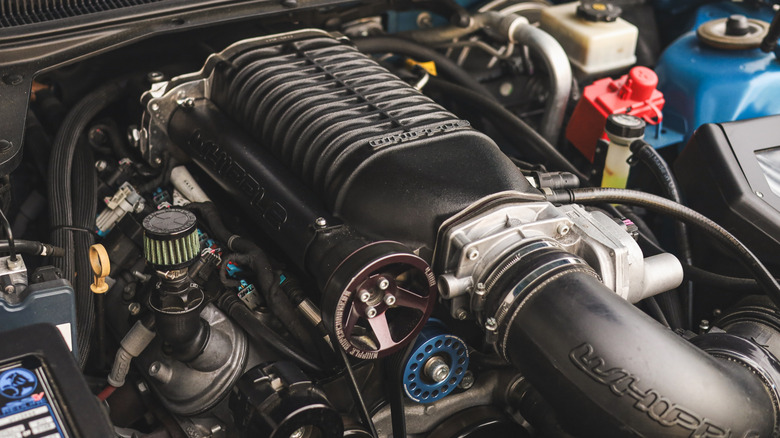
In recent years, the issue of turbo lag has been largely resolved by the advent of electric turbochargers, like the ones found in the new Porsche 911 Turbo S. Here, a small electric motor on each turbo instantly brings the turbo up to speed, eliminating turbo lag. However, before e-turbos became a thing, a handful of car manufacturers were producing twin-charger systems, where a supercharger is used in combination with a turbocharger.
The theory behind using both is pretty simple. Unlike a turbocharger that is powered by exhaust gases, a supercharger is typically powered by the rotation of the crankshaft. The advantage of superchargers is that they help pump more air into the engine without suffering from turbo lag, as there's no boost threshold to worry about. This means a supercharger can be leaned on for power at low rpms, while a turbocharger can then take over once it hits its boost threshold and fires into life.
Very few cars have ever launched with twincharged engines
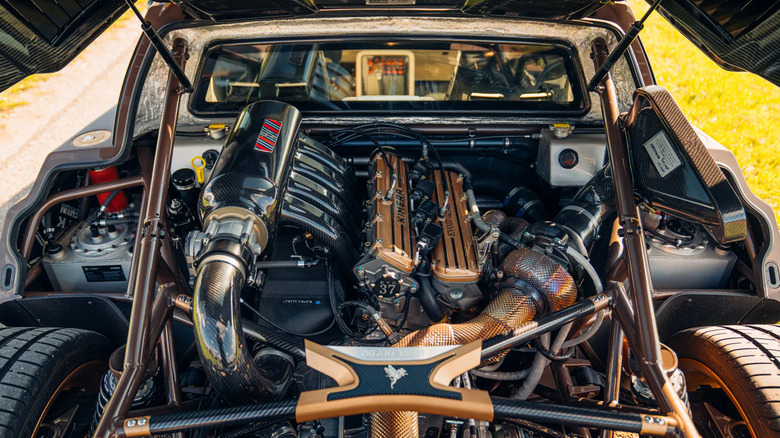
Only a small handful of production cars have ever been sold with twin-chargers. These include cars like the Mercedes-AMG E 53, Lancia Delta S4, Skoda Fabia RS, Audi SQ7, Zenvo ST1, and more recently, Kimera's EVO37 restomod. While combining a turbocharger and a supercharger may sound like the best of both worlds, there are some obvious drawbacks.
Most notably, installing both a turbocharger and a supercharger adds weight, complexity, and cost. A turbo operating on its own already requires several additional parts in the engine bay, including an intercooler, boost pipes, unique intake manifold, and the turbo itself. For a supercharger, you need an extra pulley coming off the crankshaft and the supercharger, usually positioned on top of the engine. All of this adds cost. In addition, the extra complexity means there are more failure points and repairs can be a headache. With this in mind, it's little wonder why few brands have ever committed to developing and building cars with twin-chargers and why, if you like the idea of adding forced induction to your car, you should probably choose between a turbo or a supercharger, and not both.