

How Higher Compression Can Give An Engine More Power While Saving Fuel
More power typically hurts fuel economy, but higher compression breaks the rule. Here’s how modern engine design squeezes out both.
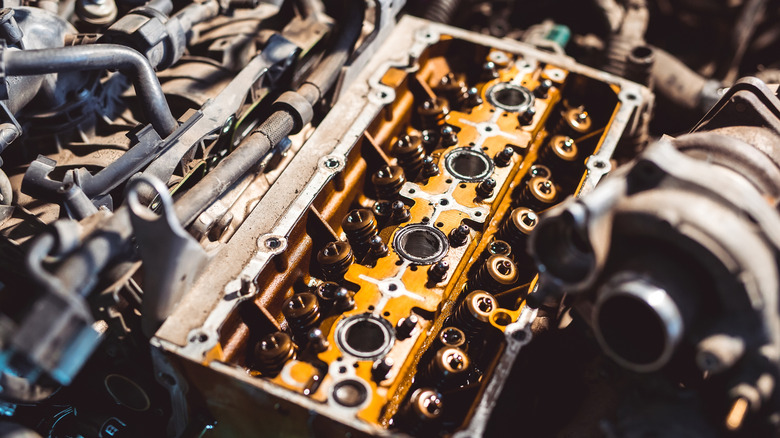
While the automotive industry is at an important point as an increasing number of buyers gravitate toward EVs, there are still many of us who will want to hold on to combustion power for as long as possible. But that doesn't mean we have to give up concerns of fuel efficiency or horsepower while continuing to use our tried-and-true internal combustion engines. One of the ways that's been touted as a solution to increase fuel efficiency from modern engines is by having a higher compression ratio.
But what exactly is an engine's compression ratio and how can something seemingly simple on paper actually give you the dual benefit of better gas mileage and greater horsepower? Keep reading to learn more about how compression works inside an engine, and learn how higher compression ratios can give an engine more power while saving fuel. Because as more automakers look for ways of increasing efficiency without sacrificing power (modern cars are heavier than before, after all), it's very likely that high-compression engines are going to become more prevalent in the years to come.
What Is Compression Ratio?
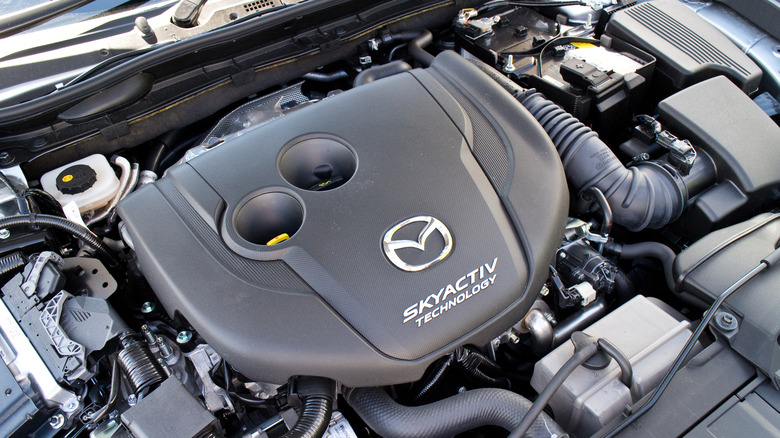
To understand how compression ratio affects fuel efficiency and horsepower, you have to understand how a combustion engine works. The layman's explanation for most common engines is that fuel and air are mixed at the top of the cylinder, which is ignited by a spark emitted from a spark plug. The resultant combustion is what drives a piston down: this is known as the power stroke. There are three other strokes in a four-stroke engine — intake, compression, and exhaust — but the power stroke is the one we're focusing on, as it's where the combustion happens.
The piston that is sent down the cylinder on the power stroke is connected to the driveshaft (via the connecting rod). That motive force is transferred through several mechanical components (such as the gearbox, driveshaft, and differential) and is essentially what's responsible for moving the car. Repeat this several thousand times a minute, and you have what drives an ICE car engine.
Compression ratio is the measure of how much volume is at the bottom of the piston's stroke (bottom dead center) versus how much volume is at the top (top dead center). So a compression ratio of 10:1 would mean that the air-fuel mixture that gets ignited at the beginning of the power stroke is compressed in a space 10 times smaller than its volume in the intake stage.
Essentially, a higher compression ratio equates to a smaller space at TDC. A smaller space at TDC means more room for the piston to travel on the power stroke.
Are higher compression engines more fuel efficient?
A typical four-stroke petrol engine is actually quite inefficient, with an efficiency of up to 27%. The reason is that for three of the four strokes, no horsepower is being made, but energy is required for them to occur. The intake, compression, and exhaust stages are thermally inefficient. The power stroke, as the name implies, is the one where all that energy is converted. When compression is increased, thermal efficiency goes up. That's because higher compression means that the expanding gases that have been ignited can travel longer, pushing the piston down with more force, translating into more power. The same amount of fuel in a lower compression engine would produce less horsepower and, therefore, would be less efficient.
In simple terms, higher compression allows power to be made from a less amount of fuel. And yes, higher compression engines do make more power. As we touched on above, while they're more efficient, it also means that more horsepower can be made for the same amount of fuel. Some manufacturers are already doing this both as a means of keeping ICE models and as a complement to hybrid electric vehicles. For example, Mazda, with its SkyActiv engines, run a very high compression ratio of 13:1 compared to "conventional" gasoline engines, which vary from anything between 8:1 to 10:1.