

You Can Run Ford's EcoBoost Engines On Regular, But There's A Benefit To Premium
Higher octane ratings will cost you more but it could be worth the price

Regular and premium gasoline may look and smell the same, but they differ in many key ways. In the U.S., most regular pump gas has an octane rating of 87, while premium gas generally ranges from 91 to 94 octane. The increased octane rating means premium gas is better for performance and is often recommended for use in supercharged, turbocharged, and high-compression engines. And in the Ford world, regular and premium gas can mean the difference between an engine that's constrained and one that produces maximum power.
For years, Ford has promoted its popular EcoBoost engines as supporting both regular 87 octane gas and premium gas with an octane rating of 91 or higher. Thanks to Ford's Octane Adjust Ratio system, these engines can run on 87-octane fuel, but premium fuel is needed to achieve peak power and match the figures Ford promotes. The real-world performance differences between the two, however, are stark.
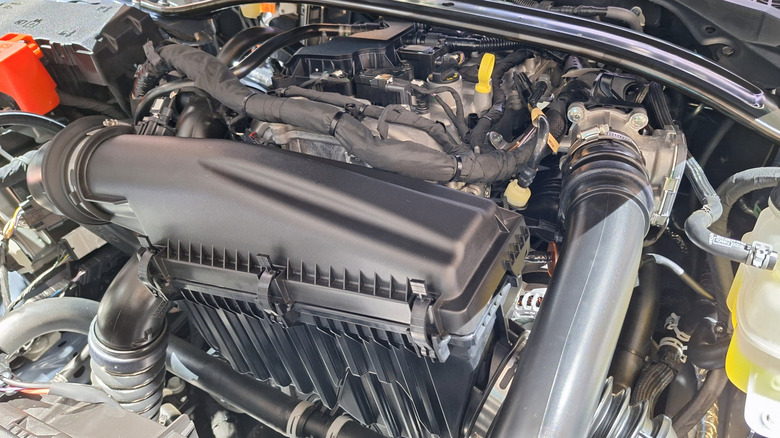
Take the Ford Bronco's turbocharged 2.3-liter EcoBoost inline-four and turbocharged 2.7-liter EcoBoost V6 engines, for example. Ford says that with regular fuel, the four-cylinder is capped at 275 horsepower and 315 pound-feet, while the same engine delivers 300 hp and 325 lb-ft with premium fuel. Similarly, the 2.7-liter model has 315 hp and 410 lb-ft with everyday 87-octane fuel, or 330 hp and 415 lb-ft with high-octane fuel.
There's a big difference between different octane fuel in the real world
In 2019, Car and Driver set out to verify what the difference between 87-octane and 93-octane fuel would be. In its test, the folks at C&D put a used Ford F-150 with the twin-turbocharged 3.5-liter EcoBoost V6 on the dyno, and found that on 87-octane, it delivered 360 hp and 463 lb-ft to the wheels. Filling it with 93-octane fuel raised these figures to 380 hp and 475 lb-ft, while also slashing the 0-60 mph (0-96 km/h) time from 5.9 seconds to 5.3 seconds. The fuel change also improved the truck's quarter-mile time from 14.5 seconds to 14.0 seconds.
Ford's Octane Adjust Ratio system is similar to the knock-control systems that have existed in production cars for decades, but is a little more advanced. It is a strategy used in the carmaker's ECUs and, rather than reacting after the engine detects knocking, it instead detects what octane fuel is sitting in the tank. If it detects premium, high-octane fuel, it advances ignition timing to boost power and torque. This also improves fuel economy and lowers emissions. If low-octane fuel is detected, the engine will pull timing to prevent pre-ignition and knocking. This technology is why EcoBoost engines, designed to run best on premium fuel, can also use low-octane fuel.
EcoBoost owners can switch back and forth between regular and premium gas
This tech enables EcoBoost owners to safely switch back and forth between regular and premium gas without worrying about engine damage. So, if you're driving in an area where premium fuel is hard to find, or you simply don't want to pay extra for 91 octane every time you visit the pump, you can feel free to get regular gas. Just be warned that your car will have less power, won't feel as responsive, and will probably use more fuel than if it had premium gas.
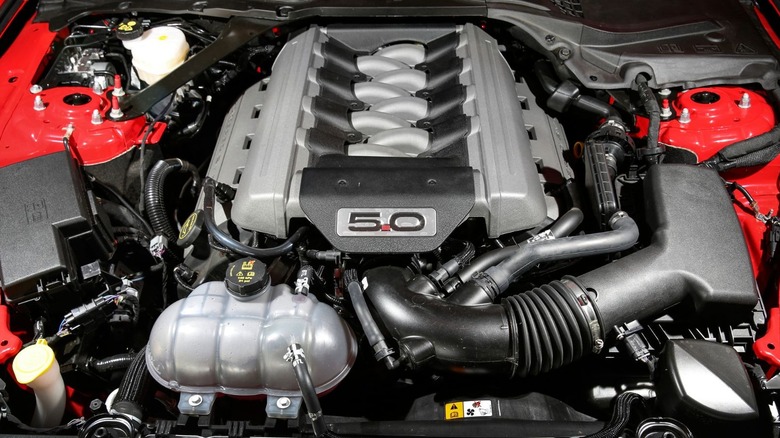
Interestingly, it's not only Ford's EcoBoost engines that support regular and premium gas. For example, the beloved naturally aspirated 5.0-liter Coyote V8 of the Mustang will happily run on 87-octane fuel. However, to achieve the quoted 480 hp and 415 lb-ft, owners need to use 91-octane or 93-octane fuel. The all-conquering supercharged 5.2-liter V8 used by the F-150 Raptor R is different. The owner's manual on that high-end version of the truck specifies fuel with a minimum octane rating of 91. It makes sense this engine only supports the good stuff because it delivers a frankly ridiculous 720 hp and 640 lb-ft.