

Tesla Made A Lot Of Bold Claims About The New Roadster, But Do You Believe Any Of Them?
How real was what we saw? How likely will it make production?
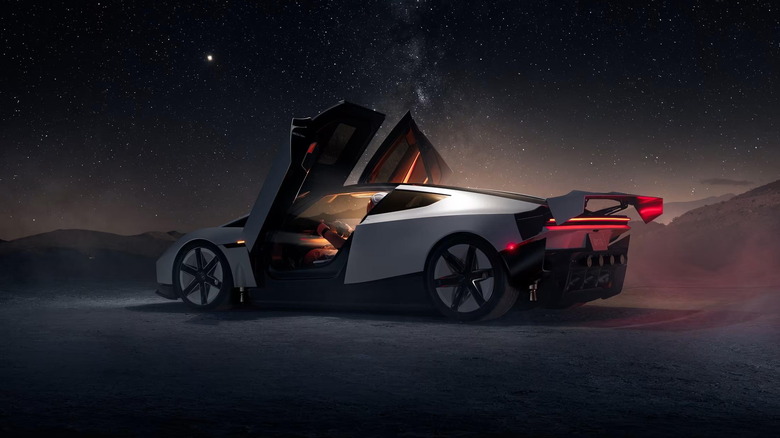
In 2018, Elon Musk told Joe Rogan he'd use thrusters to make a Tesla fly. Last night, the brand drove a car upside down, sent it off a ramp, flipped it over, and landed it. Then it cleared a line of its own vehicles with another aerial maneuver. Whatever you think of Musk, that was one hell of a way to introduce a sports car. Watching another executive pull a sheet off another car is going to fall a little flat for a while.
Of course, the morning after has left us with a bit of a problem. There's no question that what we saw was extraordinary, but is it really something people will be able to buy? Since the reveal, Tesla has shared considerably more through various interviews. Some of those details make the Roadster more impressive. Others put gigantic asterisks next to the stuff we're all gawking at. For example, which Roadster are we really talking about here? Because not all of them have the same features.
Trims
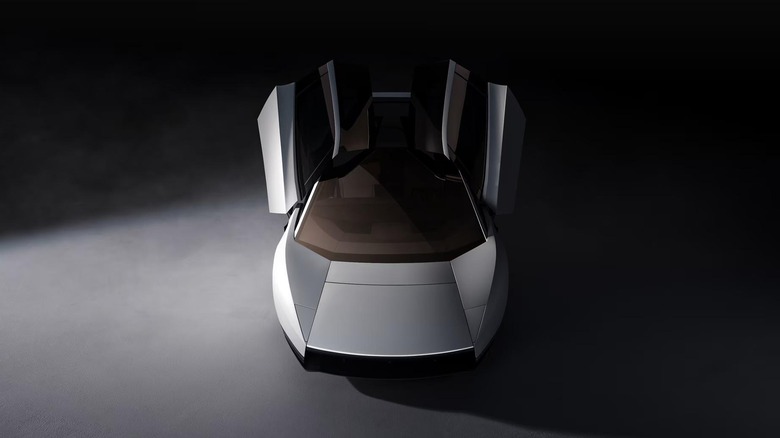
Tesla says that buyers will have the option to pick from four trims: Roadster, Performance, Thrust, and Rocket. That's key, as it seems that in plenty of cases, the only specs getting thrown around are the ones tied to the most extreme. Here's a general idea of what Tesla seems to confirm at this point. All trims will use rear-wheel drive exclusively.
Some trims, Tesla hasn't said which ones specifically, will make over 1,341 horsepower (1000 kW) and 1,033 lb-ft (1,400 Nm) of torque. According to Top Gear, the base car will make a measly 1,073 hp (800 kW) and 885 lb-ft ( Nm) of torque.
Tesla says that the Performance will do 0-60 in under 1.6 seconds, Thrust will do it in under 0.9, and the Rocket will do it in under 0.59. The company told Hagerty that it'll actually manage it in 0.55, but that's with one foot of rollout. Frankly, at that speed, it's almost comical that they're considering rollout.
The company is targeting 300 miles (483 km) of range, with Top Gear reporting between 310-320 (499-515 km) depending on the model. Tesla is aiming for a final production weight of under 1,700 kg (3,748 lbs). That's specifically for the base version, and honestly, if achieved, it would be a big plus in terms of driving dynamics. Less weight improves every aspect of vehicle dynamics regardless of powertrain.
Take away all the thruster stuff, and there's plenty to get excited about. A rear-wheel-drive, relatively light, very powerful car that can use suction for downforce is a great recipe. It's also quite a departure from the car revealed in 2017, so carrying old specifications forward is going to cause confusion. That all said, we've got to get into some of the wilder claims here.
The tanks and top speed
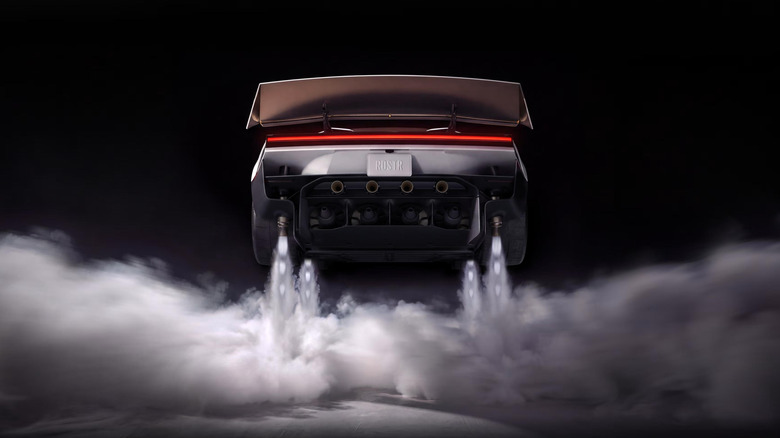
Thrust and Rocket both come with air tanks and thrusters, but each uses a different hardware configuration. Thrust uses four rear cold-gas thrusters supplied by a 200-liter nitrogen tank. Rocket adds another 400 liters where the passenger would otherwise sit, bringing the total to 600 liters, along with six additional thrusters. Obviously, those aspects are different because each car has a different performance envelope.
Top Gear reports that the Thrust tank empties in roughly six seconds and requires refilling at a station. In other words, that spectacular launch is a one-shot party trick before replenishing the gas. Running out doesn't mean the electric motors stop working. It does mean the car no longer has the extra propulsion behind its wildest acceleration claim.
Refilling reportedly takes quite a while. As we reported yesterday, the car simply uses atmospheric air, but according to Hagerty, the Rocket trim takes six to seven hours to refill the 600-liter system. Tesla aims to cut that to 30 minutes, and we'll come back to that idea shortly, but even 30 minutes would create an unusual rhythm at the drag strip. Keep in mind that the Thrust trim should take substantially less time, since it uses only a 200-liter tank.
Tesla's public launch claim includes a top speed of more than 230 mph (370 km/h), though Elon Musk said he'd like it to be half the speed of sound. That's a cool 384 mph (617 km/h). In an interview with Top Gear, Tesla says it's aiming for 330 mph (483 km/h). Those are all dramatically different figures, and each one will need validation.
It's one thing to be sincere about a target and another thing to see a car achieve it in the real world during independent testing. That last bit is key. Automakers pull off all sorts of wild things when they lock down a track and put a team on a unique project or goal. Can an owner manage the same feats without that factory team backing them up?
Was that a movie prop we all watched?
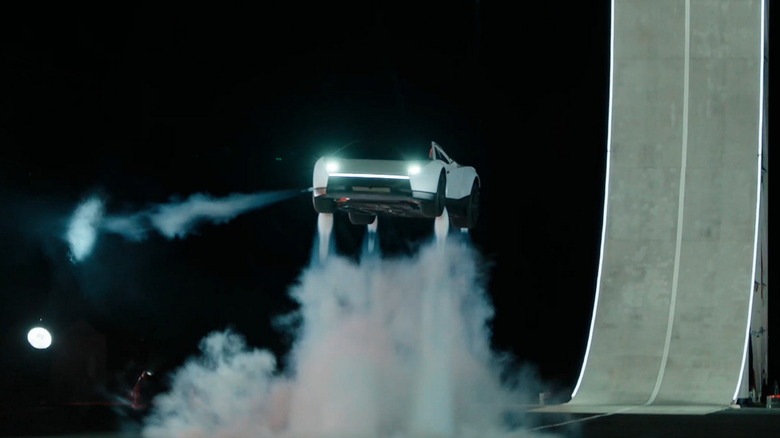
There's a fair question here because, frankly, what we all saw was about as wild as any car demo ever. Some have claimed that they saw wires helping to hold the car up, and while that's a bit tough to follow, there's still plenty of room for doubt. How closely did the cars we saw last night resemble the proposed production Roadster? Did they have the same battery, tanks, suspension, and control systems? Tesla hasn't been super specific.
Of course, we also shouldn't simply write off what happened. Even if the car was less of a production mule and more of an engineered stunt car, it was a nifty show. Ultimately, time is going to tell us exactly how real those stunts were, whether that's to Tesla's benefit or not.
The less flashy stuff is still very cool
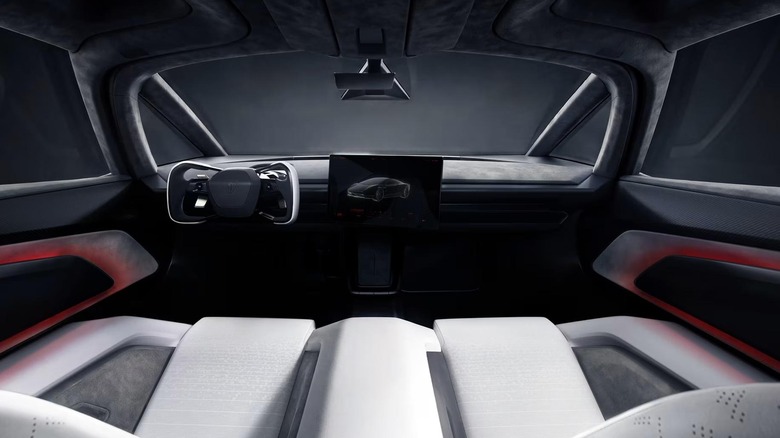
To Tesla's credit, some of the most interesting work sits beneath the stunts. The automaker described bespoke 4680 cells with aluminum cans and cooling on both sides. The car also features steer-by-wire, brake-by-wire, and active aerodynamic surfaces, including a rear wing with different operating modes. The suction system appears genuinely useful and is proven racing technology.
Those details make even the base or Performance versions of this car sound promising. Better cooling can make for a car that doesn't need quick pit stops like most EVs. Well-tuned steering can make a difference on literally every single corner. Aero that actively balances grip and drag is already a key piece of the industry. And none of this requires refilling a nitrogen tank.
Turning it over to you
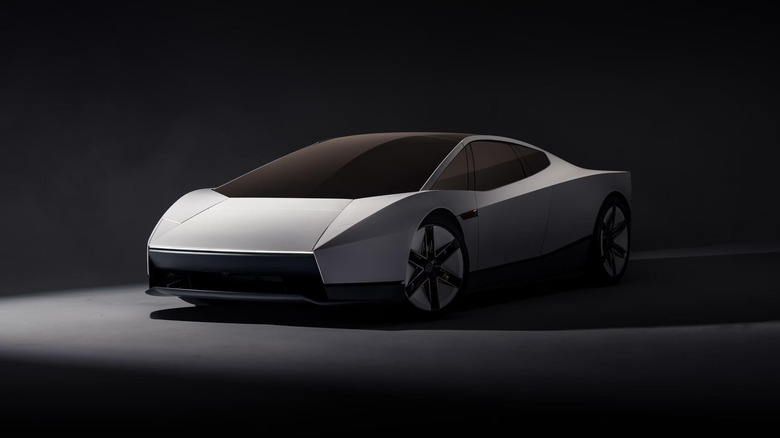
This is ultimately where things sit for the time being. Some of Tesla's claims look plausible. Some need substantial qualification. Others need evidence we simply haven't seen. The show was spectacular, and wanting the finished car to be just as spectacular is entirely reasonable. But let's circle back to cutting air-tank refueling time from six hours to 30 minutes.
That single goal is a drastic reduction and will take a lot of engineering and innovation and possibly some compromises. Now, scale that up to every other wild and crazy thing Tesla is promising. It's easy to see why there are plenty of doubters out there this morning. Can the team really sell the car we saw to customers in 2028? We hand the question off to you. What do you believe Tesla will actually manage out of all the claims it's made in the last 24 hours? Sound off in the comments.