

Iridium Vs. Platinum Spark Plugs: Are There Performance Or Efficiency Differences?
There are differences that are important based on your car

If you know anything about internal combustion, you'll know that spark plugs are key to performance and efficiency. But there are two main types of spark plugs on offer today: iridium and platinum, and the choice of spark plug can make a difference on how your car engine performs. That said, it's more nuanced than simply choosing one over the other, and it greatly depends on the application. First, the basics. Spark plugs in a gasoline engine play a key role because, without them, the gas-air mixture would not combust, and simply put, you'd go nowhere.
But even though they're a cornerstone of any gas engine — virtually as old as the invention itself — the tech behind them continues to develop. In the old days, spark plugs were made of copper. Copper is no longer used on modern cars because it wears out relatively quickly inside a cylinder of exploding gas that can routinely exceed 2,000 degrees Fahrenheit in normal operation. So, which type of spark plug is better? To answer that, we need to discuss which is most cost-effective for your situation and whether can you mix and match the two.
The choice is dependent on your car
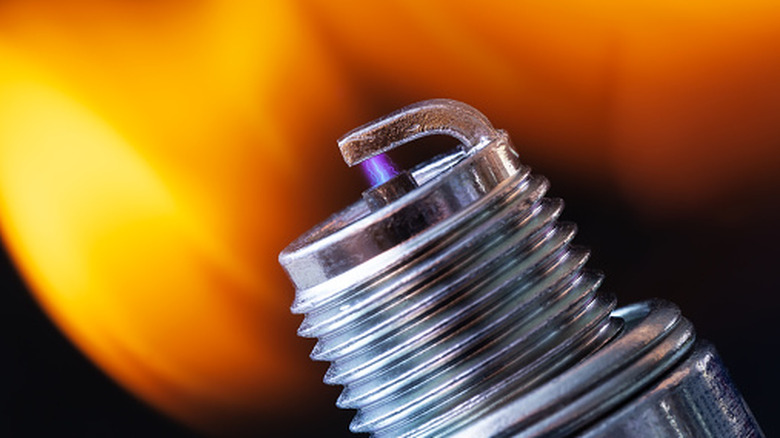
Whether or not you go for platinum or iridium spark plugs is highly dependent on your car and its engine. With a melting point of over 3,200 degrees Fahrenheit, platinum is perfect for most daily driving applications. It's tough, durable, and cost-effective, with platinum spark plugs capable of lasting beyond 60,000 miles in a well-maintained engine. Iridium plugs, on the other hand, are your high-performance heroes.
If you've got a powerful vehicle with a high-performance engine — one that's turbocharged and/or high-revving — it almost definitely needs iridium plugs. In fact, many modern engines come from the factory with iridium spark plugs in a quest for more efficiency and durability. Iridium spark plugs have a melting point of around 4,400 degrees Fahrenheit, meaning they can handle the increased temperatures of highly-strung gasoline powerplants. Plus, they come with ultra-fine electrodes that generate a more precise and cleaner spark.
This has a double benefit; in addition to optimal power, it also provides better fuel efficiency. So, what is the main disadvantage of iridium spark plugs? Iridium spark plugs can be expensive compared to their platinum counterparts — although probably not as pricey as quoted by one Dodge dealership. In fact, they can cost over twice as much as an equivalent platinum spark plug. But, if you've got a performance car that requires this type of spark plug, then yes, they are worth the extra money.
Can I mix iridium and platinum spark plugs?
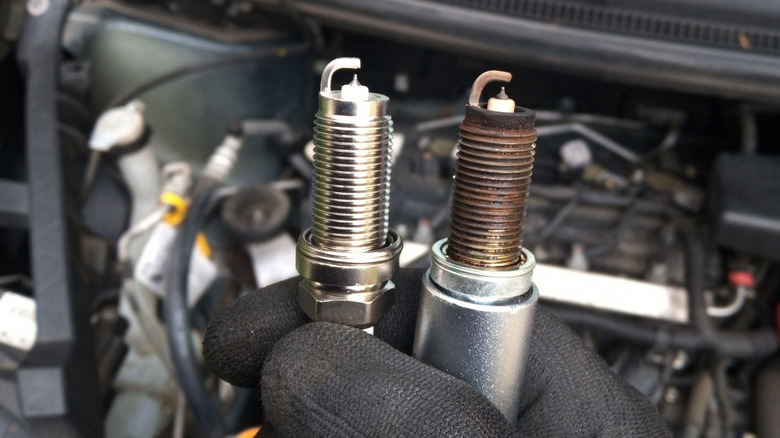
Now that you know about platinum and iridium spark plugs, you should have a better idea about how they affect your car's performance and efficiency. But when it comes to mixing the two, it's a pretty hard no. You shouldn't do this under any circumstances. Using a mix of iridium and platinum plugs in your engine will cause myriad issues, since combustion won't be well-matched across all cylinders. If you're replacing the spark plugs, you need to replace all of them with the correct type, at the same time.
As well, you won't get a performance boost if you install iridium plugs in an engine designed for platinum plugs, even when it's a $20,000 job on a Bugatti. You'll only be draining your wallet unnecessarily. By the same token, if you think you can install platinum plugs in an engine designed for iridium, you shouldn't do this either, as there will be issues with performance and fuel efficiency. At the end of the day, the best advice we can give you is to consult what the manufacturer has specified and stick to that, whether that be platinum or iridium spark plugs.