

GM Patents Cars That Change Camber And Ride Height Before You Lose Traction
Grip is important, and GM is working to find new ways to increase that grip
Cars are absolutely full of wildly impressive technology. Among some of the most overlooked bits of that tech are the components that go into stability and traction control. General Motors just patented a system that would take that to a whole other level. It looks at the road ahead, predicts when a vehicle might begin to pull in an unwanted direction, and then automatically adjusts its suspension and steering in real time to help the driver maintain control.
The newly granted patent, US 12,780,181 B1, published November 3, describes technology designed to combat what GM calls "traction steer." That's when differences in grip between the left and right tires cause a vehicle to pull or turn unexpectedly, particularly during acceleration or braking. GM thinks it can predict those situations before they happen and use adjustable ride height, active camber, and steer-by-wire technology to minimize their effects. Ensuring that the resulting behavior feels natural to a driver might be tough.
Seeing trouble ahead
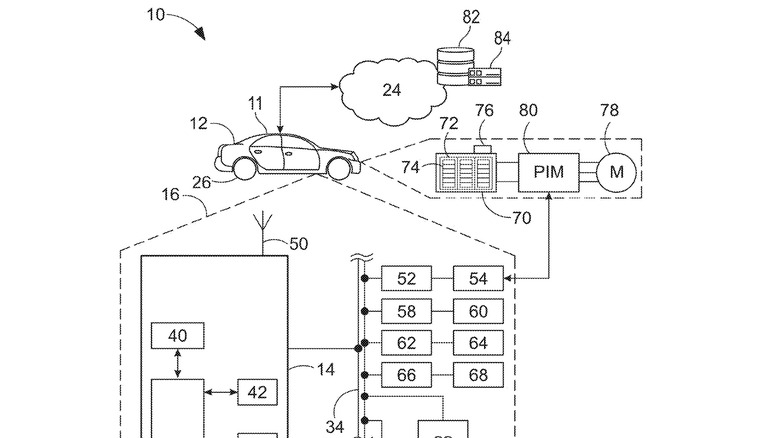
Figure one of the patent gives us the clearest visual interpretation of how this would work. It shows a sedan with a huge network of sensors and communication systems. In practice, the car would use a forward-facing camera to identify the shape of the road ahead. The vehicle would then compare that to digital mapping data and try to determine how the surface could affect stability.
An inertial measurement unit and steering rack force sensor would verify those predictions. As the system calculates all of this data in real time, it would continue to predict if the upcoming road surface would upset stability. If the system believes the vehicle could lose stability, it would begin making corrections before a traction-steer event happens. That's where this gets particularly fascinating.
Rather than simply relying on steering and braking input, GM wants to actively change how the vehicle distributes its weight. In effect, it wants to leverage whichever tires have the most traction through that shift. For example, the patent explains that raising the left side of the vehicle could transfer additional load to the right-side tires.
Raising the front suspension could similarly shift load toward the rear axle. Depending on the road conditions, the system could make individual adjustments at each corner to better balance available traction. Of course, we've all seen active suspensions before, just not used in this particular way. What's wilder is the camber and steer-by-wire situation.
Going boldly
Steer-by-wire tech has been around for decades, but it wasn't until the Tesla Cybertruck that it made its way into a production vehicle on American roads. It provides an advantage in that it offers a variable ratio to drivers. In other words, turning the wheel 30 degrees to the right at 80 mph will turn the physical wheels differently than it would at 15 mph. That single feature would allow GM to make small steering adjustments at the front or rear wheels to compensate for forces that would otherwise pull it off course.
The camber system might be the most innovative piece, though. Camber is the degree to which your tires are leaned over when viewed from the front or rear of the car. Most automakers call for some camber during an alignment because it enables better traction in turns.
Of course, if one could change camber on the fly, something that no production car on sale today can manage, it would allow the vehicle in question to leverage camber to achieve maximum grip whether turning or going straight. That alone could be a game-changer on multiple levels. Performance cars would have even better grip in corners and on straights. Pedestrian vehicles could see tire life improvements because the tires aren't chewed up due to camber requirements.
That said, GM hasn't mentioned any particular model or production plan for the technology. It could end up on a shelf and never make it to production, or it could be the next big thing in traction control.