

Can Directional Tires Be Rotated From One Side To The Other?
Swapping sides takes more work than most owners expect.

Technically, directional tires can be rotated from one side of a car to the other. Nobody can stop you from unbolting a wheel/tire combo from one side of the car and putting it on the other side. The catch is that doing it properly involves more work than unbolting the wheels and swapping their positions. Skip that extra work and those carefully designed tread patterns will end up running backward. That might not sound all that terrible, but for these "unidirectional" tires, the rolling direction matters.
Crossing directional tires requires removing them from their wheels and remounting them in the correct orientation for the opposite side. Each one then needs rebalancing, which is where the red and yellow dots on tires come in. So sure, you can unbolt whatever is on the passenger side of your car and swap it to the driver's side. But the tread will be heading in the wrong direction. Still, there are other ways to do this job without messing anything up.
Some owners will simply swap the rear tires onto the front and vice versa, keeping each tire on the same side of the car. Of course, that only helps if you have what we call a "square" fitment. That means that all four of your wheels and tires are the same size. Other owners have larger rear wheels and tires, so such a swap wouldn't work. Most major tire brands offer unidirectional tires, and the restrictions come down to how the tread itself meets the road.
Why the direction matters
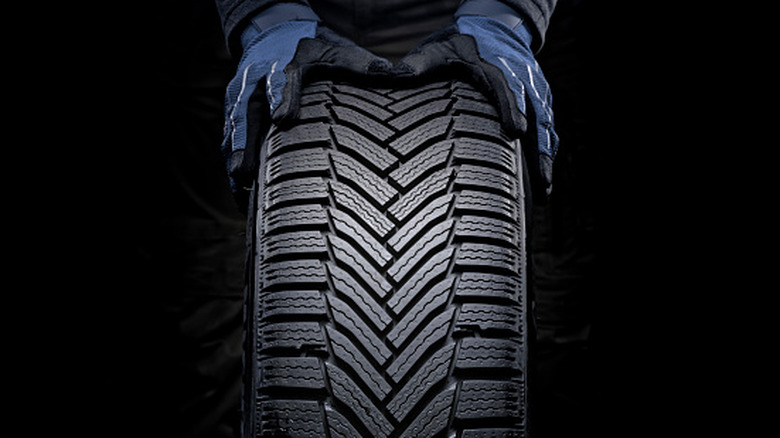
Directional tires are designed to roll in a specific direction during forward travel. Their tread often features a recognizable V-shaped pattern, with channels arranged to move water away from the contact patch to help prevent hydroplaning. A wheel with the directional tire pointed the wrong way won't grip as effectively, which can cut into braking performance on wet roads.
Thankfully, there's a very simple way to check. Directional tires typically have an arrow marking on the sidewall indicating how the tire should roll. Once installed on the wheel and vehicle, the arrow should face forward when it's at the top of the wheel. The directional nature of a tire can benefit drivers on multiple surfaces. Snow, rain, and mud can all clear the contact patch more easily, in some cases, if the rotation direction is correct. In fact, a tire's tread pattern can affect winter performance more than its width.
Let's imagine that you have a square setup and directional tires. The easiest way to rotate said tires is simply to swap them between axles on the same side. So your front tires would move to the rear, and your rears would move up front. The trade-off is that the tires may wear less evenly and more quickly. Some folks go further and swap them both from front to back and from one side to the other, but that means having the tires dismounted from the wheels, remounted, and balanced again. Still others will simply swap tires from one side to the other and forgo moving them from one axle to the other, which requires the same extra work.
For a staggered setup, things are trickier. Because the tires can't go from front to back, rotating them requires dismounting all four tires from the wheels and then remounting them on the opposite side of the same axle. The job can be time-consuming and costly, but it can help even out wear between the left and right tires. As is the case for most tire-changing needs, a qualified shop is probably the best bet. Not only does it save you the work of doing it, but a shop is going to be familiar with everything we've discussed here.