

Spyker Says It's Positioning Itself As A Pagani And Bugatti Rival
After surviving two bankruptcies, boutique automaker Spyker is back with a stunning, hand-built supercar aimed directly at Pagani and Bugatti.
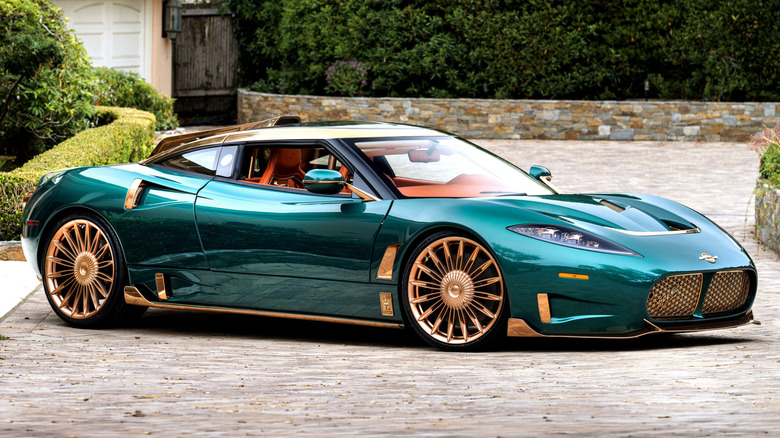
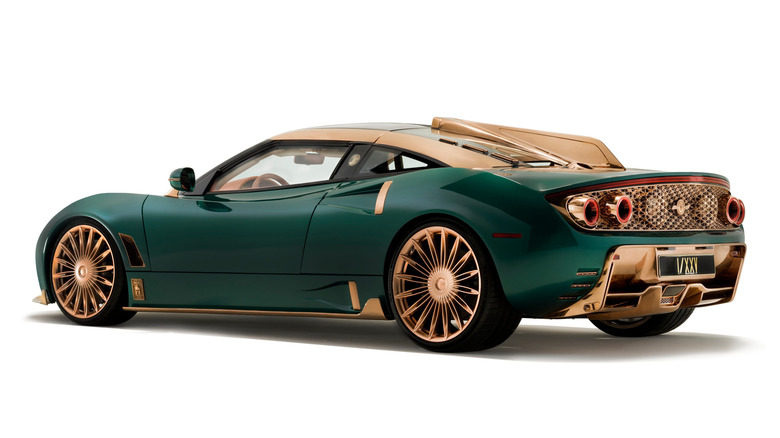
Spyker made a stunning return to the automotive world in August, unveiling its wild new C8 Preliator XXV Coupe during Monterey Car Week. The company's revival started in October 2025 when co-founder Victor Muller secured the rights to the firm's name after it went bankrupt for a second time in 2021. So, Spyker is back, and now it's aiming at the upper echelons of the market. Is Spyker's third time finally the charm?
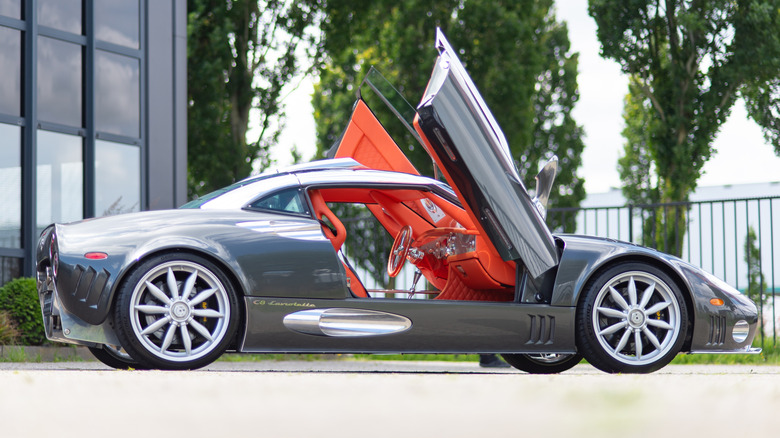
In the early 2000s, the Dutch automaker found success selling its hand-built models, including the C8 Laviolette and C8 Spyder, using Audi-sourced V8 engines. Eager to expand its presence, Spyker acquired the Midland F1 team in 2006 and competed throughout the 2007 championship as Spyker F1. Its diversion into F1 wasn't a success. The same can be said about Spyker's purchase of Saab. Spyker secured an agreement with GM to purchase Saab for $394 million in 2010, but less than a year later, Saab's cash reserves ran dry and was forced to stop production and went bankrupt. Spyker itself fell into bankruptcy for the first time in 2014, and then again in 2021 after what seemed to be a promising resurgence.
In an exclusive interview with CarScoops, Muller has blamed the company's expansion into Formula 1 and its acquisition of Saab as the cause of its previous "setbacks." Now with a renewed focus on building limited-run, high-end automobiles, the company has seemingly rediscovered its mojo. It's returned at the perfect time.
Spyker will start delivering new cars next year
Wealthy collectors and car enthusiasts are happily dropping millions of dollars on exclusive supercars and hypercars, unlike at any other time in the past, shunning EVs and demanding traditional driving thrills. Spyker has secured fresh funding for its rebirth and has already finalized engineering of the new C8 Preliator XXV Coupe. Deliveries will start in the second quarter of 2027. By the end of next year, all 25 units will have been built.
"We will position ourselves at the very top of the market, where Pagani, Koenigsegg, Bugatti, and Gordon Murray Automotive are the established brands," Muller told CarScoops. "We do not have to convince buyers that Spyker offers something genuinely different, because it already does. We have clearly set ourselves apart through our design, our attention to detail and the outstanding craftsmanship of our workforce. The brand's heritage, dating back to 1880, complements that picture."
Although there's plenty of competition in the high-end automotive space, Spyker is confident it can stand out. According to Muller, "there are only a handful of authentic hypercar brands that qualify as boutique brands: companies that have either been around for a very long time, such as Bugatti and Spyker, or were founded more recently, such as Pagani and Koenigsegg." According to him, "most others are not here to stay."
Buyers are lining up
The Dutch company doesn't have ambitions to produce hundreds of vehicles. In fact, "Spyker will build 50 cars for the entire global market" in a good year, Muller told us, and it has more than enough willing buyers to sustain itself.
"There is a clearly defined group of buyers who are drawn to Spyker's distinctive aviation-inspired design, our craftsmanship and our Dutch identity. There are plenty of these buyers, and we only need a handful of them each year. We will never be a mass producer," Muller added.
The new C8 Preliator XXV Coupe is more in line with what you'll find in a Pagani but doesn't promise the same kind of neck-snapping performance as something like a Koenigsegg or a Bugatti. It's powered by a twin-turbocharged 4.0-liter V8 with 800 horsepower and 737 pound-feet (1,000 Nm) of torque. This engine is coupled to a six-speed manual transmission driving the rear wheels. Just like a Pagani, Spyker's attention to detail is mesmerizing, and, as it did in the past, it continues to use hand-formed aluminum panels. Each Preliator will take roughly 2,100 hours to build.
What's next for Spyker? Well, the company is remaining tight-lipped about future product plans. But Muller is confident it can stick around this time.
"Success for Spyker means building a long-term, sustainable business, fed by new designs and new models for years to come," Muller said. "The single biggest obstacle would be a global downturn that affects even the wealthiest buyers. We do not expect that to happen in the foreseeable future, so if we stay the course, we should be in a very good position for the long term."