

Why Those Massive Concrete Walls Line So Many Highways
They may not be pretty, but they serve a useful purpose.
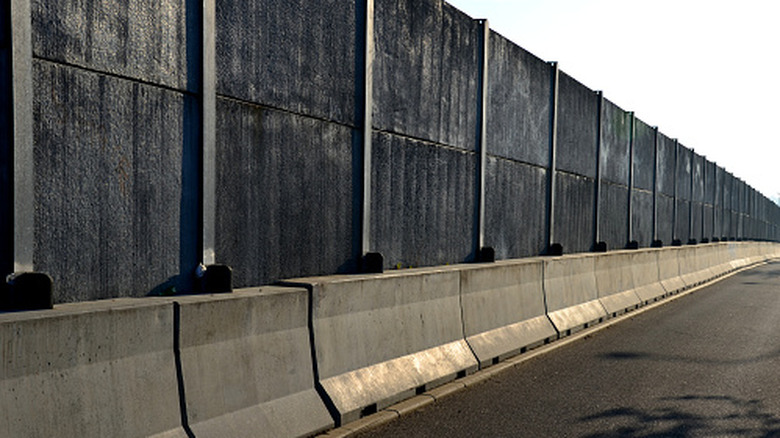
You are probably familiar with the sight of massive concrete walls on the side of the highway, particularly when driving through populated areas. But why are those sections so much taller than regular highway barriers? Are they designed for safety, privacy, or something else?
If your house is surrounded by a massive highway, the traffic roar of engine hum and tire noise can become unbearable over time. A large number of cars and trucks passing by at high speeds creates a type of loudness that won't let you have a comfortable conversation, concentrate at work, or even go to sleep. There are ways to minimize road noise in the cabin, but what about for people outside your car who live near the highway?
Thankfully, engineers have found a way to reduce noise by building concrete walls. They do a better job of suppressing unwanted sounds than scattered trees and vegetation, significantly reducing perceived noise in nearby areas.
Besides concrete, the walls can be made out of earth, wood, metal, or glass, as the main requirement for the material is to be rigid and dense without any holes or spaces in order to properly block sound. Earth is the most effective option, but it requires the most space and material volume.
How high should they go?
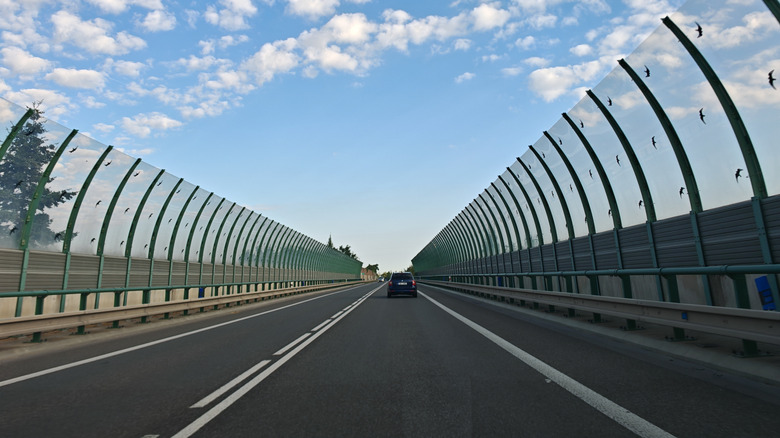
According to the Federal Highway Administration, a wall that goes up to the line of sight — in other words, blocking the view of the highway from the place it's shielding from sound – is enough for a 5 dB noise reduction. Every meter of height above that brings loudness down by another 1.5 dB. Still, walls should normally stay under 25 feet in height, as anything higher would lead to structural challenges, increased material costs, and wouldn't be pleasing to the eye.
The same agency suggests that barriers can reduce the perceived noise in houses and apartments within 200 feet of the road. This explains why you only see walls in places where the highway goes right through populated areas.
Keeping as much of the noise pollution within the road lanes might be a priority, but wall barriers can also serve other purposes. Examples include keeping wildlife from crossing a particular stretch of tarmac, protecting people from flying chunks of metal, or hiding the passing traffic from direct view in places of interest.
A different Federal Highway Administration study says the United States had 2,748 miles of highway noise barriers in 2010, with an estimated cost of $5.44 billion in 2010 dollars, which is $10.88 billion in 2026. Of course, these numbers have likely increased further over the past 16 years, as additional walls have been built along highways next to houses, residential apartments, and office buildings.