

Ferrari Revives Challenge Stradale Name For A Hardcore, Non-Hybrid 296
Ferrari ditches the hybrid for the street-legal 296 Challenge Stradale, shedding weight and piling on downforce to create the ultimate track toy.
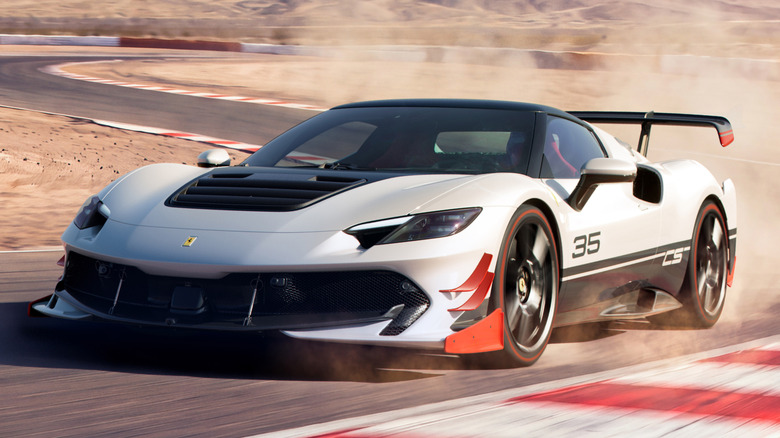
Ferrari has revived one of the coolest nameplates of its modern era, creating the wildest and most track-focused variant of its entry-level supercar yet. The new 296 Challenge Stradale is a roadgoing version of the updated 296 Challenge Evo racecar, adopting motorsport-inspired aero and chassis upgrades while ditching the plug-in hybrid system for pure V6 power.
The spiritual successor to the 360 Challenge Stradale from the '00s prioritizes mechanical simplicity, lightness, and handling prowess over outright power.
Starting with the exterior, the front end is distinguished by the pronounced splitter, the larger ducts on the hood, and the dual canards on the bumper. The tail has also been redesigned with a fixed rear wing, side fins, dual tailpipes, and a more complex diffuser with integrated spoilers.
According to Ferrari, the new aero components, the fully enclosed underbody and five pairs of vortex generators allow the 296 Challenge Stradale to produce 617 kg (1,360 lbs) of downforce at 250 kph (155 mph). This represents an increase of 72% compared to the 296 GTB, and 42% compared to the 296 Speciale.
The first non-electrified street-legal 296
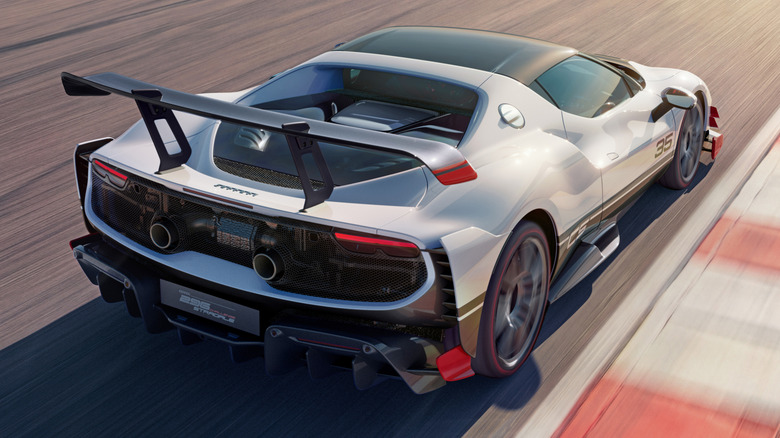
The Challenge Stradale is the first roadgoing member of the 296 family with a non-hybrid powertrain, mirroring its track-only sibling. The electric motor and the high-voltage battery are gone, letting the twin-turbo 3.0-liter V6 do the work by itself. The dry-sump engine gains hardware from the Ferrari Challenge race program, generating 661 hp (493 kW / 670 PS) and 740 Nm (546 lb-ft) of torque. Power is routed to the rear wheels through an eight-speed dual-clutch F1 gearbox.
While it can't match the combined output of the plug-in hybrid 296 GTB (819 hp) and 296 Speciale (868 hp), the Challenge Stradale is faster than both of them around the track. More specifically, it laps Fiorano in 1'18”500, which is 2.5 seconds faster than the 296 GTB and 0.5 seconds faster than the 296 Speciale.
Besides the new aero, this is largely due to its 1.98 kg/PS power-to-weight ratio. By saying goodbye to electrification, the Challenge Stradale strikes a dry weight of 1,330 kg (2,932 lbs), which is 140 kg (309 lbs) less than the 296 GTB and 80 kg (176 lbs) lighter than the 296 Speciale. Removing the hybrid system was no easy task, as Ferrari had to engineer a mechanical A/C compressor, a Belt Starter Generator with alternator and starter functions, and a new driveline.
Of course, they didn't forget the sound, with a Challenge Stradale-specific exhaust and an optional non-homologated track-only exhaust system to rival the notoriously loud 360 Challenge Stradale.
Interior and chassis upgrades
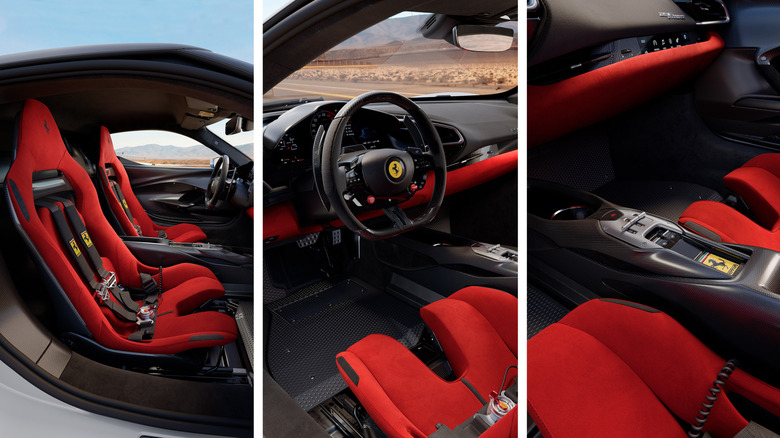
The diet continues inside the cabin, with single-piece door panels and central console made of carbon fiber, and an optional set of carbon seats borrowed from the SF90 XX Stradale. There is also the option of an exposed-chassis interior trim that strips carpets and under-seat paneling. Still, the model retains amenities like wireless charging, ADAS, dual cameras, and Matrix LED headlights.
As for the chassis setup, the suspension comprises recalibrated semi-active dampers with nearly doubled spring rates, motorsport-derived helper springs, and bespoke Pirelli P Zero R or Trofeo RS tires. Ferrari claims that stability has improved by 34% compared to the 296 GTB, with a 68% reduction in the roll gradient.
In a similar context, the electronic suite has been revised for the best possible lap times. The model gets a new track-tuned predictive slip control system, an F80-derived Ferrari Integrated Vehicle Estimator (FIVE), and ABS Evo operating across all five Manettino modes. Beefier carbon ceramic brakes measuring 398 mm (15.7 in) up front and 380 mm (15 in) at the rear complete the revisions.
As for straight line performance, the Challenge Stradale matches the 0-100 kph (0-62 mph) acceleration of the Speciale at 2.8 seconds. However, it is a full 0.9 seconds slower in the 0-200 kph (0-62 mph) sprint, completing it in 7.9 seconds.
Ferrari didn't announce pricing for the Challenge Stradale, but Autocar reports it will cost around the same with the 296 GTB.
What about the 296 Challenge Evo race car?
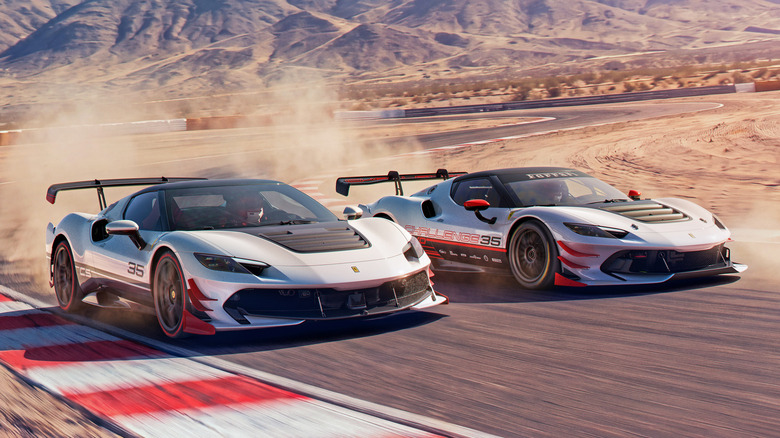
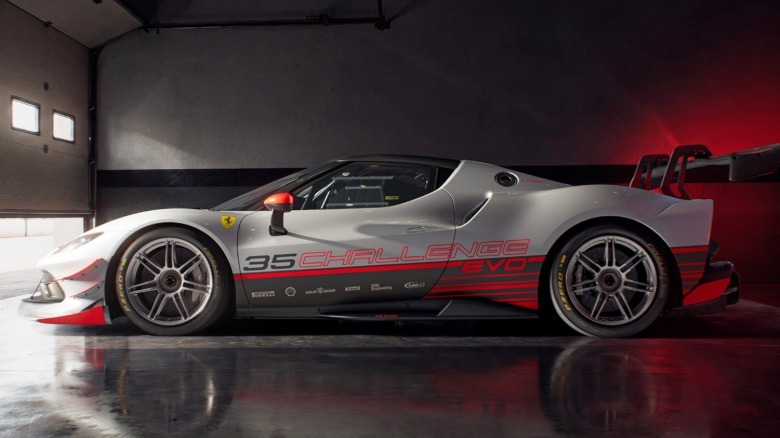
The 296 Challenge Evo is the successor of the racing model originally introduced in 2023. It shares the non-hybrid twin-turbo V6 with its predecessor, producing 690 hp (515 kW / 700 PS) and 740 Nm (546 lb-ft) of torque, mated to a seven-speed dual-clutch gearbox.
The biggest difference in the Evo is the redesigned aero. The team made changes to the front splitter, bumper, mirrors, underbody, adjustable rear wing and rear diffuser, allowing the racecar to produce 12% more maximum downforce compared to the outgoing 296 Challenge. There is also the option of increasing rear ride height by up to 10 mm (0.4 in) for a further boost in downforce. In the opposite direction, teams have access to a Low Drag kit for faster tracks, which cuts drag by 4% by removing two flicks from the bumper and one nolder from the wheel arch.
 Ferrari
The Challenge Evo rides on 19-inch wheels shod in slick tires, and has larger brakes compared to its roadgoing counterpart. Furthermore, it has a stripped out cabin with a roll cage, a racing bucket, a removable F1-style steering wheel, custom switches on the center console, and an optional passenger seat for coaching.
According to Ferrari, the 296 Challenge Evo is 0.8 seconds faster than its predecessor at the Mugello track. The new racecar will debut in the 2027 Ferrari Challenge Seasons in Europe and North America before expanding to regional series in 2028.