

What Is Top Tier Gas, And Is It Really Better For Your Car?
As the name implies, Top Tier gas meets more than the minimum standards.
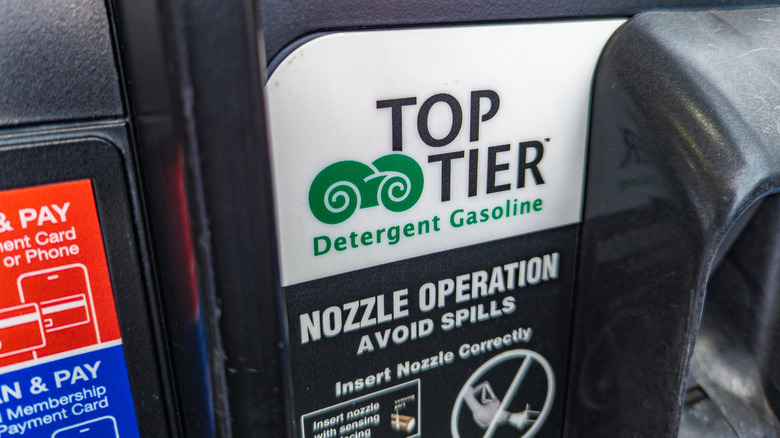
If you want your vehicle's engine to run at its best, live a long and healthy life, and stay as fuel-efficient as possible, you may want to start paying closer attention to the fuel you use. No, we're not talking about reaping the benefits of premium gas rather than regular, but about gasoline that meets the Top Tier standard. Tests show that using Top Tier gasoline can have a significantly positive impact on an engine.
What exactly is Top Tier gasoline? General Motors, BMW, Toyota, and Honda developed it in 2004 as a high-detergent gasoline. You see, the gasoline you pump into your car isn't only gas, or a gas/ethanol mix. Retailers also treat the gas they sell with different chemical additives, or detergents, to prevent or eliminate light carbon deposits from important engine components.
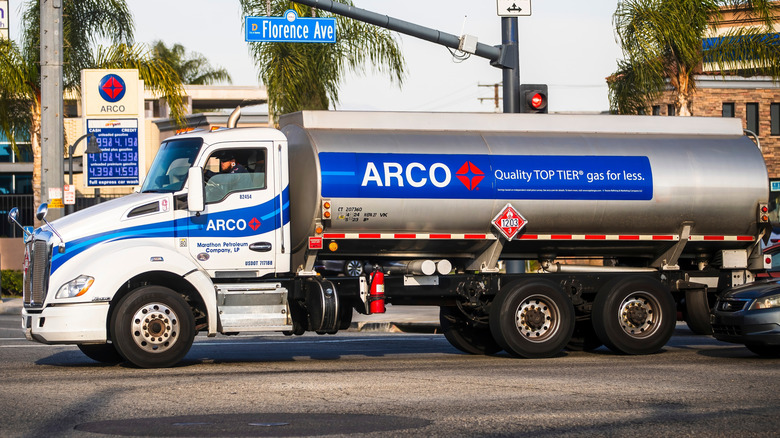
This new Top Tier standard arrived eight years after the EPA established minimum detergent requirements to combat higher carbon buildup in fuel-injected cars than from traditional carburetors. For carmakers like GM and BMW, these standards didn't go far enough, so they created their own. Only certain gas retailers in the United States sell Top Tier gas with these more potent additives, including Arco, Chevron, Mobil, Reeders, Exxon, Fast Fuel, Texaco, Sunoco, and over a dozen others.
Top Tier gas cuts down carbon deposits
In 2016, AAA conducted an in-depth investigation to see what difference Top Tier gas can have. It purchased Top Tier and non-Top Tier gasoline from a southern Texas market. Dyno runs can prove an engine's horsepower, but they can also test many other things. In this case, researchers tested an engine on a dynamometer for 100 hours, the equivalent of 4,000 miles of real-world use. Researchers then stripped down the engine and measured the thickness of the carbon deposits left on the intake valves, injectors, cylinder heads, piston tops, and throughout the combustion chamber. They found that using Top Tier gasoline reduced carbon deposits by an extraordinary 19 times.
Another test in the same study showed that switching to Top Tier gasoline can positively affect an engine that was previously operated almost exclusively on non-Top Tier gasoline. AAA first tested an engine on poorer-quality fuel for 10,000 miles to build up carbon deposits. It then stripped down the engine, measured the carbon, and reassembled it without cleaning it. The engine was then fueled with Top Tier gasoline and run for an additional 5,000 miles before being stripped down again. Researchers found the additives reduced existing intake valve deposits by 45% to 72%. The study also found running an engine for an extended period with non-Top Tier gasoline can lead to rough idle, hesitation, possible knocking/pinging, and reduced fuel economy.
The downside of Top Tier gasoline is that it's slightly more expensive. AAA's analysis determined that this high-quality fuel is typically three cents per gallon more expensive than non-Top Tier brands. If you can afford to pay that little extra, it's well worth it. The new Top Tier+ standard has even higher specifications for today's smaller direct-injection engines with forced induction.