

Ford F-150 Coyote Vs. EcoBoost: Which Is Superior For Towing?
Performance numbers don't tell the whole story.
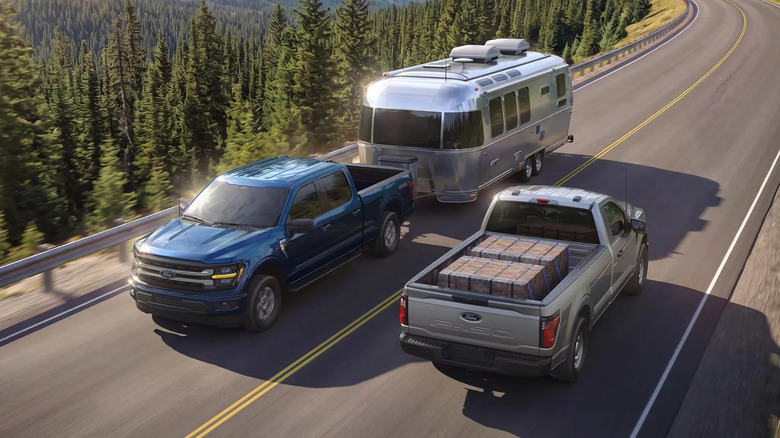
When configuring a 2027 Ford F-150, buyers face a dilemma between the twin-turbo 3.5-liter EcoBoost V6 and the naturally aspirated 5.0-liter Coyote V8. Both engines have the same maximum horsepower rating and are mated to Ford's 10-speed automatic transmission. However, their personalities are different, raising the question of whether displacement is always the answer for hauling heavy loads.
According to Ford's official spec sheet, the 3.5-liter V6 generates 400 horsepower at 5,250 rpm and 500 pound-feet of torque at 3,500 rpm. The 5.0-liter Coyote V8 matches that 400 hp peak figure, although it is being delivered higher up at 6,250 rpm. Furthermore, the maximum torque of the naturally aspirated V8 is 410 lb-ft at 4,250 rpm. That's 90 lb-ft lower than the twin-turbo V6, and the Coyote delivers it 750 rpm higher.
When properly equipped, the 3.5-liter EcoBoost has the highest towing rating of the entire F-150 lineup. More specifically, the SuperCrew 4x4 trim can tow 13,500 pounds with the optional Max Tow/Haul Package and Max Tow Axle.
On the other hand, the 5.0-liter Coyote V8 tops out at 12,800 lbs, which is 700 lbs less. Payload follows suit, with the EcoBoost reaching 2,440 lbs compared to the Coyote's maximum of 2,235 lbs.
Real-world towing and fuel efficiency
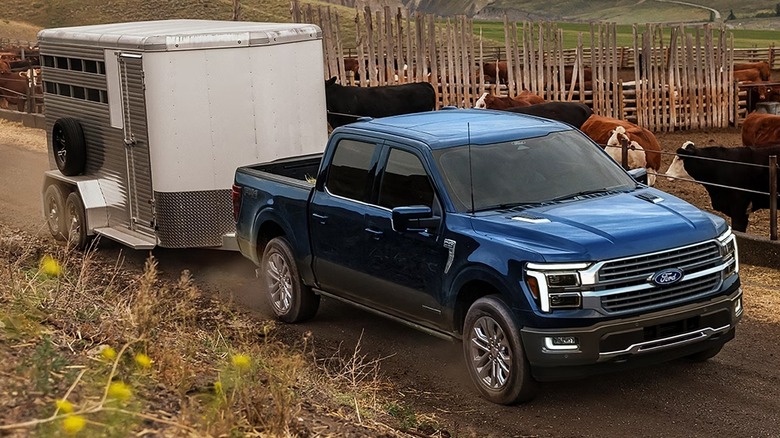
The twin-turbo setup and the availability of peak power and torque figures lower in the rev range mean that the smaller 3.5-liter EcoBoost will pull effortlessly off the line. It is also expected to hold higher gears up grades. Though for safety reasons, it would be best not to tow 1 million pounds, and stick to recommended capacities.
The 5.0-liter V8 will likely need more revs and more frequent downshifts on steep climbs. Still, its larger displacement and 12.1:1 compression ratio provide stronger natural engine braking on descents. Another detail worth mentioning is that naturally aspirated mills have a disadvantage in the thinner air at high elevations. As reported by Garrett Motion, N/A engines lose 3% of their power per 1,000 feet of altitude. The EcoBoost engine can simply spin up the turbos to maintain boost and maximum power.
EPA figures for 2027 aren't out yet, but when comparing equivalent 4x2 trims for 2026 models, the 3.5-liter EcoBoost V6 edges out the Coyote V8 at 20 mpg combined versus 19 mpg combined. While that single mpg advantage looks appealing on a window sticker, it translates to minimal savings at the pump. The owner's driving manners have a greater impact on fuel economy than engine choice.
What's the best option?
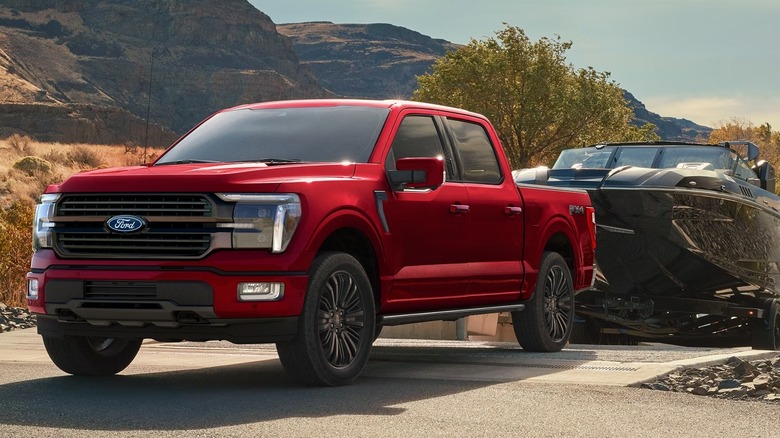
Ultimately, the 3.5-liter EcoBoost V6 is the superior towing tool for those who need maximum capabilities, thanks to its low-end torque and better fuel economy. However, the naturally aspirated Coyote V8 remains the best choice for buyers who intend to keep their truck past 100,000 miles, avoiding the thermal stress and long-term maintenance hurdles of the twin-turbo intercooled V6.
The 2027 Ford F-150 lineup also includes a new entry-level 3.0-liter EcoBoost V6 with 325 hp and 400 lb-ft. Its 8,400-lb towing capacity is fine for smaller trailers, but you'll want to upgrade to unlock this truck's true potential. A 3.5-liter V6 PowerBoost hybrid producing 430 hp and 570 lb-ft is also available. Despite its higher output than the EcoBoost V6 or the Coyote V8, its 12,400-lb towing capacity is less than those engines, though not by much. Its added complexity only saves a few drops of fuel at 24 mpg combined.
Moving up the ladder, there is F-150 Raptor's High-Output EcoBoost with 450 hp, or the optional supercharged 5.2-liter V8 of the flagship Raptor R with 720 hp. They're faster trucks, but each one's towing capacity is under 9,000 lbs. Most buyers will likely stick to the mainstream V6 and V8 options for towing duties.