

Insurers Say Iowa's Phone Ban Prevented 470 Crashes, Give Or Take 20%
The law appears to be changing driver behavior, but the supporting data has notable limitations
- Iowa drivers appeared to use phones less after the hands-free law took effect.
- The study relies on modeled estimates, not verified crash reductions.
- Missing sample-size details leave questions about how representative the results are.
A year after Iowa's hands-free driving law took effect, new data from Nationwide Insurance and Cambridge Mobile Telematics (CMT) suggests drivers are spending less time interacting with their phones behind the wheel. That's encouraging news, but a closer look at the study reveals several unanswered questions that make its headline conclusions less definitive than they first appear. Let's break down what we know and what we don't.
What The Data Actually Shows
According to the companies, CMT analyzed more than 140 million trips between July 2025 and May 2026 and found that phone-motion distraction fell 6.9 percent while handheld calling dropped 6.2 percent. Nationwide's own opt-in SmartRide customers showed even larger declines, including a 13.6 percent reduction in screen tapping after full enforcement began. Yes, the app is tracking how often it's touched while customers are driving, but that's another subject on its own.
More: Pennsylvania Drivers Can Now Be Fined For Holding A Phone, Even A Dead One
The study estimates that those behavioral changes prevented around 470 crashes, 210 injuries, three fatalities, and more than $20 million in economic losses. However, that figure isn't based on actual crash counts. Instead, it was modeled using historical Iowa crash data alongside federal economic impact estimates.
A 20 Percent Margin Of Error
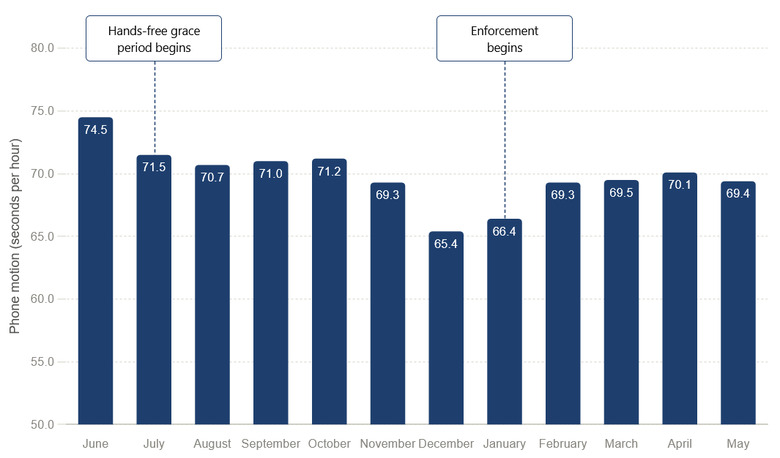
When Carscoops asked about the methodology, CMT acknowledged the analysis did not control for factors such as weather, traffic volume, fuel prices, or broader economic conditions. All of those can swing driver behavior. The company also clarified that the reported 470 prevented crashes carry a 20 percent margin of error. Read that number again, then reconsider how confidently anyone should be citing it.
Perhaps the biggest unknown is how representative the data actually is. While CMT analyzed 140 million trips, neither company could say how many unique Iowa drivers contributed those trips or what percentage of the state's motorists they represent. That's an important distinction, since millions of trips don't necessarily equate to a broad cross-section of drivers.
Promising, But Not Proof
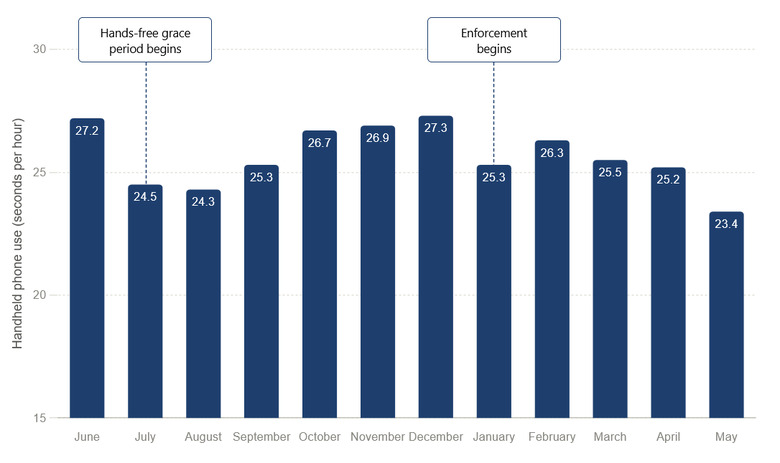
None of this means Iowa's hands-free law isn't working. Preliminary state crash data involving electronic-device distraction appears consistent with an improving trend, and both Nationwide's customer data and CMT's broader analysis point in the same direction. But until the underlying sample size and methodology are more transparent, the study is better viewed as compelling evidence of changing driver behavior than definitive proof of the law's overall safety impact.