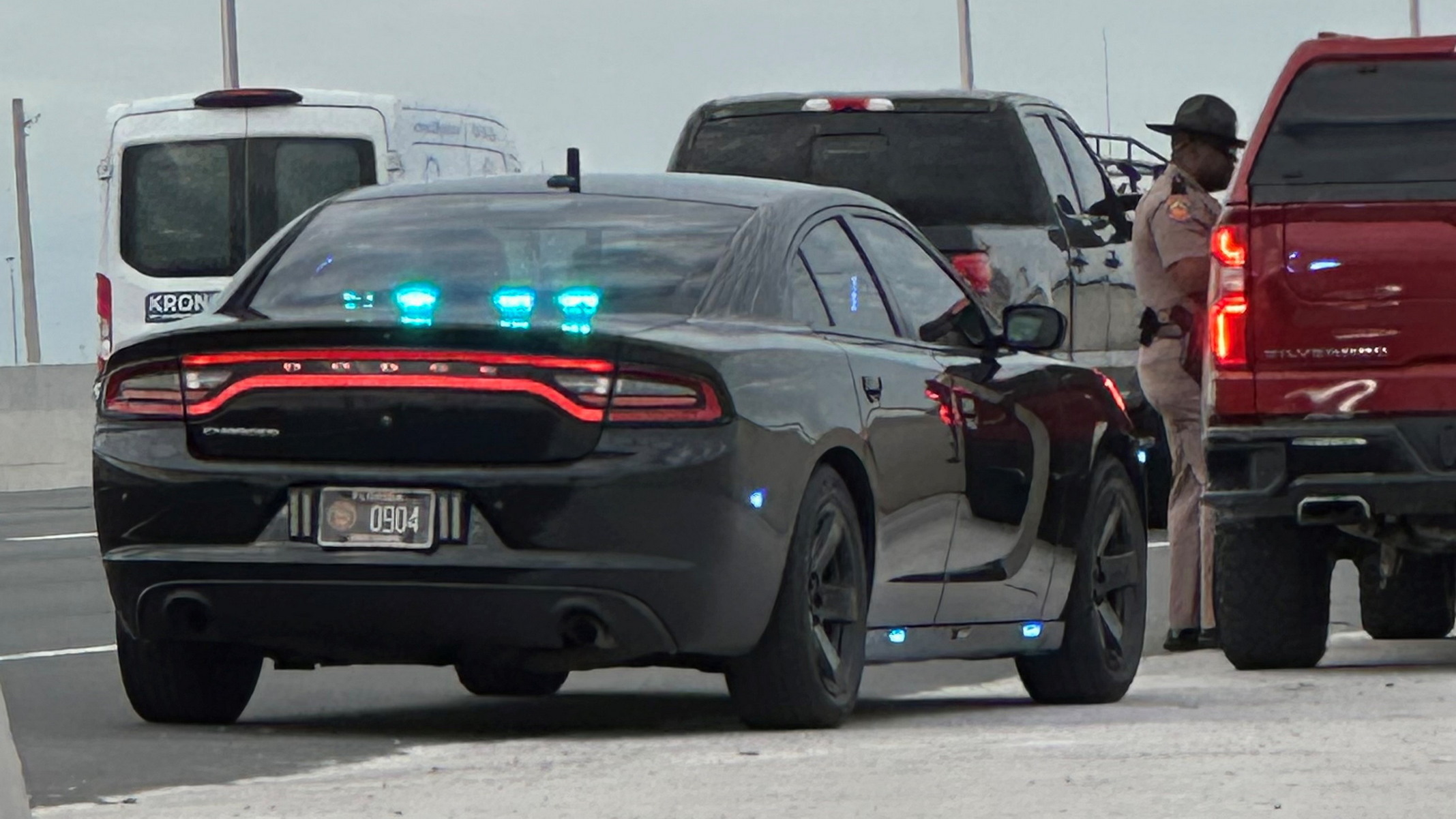











- Orange County deputies are stopping motorists who block the left lane.
- Florida law requires drivers being overtaken to move right when practical.
- Speed differences matter, but road design influences how drivers behave.
Florida drivers need to be especially careful to go at exactly, or very close to, the speed limit or risk a ticket. That’s essentially the message from local law enforcement after a new campaign targeting left-lane campers. The result is the opportunity for police to ticket either those going too slow or those overtaking at speeds above the limit. In terms of revenue generation, it’s a win-win. In terms of road design and speed limit-setting, it seems like a lose-lose.
Under Florida Statute 316.081, a driver on a road with two or more lanes in the same direction cannot continue in the far-left lane when they know, or reasonably should know, that a faster vehicle is overtaking them from behind. There are sensible exceptions for passing and preparing to turn left, but a violation is a moving infraction. The statute is at the heart of a recent enforcement campaign highlighted online by FHP.
Read: Florida Drivers Stunned As Dozens Jailed Under Harsh New Super Speeder Law
In a short video, the department emphasizes that the left lane is for passing only. Officers pulled over plenty of drivers for simply traveling in the left lane and cited several of them. OCSO is absolutely right in emphasizing the dangers of misusing the left lane. Drivers who can’t pass sometimes resort to more dangerous maneuvers and put everyone at risk. On top of that, speed differential is important as well. Federal highway research has repeatedly found that crash involvement rises as a vehicle’s speed departs from the surrounding traffic stream, whether it is faster or slower.
Speed Variance Cuts Both Ways
That doesn’t make a left-lane camper morally equivalent to somebody doing triple digits, but it does explain why a rolling roadblock can lead to sharp braking, frustrated lane changes, and increasingly dumb decisions. FHWA research has linked greater speed variance with higher crash involvement, too. But Florida is an interesting case given its infrastructure and emphasis on arresting those caught doing 100 mph, or 50 mph over the limit.
That threshold comes from House Bill 351, the so-called Super Speeder law that took effect on July 1, 2025, and created a criminal offense called dangerous excessive speeding, punishable by up to 30 days in jail and a $500 fine on a first conviction, rising to 90 days and $1,000 for repeat offenders.
The state essentially asks drivers to police themselves on roads that appear as though they were designed for a much higher figure than the speed limit sign suggests. Wide, flat, multi-lane arterials with broad shoulders, forgiving sightlines, and a parade of driveways can feel like safe places to increase speed. That’s largely because in some settings, with the right conditions, they can be safe to travel at very high speeds.
More: Florida Showed A Corvette Driver What 85 MPH Over The Speed Limit Gets You
Drivers are responsible for their choices. Full stop. But if a road’s geometry tells half the traffic to cruise at one speed while the signs and enforcement tell them another, then the resulting mess is not solely a driver problem. It is infrastructure offering mixed instructions, then acting surprised when people interpret them differently.