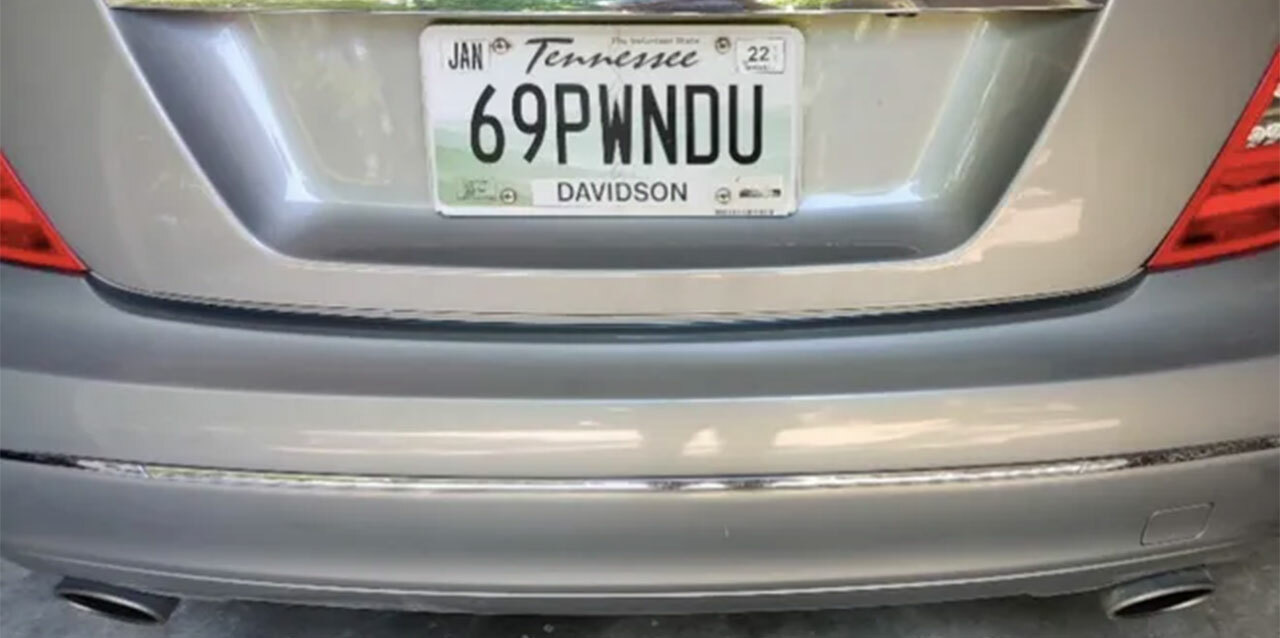
- Tennessee revoked Leah Gilliam’s ‘69PWNDU’ plate in 2021 citing inappropriate meaning.
- Her lawyers rejected a Tennessee Supreme Court decision siding with state officials.
- Court ruled vanity plates count as government speech, not personal free expression.
It’s not uncommon for state officials across the US to reject or revoke personalized license plates that they deem offensive. However, a woman in Tennessee is so upset that her personalized plate was revoked in 2021, that she is now taking her case to the US Supreme Court. That sounds like an awful lot of effort over a plate, but according to the woman, the state is violating her free speech.
Read: We Laughed Really Hard At Some Of The Banned Florida License Plates
The plate in question reads ‘69PWNDU’ and was approved for use by Leah Gilliam from Nashville in 2010. The plate references the ‘pwned u’ phrase used by gamers, while Gilliam says the 69 is in reference to her phone number. However, the plate was revoked in May 2021 with the state alleging it referenced ‘sexual domination,’ according to The Tennessean.
Free Speech or Government Speech?
Gilliam first challenged the decision in the Tennessee Supreme Court, but the court sided with the state. The justices ruled that personalized plates are considered government speech, not private expression, which means they fall outside First Amendment protection.
Her legal team argues the ruling sets a dangerous precedent. If plates are government speech, they warn, authorities could allow slogans supporting one political party while rejecting those supporting another, creating a system ripe for viewpoint discrimination.
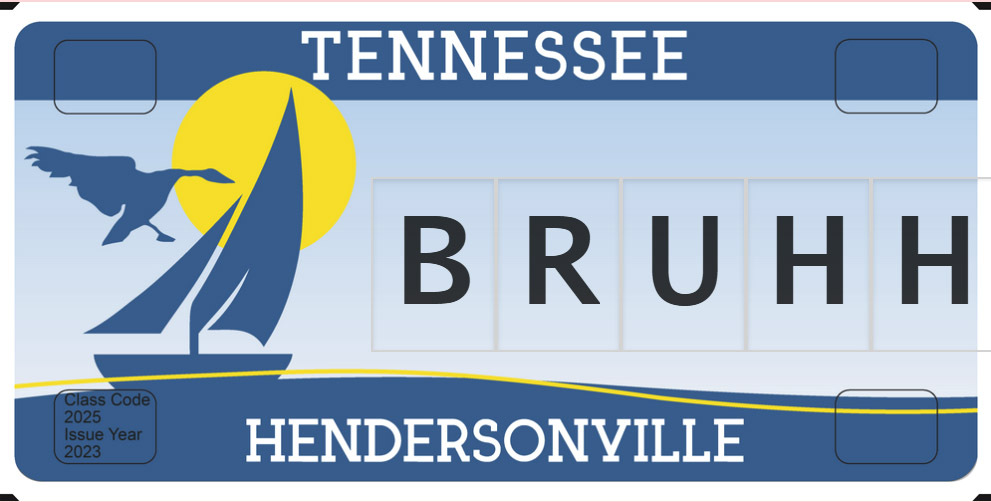
A Patchwork of Rules
The lawyers also point to inconsistencies across state lines. “Intervention is needed promptly, given that a car owner’s First Amendment speech rights change when she moves states,” the lawyers said in the Supreme Court. “The same personalized plate that appears on cars in Maryland, Oregon, Delaware, Rhode Island, Kentucky, California and Michigan can be prohibited in Tennessee, Indiana and Hawaii.”
For example, Texas blocked a driver from displaying “JAIL 45,” aimed at Donald Trump, while Michigan rejected “OSUSUCKS” for football rivals. Arizona allowed “JESUSNM,” yet Vermont stopped “JN36TN,” shorthand for John 3:16. The result is an inconsistent patchwork of what counts as acceptable expression.
Beyond the Bumper
The Tennessean reports that there are approximately 60,000 personalized plates in the state and that roughly 1,000 have been rejected since 1998. The lawyers assert that one reading personalized license plates believes they are messages from the state, and are instead simply “messages from car owners, not Tennessee.”
According to groups including the Foundation for Individual Rights and Expression and the First Amendment Lawyers Association, if the Tennessee court’s decision is “allowed to stand, [it] will cause constitutional injuries reaching beyond the bumpers of vehicles registered in Tennessee.”