













We’ve grown accustomed to how quickly electric cars evolve, but few models illustrate that pace of change as clearly as the latest iteration of Audi’s e-tron GT. What is essentially Audi’s halo EV has been completely reengineered in just a few short years. This isn’t your usual mid-cycle refresh, and Audi isn’t pretending it is.
Read: Audi Gave Up On The A2, Now It’s Making The Q2 e-Tron To Win You Back
Sales of the original e-tron GT kicked off in Europe back in mid-2021, though Australian deliveries didn’t begin until late 2022. Fast forward just over 18 months, and Audi has already rolled out a completely new e-tron GT line-up, one so far ahead of its predecessor that even the latest base model now outguns the previous RS flagship in power.
QUICK FACTS
This new model went on sale Down Under towards the end of 2025, and we recently had the opportunity to live with the flagship model in the range, the all-new RS e-tron GT Performance. I was not prepared for what I would discover.
What’s New?



Photos Brad Anderson/Carscoops
Most would agree that the e-tron GT is an extraordinary piece of automotive design. We’d argue it’s the best-looking EV on the market, and one of the finer-looking sedans of the past decade. However, the original RS version just didn’t look special enough.
Aside from minor visual tweaks, the flagship version looked virtually identical to the base model, which was somewhat disappointing for an RS-branded car. Audi appears to have addressed these complaints and, for the 2026 RS e-tron GT and RS e-tron GT Performance models, has ensured they stand out from the base version.
Also: All Future Audis Will Have This Grille, Mustache Memes Be Damned
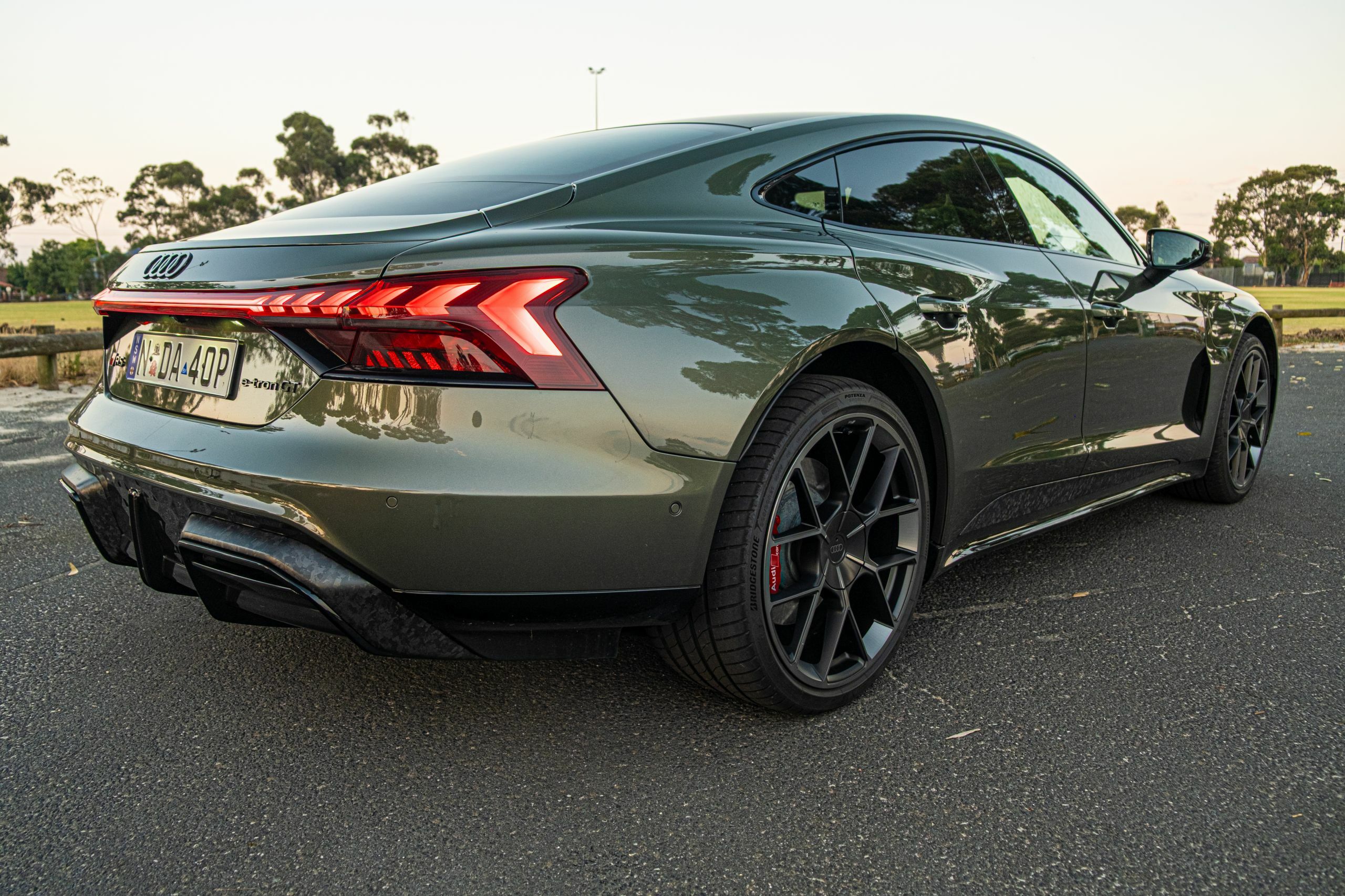
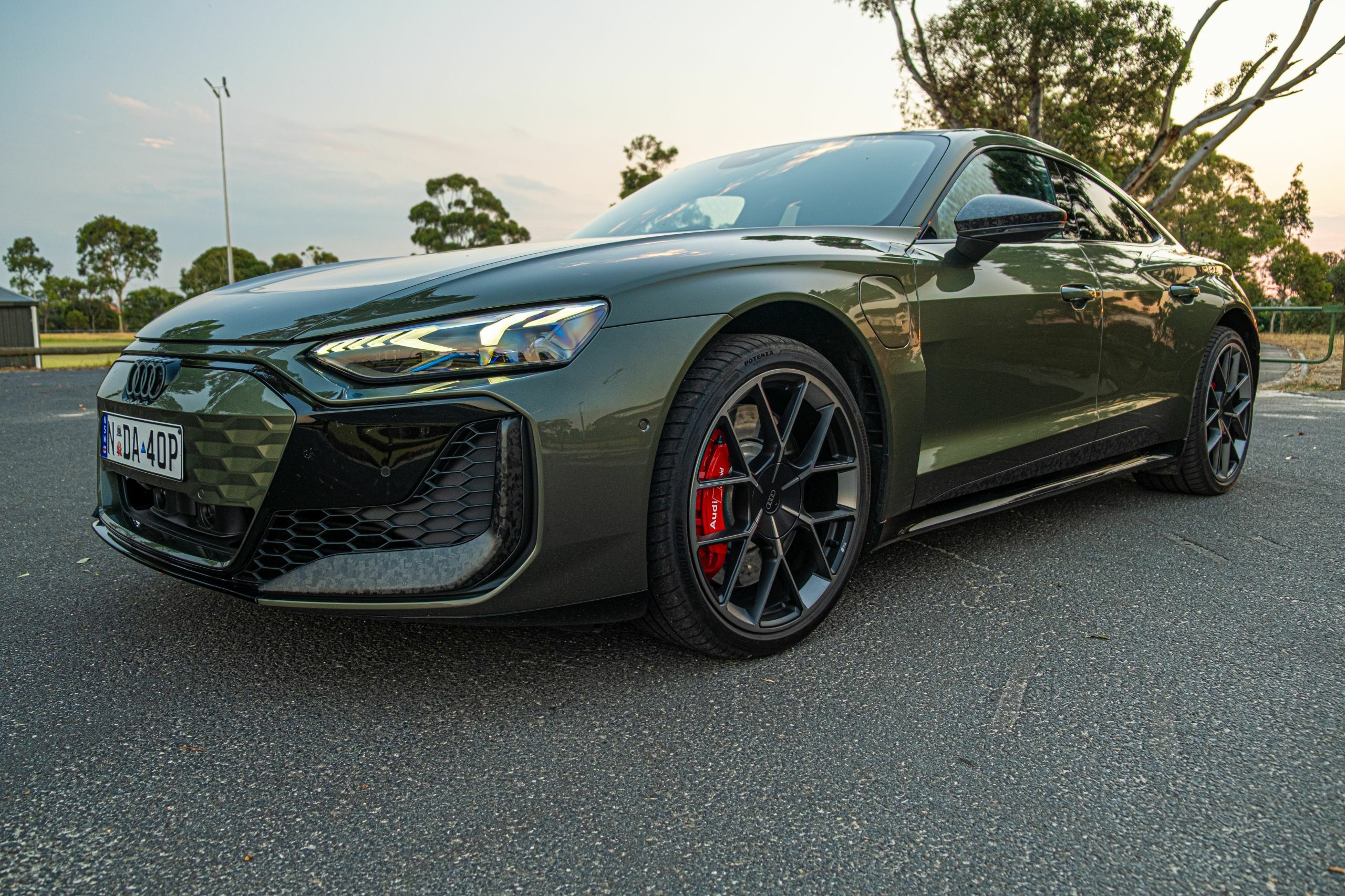
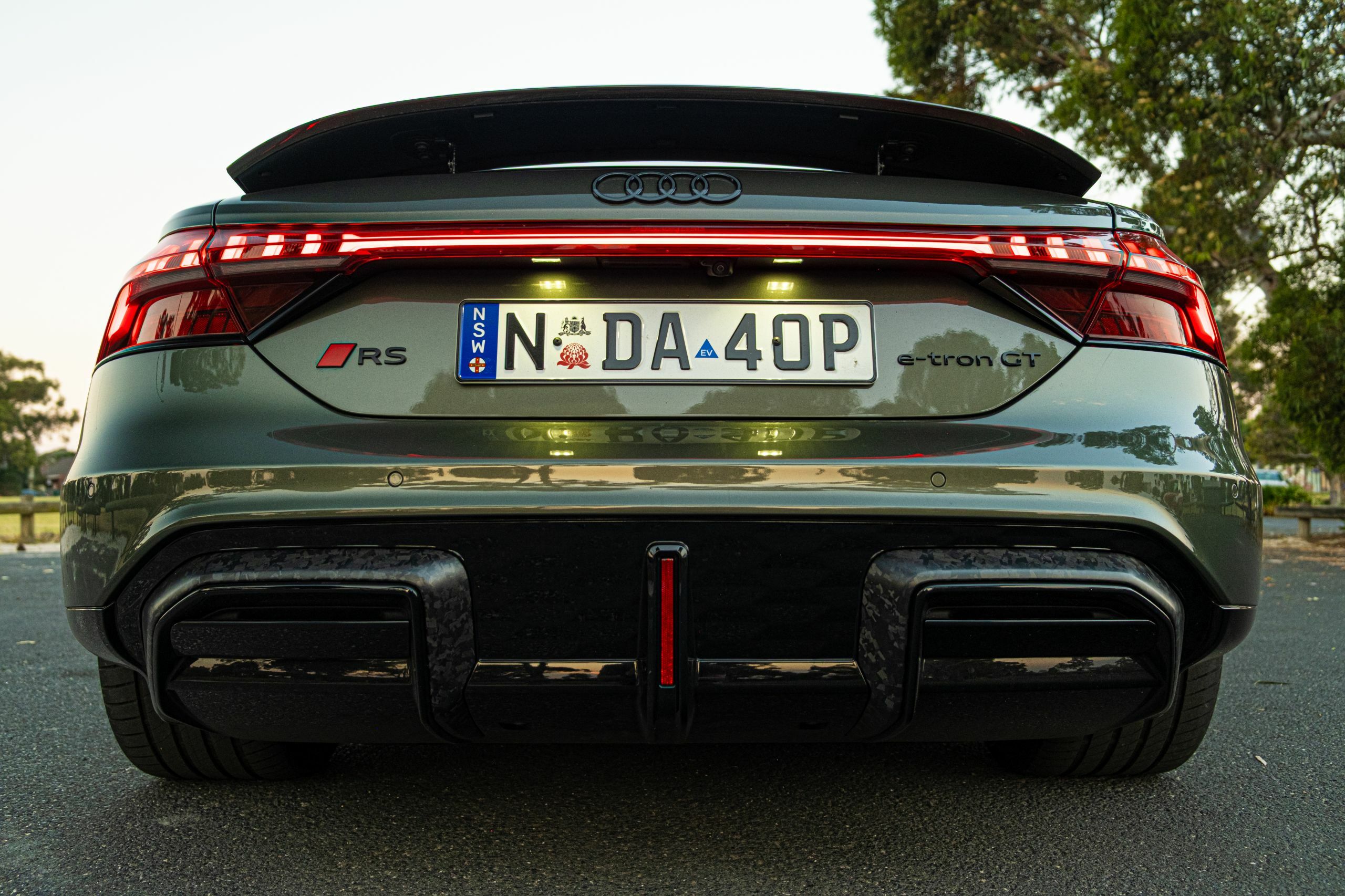
The most obvious updates are found at the front. While the same basic grille has been retained, the front air intakes are now more aggressive, with a forged carbon fiber finish, as on our test car. The bold new touches continue at the rear with a bespoke diffuser, also finished in forged carbon, and a set of unique six double-spoke 21-inch wheels.
An Updated Powertrain
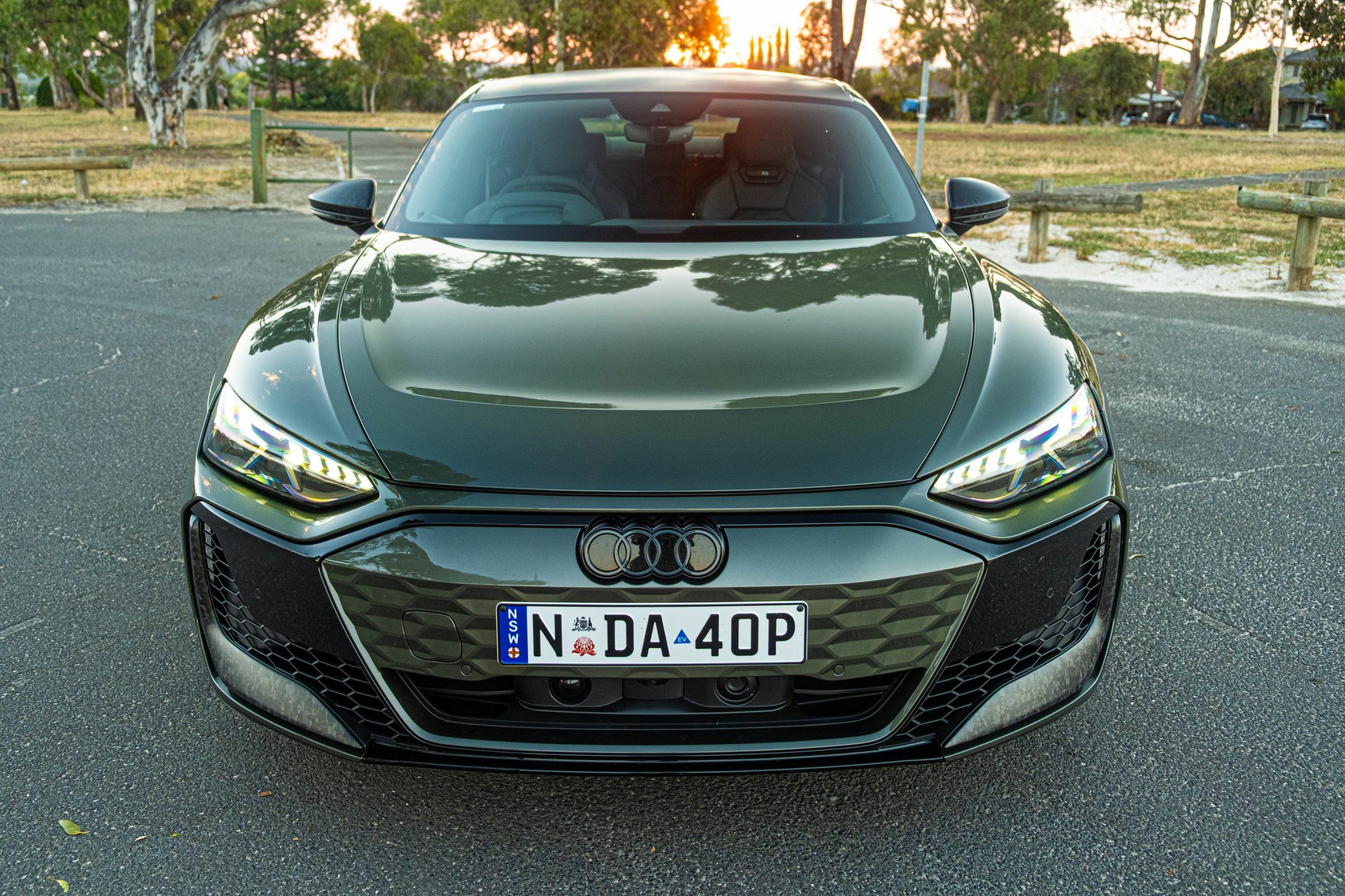
These updates are welcome, but they pale in comparison to the changes that Audi has made under the skin. The 84 kWh battery pack of the old model has been removed and replaced with a larger 97 kWh battery that weighs 9 kg (19.8 lbs) less. Additionally, all three e-tron GT versions now support DC charging speeds of up to 320 kW, a welcome boost from the 270 kW of the old model.
Read: 2025 Audi RS e-tron GT Performance Has 912 HP, Hits 62 MPH In 2.5 Seconds
Then there’s the power. The base S e-tron GT has 500 kW (670 hp) and 717 Nm (529 lb-ft) with launch control, allowing it to hit 100 km/h (62 mph) in 3.4 seconds and drive 558 km (347 miles) on a charge. The mid-tier RS e-tron GT is rated at a peak of 630 kW (845 hp) and 865 Nm (638 lb-ft), running to 100 km/h in 2.8 seconds and boasting a driving range of 522 km (324 miles).
The daddy of the line-up is the RS e-tron GT Performance we tested, Audi’s equivalent to the refreshed Taycan Turbo S. It peaks out at 680 kW (912 hp), 1,027 Nm (757 lb-ft) of torque, and can hit 100 km/h in a claimed 2.5 seconds. It does all of these while boasting a range of 528 km (328 miles). It’s not cheap, however. In Australia, prices for the flagship start at AU$309,900 ($216,800), though our test car included several options, bringing the total to AU$324,400 ($226,900).
A Cabin To Remember


Photos Brad Anderson/Carscoops
The interior of the new RS e-tron GT Performance is largely the same as the pre-facelift model, but does benefit from some updates. These include a new flat-bottom and flat-top Alcantara steering wheel with bright red Boost and RS buttons.
Our tester was also fitted with the AU$4,500 ($3,100) performance design package, adding several green accents and Nappa leather. It also included the AU$10,000 ($7,000) Matt carbon camouflage package, which adds forged carbon to the exterior, side sills, dashboard, and door panels. The look of the carbon won’t be to everyone’s tastes, but it’s certainly striking.
Review: The 2024 Audi RS e-tron GT Will Warp Your Sense Of Reality
Most touchpoints are excellent, and the cabin carries a premium feel. Still, much of the switchgear and lower-grade plastics come straight from less expensive Audi models, which is somewhat disappointing given the car’s sky-high price tag.
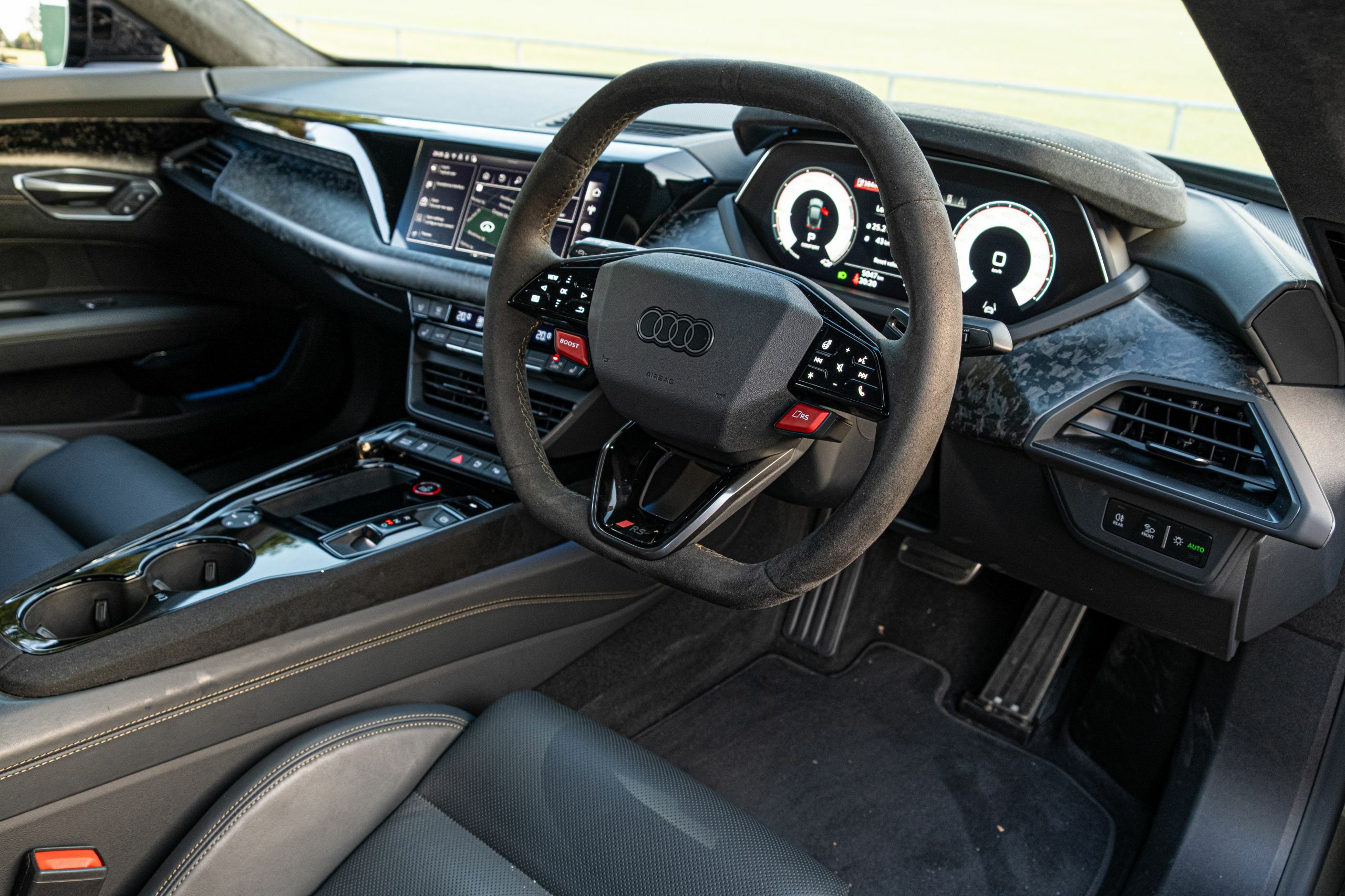
Among the key features carried over from the pre-facelift model are the superb RS-branded front seats, the 10.1-inch infotainment display, and the 12.3-inch digital instrument cluster. There’s wireless Apple CarPlay and Android Auto, a thumping 16-speaker Bang & Olufsen audio system, and among the finest front seat massage functions of any car currently on sale. To put it simply, the RS e-tron GT is a joy to spend time in.
Read: Audi Design Boss Wants To Remove Big Screens From Future Models
Perhaps the most obvious downside of the incredibly good looks and that swooping roofline is that headroom in the rear isn’t great for tall adults. It also feels a little sparse back there with just a pair of USB-C ports and simple fan speed controls.
Unrelenting Acceleration


Photos Brad Anderson/Carscoops
Heading into my week with the RS e-tron GT Performance, I knew it was going to be the quickest car I’d ever driven. But nothing could quite prepare me for this EV’s ferociousness off the line, and yet its plushness and comfort during daily driving.
As mentioned, Audi quotes a 0-100 km/h time of 2.5 seconds. Try as I might, I was never able to match that with my GPS timer, recording a best time of 2.63 seconds, covering the sprint to 100 km/h in just 39.1 meters (129 feet). If you can actually feel the difference between 2.63 and 2.5 seconds, congratulations, you might be part stopwatch. As for what that kind of speed feels like? Absolutely brutal.
Pin the throttle and the Audi throws you back into the seat, building speed in a way that is truly terrifying. Like the original e-tron GT, this new model retains a two-speed transmission. While the original shifts into second gear at around 85 km/h (53 mph), the flagship Performance model will hold first gear for as long as possible, enabling remarkable acceleration.
During my testing, it felt like the car changed into second gear at around the 120 km/h (75 mph) mark, and when it does, the EV accelerates even faster, as if it’s a spaceship getting sucked into a black hole. It’s absolutely mesmerizing. Remarkably, the car delivers this performance while struggling to put all its power to the ground.
Regardless of whether the ESC is on, in Sport mode, or disabled entirely, the car will spin all four wheels to beyond 100 km/h, leaving faint black tire marks in its wake. I have no doubt that if I had been able to find a grippier piece of tarmac to reduce wheel slip, a 2.5-second run would have been achievable.
Chassis Changes


Photos Brad Anderson/Carscoops
Equally impressive as the way the RS e-tron GT Performance lurches forward is the new active suspension system. It builds upon the already remarkable setup of the old car, using technology similar to what’s found in the facelifted Porsche Taycan.
There’s trick air suspension working alongside two-valve dampers that eliminate the need for traditional anti-roll bars. In Comfort mode, the system is so advanced that it can actually lean the car into a corner, while in one of the RS modes, the suspension activates to eliminate even the slightest hint of body roll. Yes, despite the car weighing 2,330 kg (5,137 lbs), it has an uncanny ability to remain flat, even during high-speed slaloms.
I was offered my first taste of this system when I unlocked the car for the first time. As soon as I opened the driver’s door, the ride height quickly jumped up a couple of inches, making it easier to get in. When exiting, the same thing happens. It’s a neat party feature that can be disabled if owners prefer not to have it.
Read: Audi’s 2026 A5 And Q5 Fix One Of Its Most Annoying Interior Decisions
Presented with a mountain road, the car absolutely shines. Fitted with 265/35 front and 305/30 Bridgestone Potenza Sport tires, the RS e-tron GT Performance can speed through corners beyond what some potent sports cars can do, with very little fuss. It’d take a very brave soul to push this thing to its limits on the road, and it probably needs to be driven on a track to be fully appreciated.
As with before, the comfort is also superb. With the suspension in one of the softer settings, the e-tron GT soaks up bumps better than any other Audi, oftentimes making potholes and speed bumps feel almost non-existent. It honestly beggars belief how comfortable the car is on long journeys. An all-wheel steering system also ensures it’s easy to drive in tight urban areas and parking lots, reducing the risk of curbing those inevitably very expensive wheels.
All of the incredible performance comes at the expense of efficiency. Audi quotes efficiency of 21 kWh/100 km, and while I was able to match that figure, it’s slightly higher than the old car. But, just like you shouldn’t buy an Audi RS6 Avant expecting it to be fuel efficient, the Performance isn’t the type of EV you should buy if you want to eke out as much range as possible.
See: Audi Driver Hits 190 MPH On Public Road, Then Shows It To The Cops On TikTok
Critiquing the car’s handling is rather difficult. Some may find the steering to feel overly assisted and unnaturally sharp, but I grew accustomed to it very quickly.
One frustrating issue I experienced with the parking sensors is that they beep incessantly and loudly, as if you’re about to hit something, even when there are several inches of clearance. There were also a couple of occasions when the rear-cross traffic alert system was engaged while I was reverse parking, even though there was no risk of hitting anything.
Verdict
The e-tron GT remains the best EV that Audi currently produces, and the flagship RS e-tron GT Performance provides true supercar-levels of performance, making it one of the most engaging and enjoyable EVs to drive, too.
The additional performance Audi has added is extraordinary, but it comes at a cost. The old flagship started at AU$246,875 ($172,700), or more than AU$63,000 ($44,000) less than the new one. That’s a sizeable price hike, regardless of the changes made. If this new model follows the same depreciation curve as the pre-facelift model, it could be an absolute bargain in a few years.


