- Vehicles assembled in Canada face effective tariffs of 12 to 13 percent.
- Those rates sit close to tariffs on cars imported from Japan and Korea.
- U.S.-built vehicles gained market share as Canadian output slipped.
The Trump administration’s controversial tariff regime appears to have contributed to a drop in vehicle production in Canada, alongside a rise in the number of new cars built in the United States. Little wonder, then, that the Canadian government is hoping it can convince Chinese brands to start assembling cars on its soil.
The Center for Automotive Research (CAR) reports that Canadian vehicle production dropped 15 percent year-over-year through April. It’s understood that factories in Canada built approximately 64,000 fewer vehicles through April than the year prior, while US production rose by roughly 44,000 units, or 1.2 percent.
CAR chief economist Tyler Harp presented the findings during the organization’s annual Management Briefing Seminars in Ypsilanti, Michigan.
Read: Detroit Automakers Slashed Canadian Production, Setting Up Tense Union Talks
According to Autonews, Harp said that vehicles built in Canada face effective tariff rates of between 12 and 13 percent, even though many of them feature more than 50 percent US content. These tariffs are largely on par with those of other countries, like the 15 percent levies applied to vehicles manufactured in Japan and South Korea.
Automotive Parts Manufacturers’ Association president Flavio Volpe explained that USMCA exemptions for compliant Canadian and Mexican parts cover direct exports only, not the same parts once they’re bolted into a finished vehicle headed for the US. The upshot is that a Canadian-built car can still draw a hefty tariff even when a good chunk of it was made in America.
Production Cuts
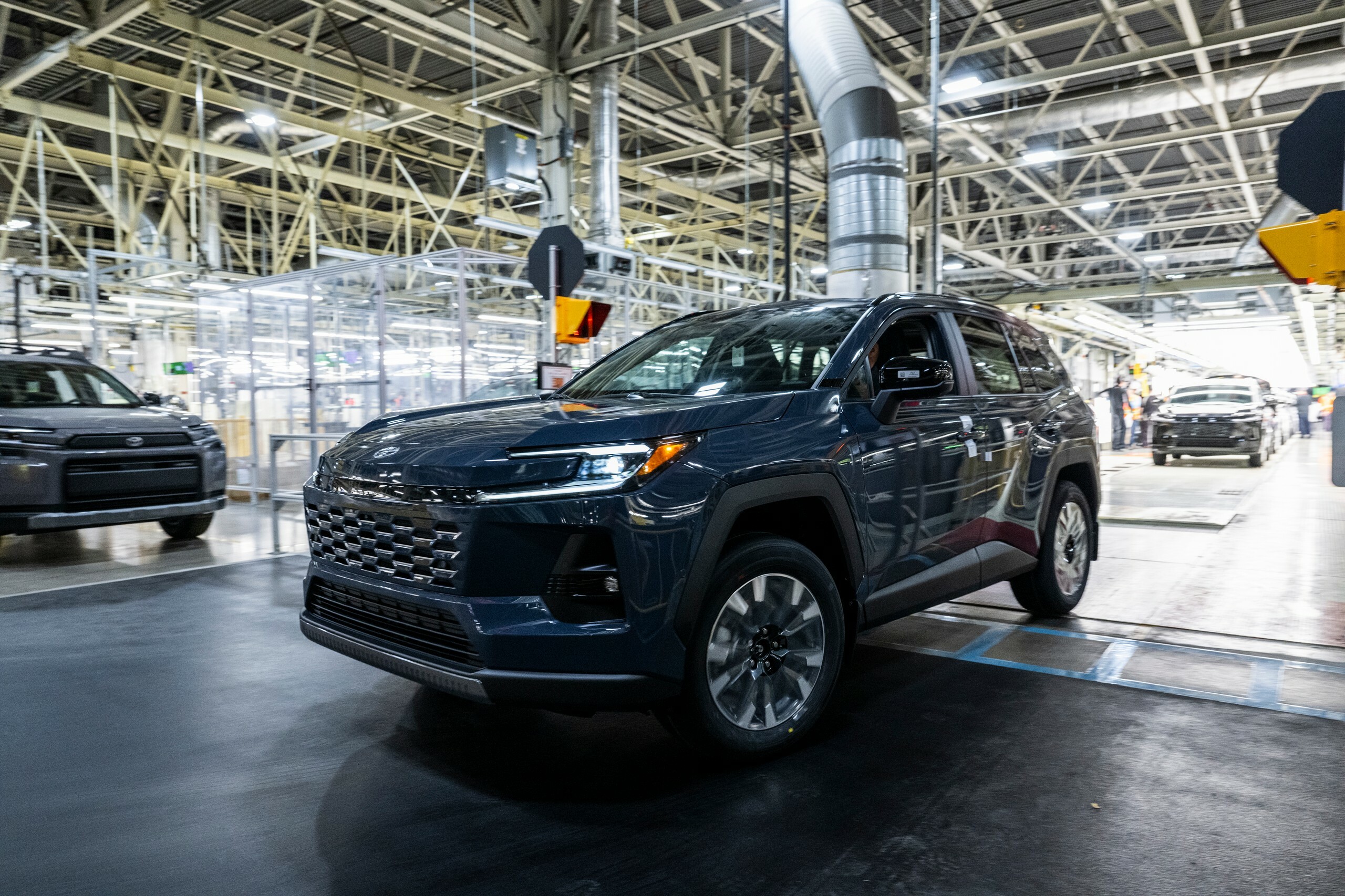
Not all the vehicles that Canada has lost are now being built in the United States. As reported by Auto News, GM has completely halted production at the CAMI Assembly Plant in Ontario following the axing of the BrightDrop delivery van. In addition, Toyota’s Ontario plant, responsible for building the RAV4, experienced several weeks of reduced output while shifting to the new-generation model.
Nevertheless, US-built vehicles have increased their market share by 5.94 percent, while Canada has accounted for 45 percent of losses from trading partners. Add Mexico into the mix, and the US’s two neighbors accounted for 69 percent of total market-share losses over the past year.
Harp said the tariff policy has had less impact on overseas imports and instead shuffled sales and production around within North America.
Things could get worse for Canada. The Automotive News Research & Data Center notes that many of the nation’s highest-volume vehicles endured a disappointing first quarter. For example, the changeover to the new-gen RAV4 saw its sales drop 47.9 percent, while sales were also down on the Chrysler Pacifica, Honda CR-V, Honda Civic, and Chevrolet Silverado, all of which are built in Canada.