










- The Flying Caduceus pioneered jet-powered land speed racing.
- The historic machine was withdrawn before the auction.
- Its influence extends to today’s fastest record-setting cars.
Some auction lots sell for millions. Others never make it to the auction block at all. That’s the story of the Flying Caduceus, a one-of-a-kind jet-powered land speed racer that helped change motorsports history and was expected to cross the block this month with an estimate of up to $90,000. Instead, the lot was quietly withdrawn, leaving enthusiasts wondering what happened to one of the most significant speed machines ever built.
Read: Colorado Deputies Stopped A 130-MPH Ford Disguised As A Cop Car
Offered by Bonhams as part of the National Automobile Museum Auction in Reno, Nevada, the 1960 Flying Caduceus carried an estimate of $70,000 to $90,000 and was scheduled to sell without reserve. According to the auction listing, however, the lot was withdrawn before the sale.
The First Of Its Kind
That outcome is especially interesting because the Flying Caduceus isn’t just another oddball Bonneville special. Conceived by Dr. Nathan Ostich in the late 1950s, it is widely regarded as the first purpose-built jet-powered land speed record car.



Photos Bonhams
At a time when piston engines still dominated speed-record attempts, Ostich envisioned a machine capable of exceeding 500 mph (805 km/h). In fact, the speedometer caps out at above 700 mph. Ostich’s goal presented challenges far beyond simply finding enough power.
The Real Enemy Was The Tires
The biggest obstacle wasn’t the engine. It was the tires. According to period accounts cited by the auction house, Ostich and his team realized that conventional tires would literally tear themselves apart at the rotational speeds required for a 500 mph run. Firestone eventually joined the effort, developing a specialized wheel-and-tire package capable of surviving the immense forces involved.
Power came from a General Electric J47-19 turbojet, a variant originally developed to give the Convair B-36 Peacemaker extra thrust on takeoff. America’s primary nuclear bomber of the early 1950s carried four of them alongside its six piston engines, and this one produced 5,200 pounds of thrust, the equivalent of around 6,930 hp. It sat within a four-foot-diameter tubular chassis wrapped in aluminum bodywork, with four-wheel independent suspension, disc brakes, and an eight-foot parachute rounding out the package.
A Legacy Bigger Than Its Top Speed
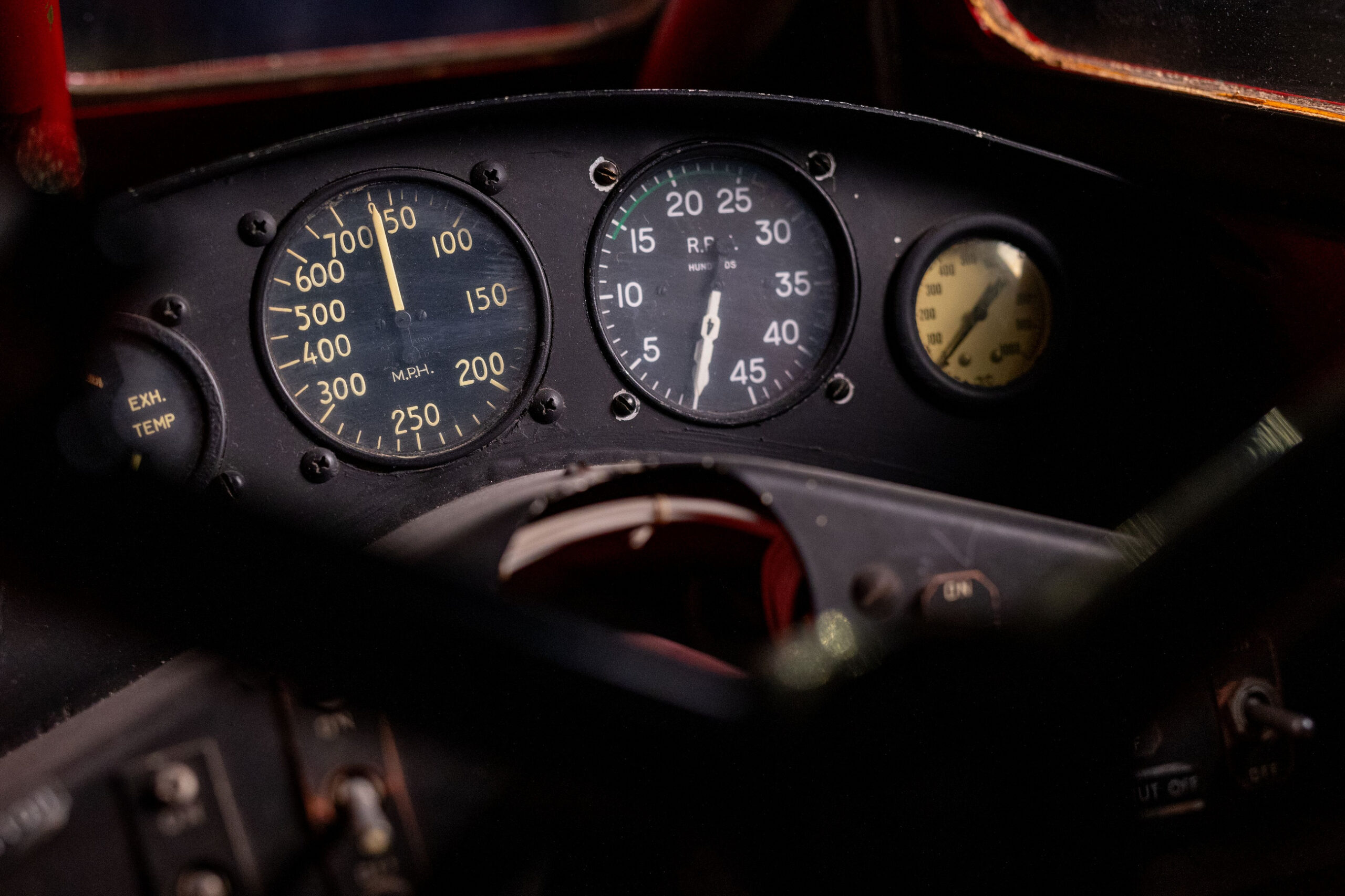
Although the Flying Caduceus never achieved its ultimate goal, it reached 359.7 mph (579 km/h) during testing and proved that jet-powered land speed cars were viable. That breakthrough helped pave the way for machines such as Craig Breedlove’s Spirit of America, Richard Noble’s Thrust programs, and ultimately Andy Green’s Thrust SSC, which remains the current land speed record holder.
In that sense, the Flying Caduceus may be one of the most influential vehicles you’ve never heard of. Whether it returns to auction or disappears back into private hands, its place in land speed racing history is already secure.