









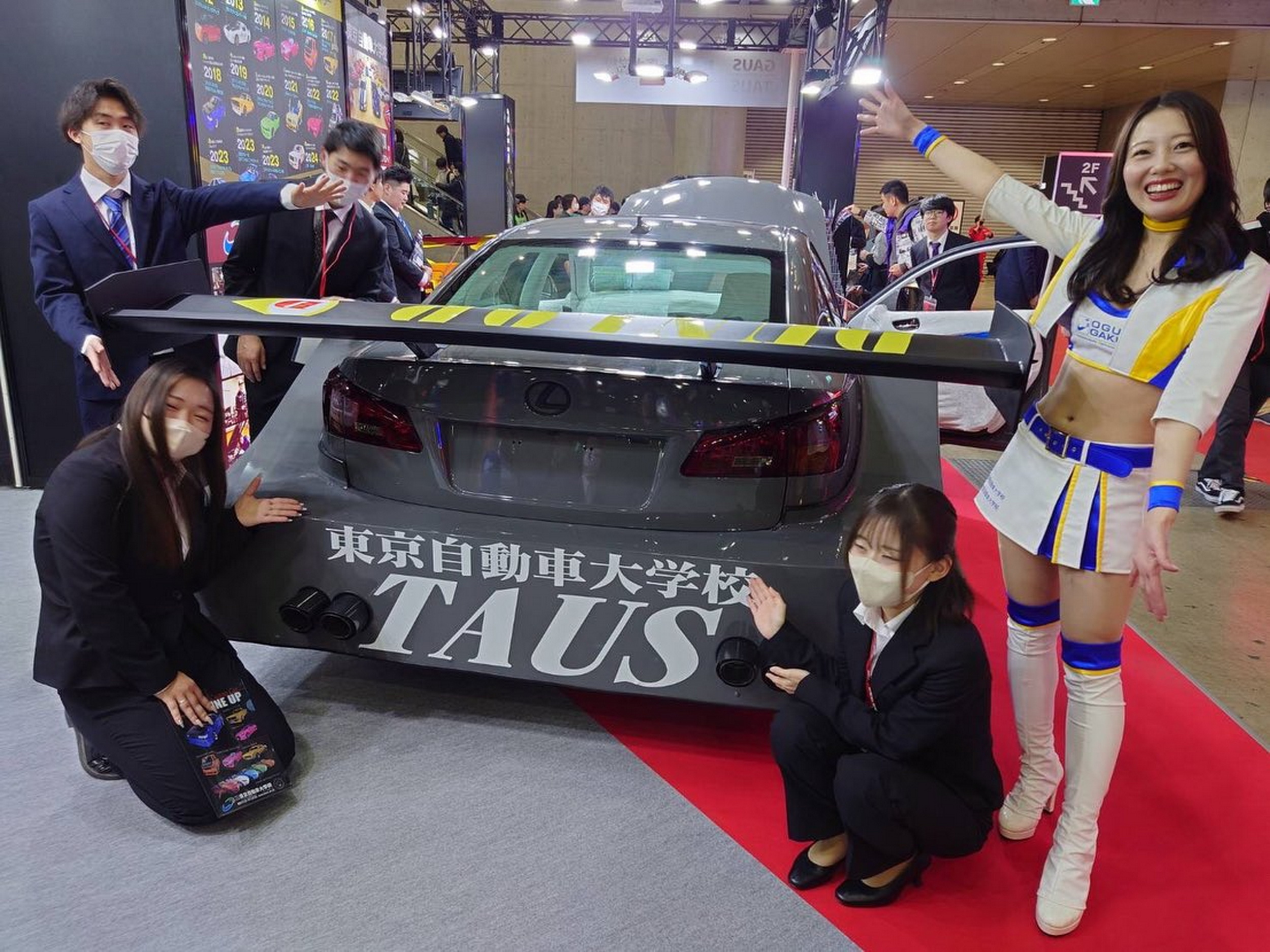
- The TAUS-HFRS is a Lexus IS with retro-inspired body styling.
- Its exterior reflects old Japanese culture and sharp angles.
- It debuted at the 2026 Tokyo Auto Salon as a design study.
Some car shows are all about polish and power, but the Tokyo Auto Salon has always left room for the earnestly bizarre. Automakers roll out wild concepts, tuners flaunt their latest Frankensteins, and wedged somewhere between the neon and carbon, students unveil what they’ve been cobbling together in classrooms and garages.
That’s where this Lexus comes in, a project from Kokura Gakuen Gunma Automobile College that looks less like a car and more like it was rendered in Minecraft, one block at a time.
More: Before Lexus Turns The LS Into A Minivan, They Turned A Minivan Into A Sedan
The project is named TAUS-HFRS, built on the bones of a second-generation Lexus IS sedan that was, depending on your perspective, either transformed or sacrificed. The idea? Blend Japan’s automotive past, present, and future by taking a car from the Heisei era (1989–2019), dressing it in bodywork styled after the Showa era (1926–1989), and finishing the interior with cues from the Reiwa era (2019–present).
Put another way, the concept was meant to bridge three distinct periods in Japanese car culture. And while we’re inclined to cut student builds a fair amount of slack, the final result is, visually speaking, a challenge.
Instead of the Lexus IS’s original, relatively smooth lines, the TAUS-HFRS wears a jagged, blocky bodykit painted in Chrysler’s Destroyer Gray. The front bumper is dominated by a single gaping intake, to the point where Lexus’ famously divisive spindle grille suddenly seems rather tasteful by comparison.



Bolt-on wide fenders aggressively overtake the profile, partially obscuring the aftermarket 18-inch wheels and rendering the rear doors largely ornamental. The rear end takes things even further, evoking a sedan that has been partially submerged in drying concrete.
Above that mass sits an electronically adjustable wing, joined by four exhaust pipes that jut from the bumper like oversized tailpipes on a cartoon rocket.
More: Only One Exists, And It Might Be The Smallest GR Supra Ever Built
The interior, while comparatively less chaotic, is still packed with student-applied flair. It includes white upholstery, a pair of Bride bucket seats, a TRD-branded sports steering wheel, and an infotainment screen mounted vertically in a Tesla-like configuration.
Mechanically, not much has changed. It’s still powered by a naturally aspirated 2.5-liter V6, delivering 272 hp (203 kW / 276 PS). The brakes remain factory-spec, and while it now rolls on slick tires, the only suspension modification is a set of cut springs to drop the ride height.
Learning Before Polishing
Yes, it’s easy to take shots at something this visually unconventional. But that misses the point. Projects like the TAUS-HFRS are how future designers, engineers, and builders get their start. By trial, error, and lots of zip ties.
Judging by the original sketches, which lean more toward race car than pixelated art project, the vision was bolder than the result. Still, there’s something endearing in its unfiltered ambition. Its unevenness might just be the most honest part.


Tokyo Auto Salon / Tokyo Automobile College
東京オートサロン2026へのご来場、TikTokLIVEのご視聴ありがとうございました‼️
— 専門学校 東京自動車大学校 (@T_A_U_S) January 13, 2026
自らの手で展示車両を制作し、来場者様に説明をするのは学生に貴重な経験となりました。
みなさまの温かいご声援ありがとうございました。
今後も東京自動車大学校の応援を宜しくお願い致します。#東京オートサロン pic.twitter.com/MDtOyK1PNG