


- Chrysler rejected Gandini’s design before it became the Cizeta-Moroder V16T.
- Prototype chassis 001 is the only car wearing the Cizeta-Moroder name.
- Just ten V16Ts were built, including this historically significant prototype.
Sometimes the best supercars begin with rejection. That’s exactly what happened when Chrysler reportedly passed on Marcello Gandini’s original design for the Lamborghini Diablo. Rather than letting the shape die, the legendary designer adapted it for an entirely different project, one centered around a transverse-mounted V16 engine. Now, that one-of-a-kind prototype is heading to auction.
Read: The 1988 Cizeta-Moroder V16T Is The Italian Supercar You’ve Never Heard Of
The 1988 Cizeta-Moroder V16T prototype, chassis 001, will cross the block at RM Sotheby’s in Monterey, California, as the most historically significant example of the short-lived supercar. It’s the only car to wear the Cizeta-Moroder name and one of just 10 V16Ts ever completed.
However, there’s a caveat, and it’s a big one. As a prototype, the car does not have a 17-digit VIN, which means it can’t be registered or driven on public roads and will likely live out its life as a collector’s showpiece rather than a weekend driver.
A Test Driver And A Movie Composer Walk Into A Garage



Photos: Karissa Hosek / RM Sotheby’s
The project was the brainchild of former Lamborghini test driver and engineer Claudio Zampolli, who left Italy for Los Angeles and opened an exotic car repair shop. There he befriended legendary producer Giorgio Moroder, and together they set out to build a supercar unlike anything else on the road. Moroder, the man behind several of Donna Summer’s biggest hits, had also collected three Academy Awards for his film scores.
The Cizeta name itself represents the Italian pronunciation of the initials C and Z, taken from Claudio Zampolli.
Sixteen Cylinders Behind The Cabin


Photos: Karissa Hosek / RM Sotheby’s
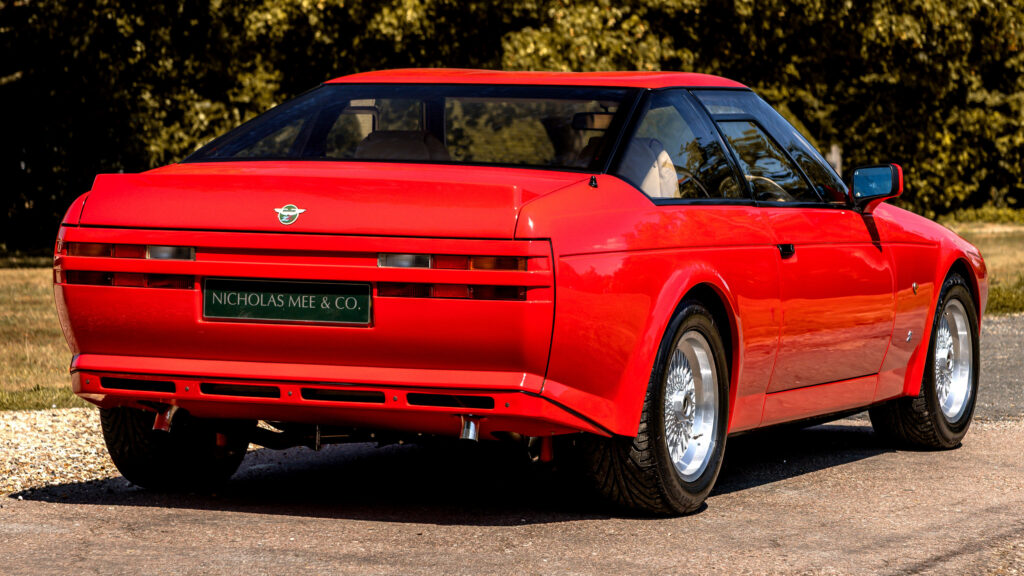
To grab headlines, Zampolli commissioned a 6.0-liter naturally aspirated V16 mounted transversely behind the cabin, paired with a five-speed manual. The engine reportedly made 540 horsepower at 8,000 rpm, breathing through 64 valves worked by eight overhead camshafts. Bodywork came from Gandini, whose resume already included the Miura, Countach, and Lancia Stratos. It featured four pop-up headlights and stretched three inches wider than a Ferrari Testarossa.
An archived Car and Driver test pegged the V16T’s estimated base price at $280,000 in 1989. Run that through inflation and you land near $772,000 in today’s money, which is genuine hypercar territory before the term existed. For a sense of what that meant at the time, a Ford Mustang LX 5.0 started at just under $14,000 that same year, and even Ferrari’s own Testarossa opened around $150,000. The Cizeta asked nearly double what Maranello’s flagship did, and it came from a company almost nobody had heard of.
The Diablo That Got Away


Photos: Karissa Hosek / RM Sotheby’s
The design itself has an equally fascinating backstory. Gandini had originally penned Lamborghini’s Countach successor, but Chrysler, which owned the Italian automaker at the time, reportedly insisted on softening the sharp-edged styling before releasing it as the Diablo.
Gandini disliked the revisions enough to walk away, later adapting many of his original ideas for the Cizeta. Ironically, Lamborghini continued celebrating Gandini’s designs while appearing to keep their creator at arm’s length. He revealed he wasn’t even consulted on the modern Countach revival until it debuted, later criticizing the retro supercar for betraying the philosophy of the original.
A Car Is Born, With Jay Leno Hosting


Photos: Karissa Hosek / RM Sotheby’s
Chassis 001 debuted in Los Angeles on December 5, 1988, during an event hosted by Jay Leno, while Moroder composed an original song titled ‘A Car Is Born’ specifically for the unveiling. The pearl white prototype features unique bodywork, lighting, mirrors, and a one-off red leather interior that differs substantially from the nine production cars built afterward.
Moroder eventually split with Zampolli before production began, leaving this prototype as the only example to wear the Cizeta-Moroder badge. He held onto it until 2022, after which it went through further restoration at Bruce Canepa’s workshop near Santa Cruz, where unfinished details were sorted out and the car was made ready for the road. It later showed up at the 2024 Pebble Beach Concours d’Elegance.
It’s a fascinating piece of automotive history. Had Chrysler simply signed off on Gandini’s original Lamborghini proposal, one of the wildest V16-powered supercars ever conceived may never have existed. Or maybe it would’ve had a Raging Bull badge on its nose. We’ll never know. You can check out the listing at RM Sotheby’s over here.