

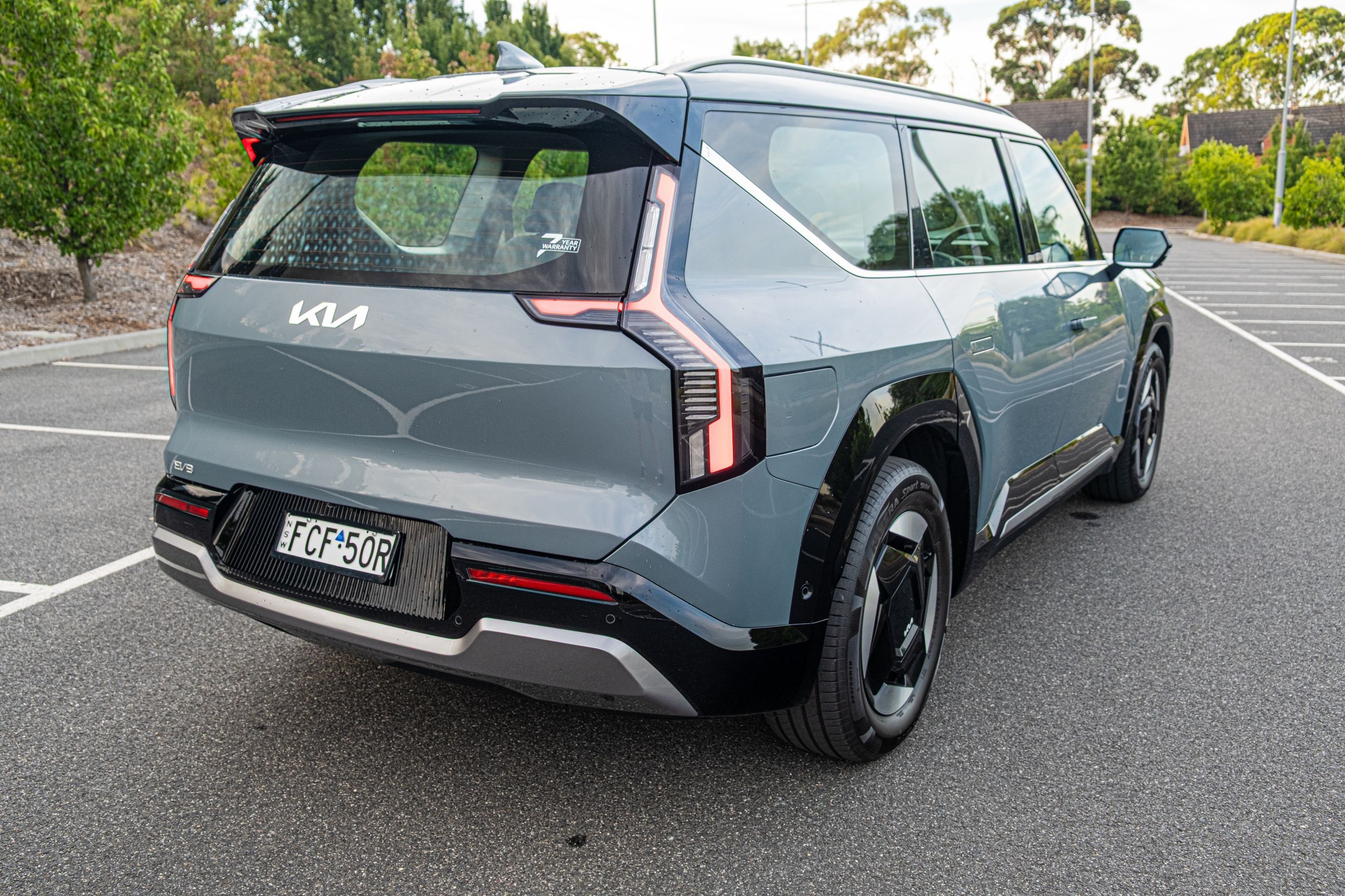
Kia’s EV9 arrived in Australia two years ago as the first fully electric SUV with three rows, and it didn’t try to blend in. The styling leaned hard into concept car territory, all sharp edges and presence, and it marked a turning point for the Korean brand as it pushed further upmarket. Locally, it wasn’t just another launch. It felt like a statement piece, and arguably the most important model Kia had put its name on in years.
In the two years since its launch, the segment hasn’t exactly exploded into life. Australia’s three-row EV space is still oddly thin, with only the Volvo EX90 and the sorted Hyundai Ioniq 9 joining the conversation so far. There’s also the looming arrival of the seven-seat Tesla Model Y L, which technically has three rows, in the same way a folding chair technically counts as living room furniture.
Review: The 2026 Ioniq 9 Calligraphy’s Biggest Threat Is Hyundai Itself
The question is, two years on, does the EV9 still hold the same appeal it had when it first launched, or has it been overshadowed by some of the newer competition? We spent a week with the mid-range Kia EV9 Earth to see where it now stands.
QUICK FACTS
Local prices for the EV9 have remained steady since the model’s introduction. While this is a good thing, it still remains pricey. The range starts with the Air, priced from AU$106,404 ($75,100) when factoring in all the on-road costs and fees, while the Earth we lived with kicks off from AU$119,273 ($84,231).
Then there’s the performance-focused GT, set to arrive shortly and expected to start just shy of AU$150,000 ($106,000). At that point, you’re not just shopping for a big electric SUV. You’re making a fairly serious financial statement.



Photos Brad Anderson/Carscoops
There’s a lot to like about the mid-range EV9 Earth on paper. It uses the same powertrain as the GT-Line, meaning there’s a 99.8 kWh battery pack and a pair of electric motors boasting 283 kW (380 hp) and 700 Nm (516 lb-ft) of torque. By comparison, the base model has a smaller 76.1 kWh pack and just a single, rear-mounted electric motor.
Kia quotes a solid driving range of 512 km (318 miles) in the EV9 Earth, the most of any model, as well as a 0-100 km/h (0-62 mph) time of 6.0 seconds. This is down from the GT-Line’s 5.3-second time and likely has to do with some electronic trickery, given it has the same powertrain.
Spacious, Functional, But A Bit Drab Interior


Photos Brad Anderson/Carscoops
Given the large footprint of the EV9, it should come as no surprise that the interior is absolutely vast. It’s a proper seven-seater – or six-seater when configured with the captain’s chairs – yet you quickly get used to the size of it.
Like other EV9 variants, as well as many other Kia EVs, the dashboard is dominated by a 12.3-inch infotainment display, a 5-inch climate control panel, and a 12.3-inch digital gauge cluster.
The implementation of the climate control screen leaves a little to be desired. It’s sandwiched between the two larger displays and is completely blocked by the rim of the steering wheel. Fortunately, Kia has included physical switches for the temperature and fan speed further down on the dash, so I very rarely had to use the screen to make adjustments. Even still, we’d prefer a narrow, horizontal display below the air vents for the climate settings.


Photos Brad Anderson/Carscoops
Just a few months ago, we drove the Hyundai Ioniq 9, a vehicle that shares its underpinnings with the EV9. Australia only gets that model in flagship Calligraphy guise, priced from AU$128,413 ($90,700), and while it’s more expensive than the EV9 Earth, the interior feels far plusher.
This isn’t to say the cabin of the EV9 is a disappointment. In fact, it’s very nice. But, whereas Hyundai has used a host of different colors, materials, and shapes in the Ioniq 9, the cabin of the EV9 is rather drab, offered exclusively with black artificial leather. There are no metal accents, or even faux metal parts, and instead just a bunch of leather (which isn’t particularly soft), small pieces of fabric on the dashboard and door panels, and plenty of black plastic. We’d expect more at this price point.
Functionally, the interior is great. Wireless Apple CarPlay and Android Auto come standard, although the Earth misses out on the head-up display of the GT-Line. It also does without Parking Collision Avoidance Assist – Forward, Kia’s relaxation seats, dual sunroof, rear privacy glass, small cube LED headlights, alloy sport pedals, premium door scuff panels, second-row sun blinds, and a 14-speaker Meridian sound system. Instead, it makes do with an 8-speaker system that’s adequate, but not particularly inspiring.


Photos Brad Anderson/Carscoops
There’s no knocking the space or comfort on offer, however. The front seats are great, as are the ultra-soft headrests. There are also plenty of charging ports, as well as heated and ventilated functions for the front seats.
Similarly, the second-row is incredibly spacious with ample legroom and headroom, even in the middle seat. Thanks to the upright roofline, there’s even plenty of headroom at the rear and slightly more than in the Ioniq 9. Cargo space is also good, with 828 liters (29.2 cubic feet) if the third row is folded down, and 2,318 liters (81.8 cubic feet) if the second- and third-row seats are folded away.
A GT Badge Isn’t Needed For Performance
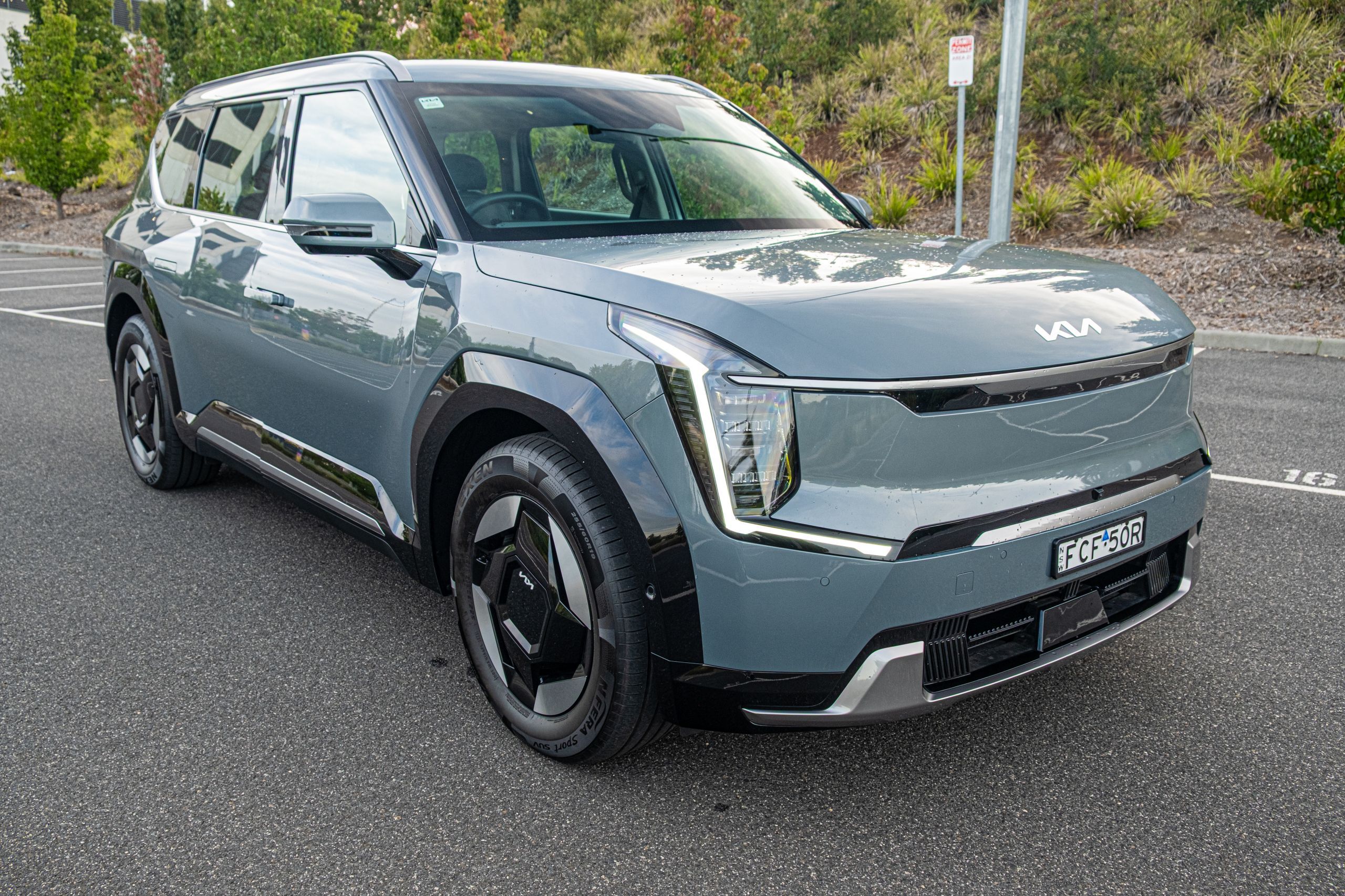
While the Kia EV9 Earth isn’t marketed as a sporty SUV, unlike the GT-Line and GT models, it certainly has a sporty edge to it.
Unlike the Ioniq 9 Calligraphy, which has more power than all EV9 models bar the flagship GT, the EV9 doesn’t waft down the road quite the same. Instead, it rides noticeably firmer and has a more dynamic edge to it. This isn’t to say it feels like an out-and-out performance car, because it doesn’t, but it’s clear Kia’s engineers were eager to create something that driving enthusiasts like ourselves would appreciate.
It’s very common for big EVs to ride quite firmly – hardly a surprise given how heavy they can be. While the EV9 does lean towards firmness rather than suppleness, even in Earth configuration, it still remains comfortable and soaks up bumps nicely, almost as well as a high-priced European rival.


Photos Brad Anderson/Carscoops
Thanks to the suspension setup, the EV9 handles surprisingly well and offers a tremendous amount of grip given its size. The Nexen tires aren’t the most premium option, given the SUV’s hefty price tag. By comparison, the GT-Line rocks Continental rubber. Kia has done a commendable job of keeping the cabin quiet, eliminating any excessive tire or wind noise, even though the EV9 has a front area like a semi-truck.
Read: 2026 Kia EV9 GT Is A Family Hauler With Fake Gear Shifts That Hits 60 In 4.3 Seconds
The steering has a nice weight, even though it’s largely devoid of feel. Similarly, the brakes have been well-tuned, and there’s no noticeable crossover between the regenerative braking and the mechanical units. Like other Hyundai and Kia EVs, the regen can be adjusted on the fly with the paddle shifters.
Annoyances with the EV9 are few and far between, although the driver monitoring system is a little overactive, beeping and flashing even if you just take your gaze away from the road for a moment, even if that’s just to look in the mirrors. In addition, the multimedia shortcut buttons, incorporated into the dash with haptic buttons similar to what’s found in the Nissan Ariya, are very hard to use on the move.
The EV9’s 800-volt electrical architecture means the battery pack can be charged from 10-80 percent in just 24 minutes, which is impressive given the 99.8 kWh pack is quite sizeable. Yes, there are some Chinese brands that have pushed charging speeds to new levels in recent years, but the EV9 is more than adequate in this department.
In news that won’t surprise you, efficiency leaves a little to be desired. Kia quotes 22.3 kWh/100 km, but we ended up averaging 23 kWh/100 km, and that was driving almost exclusively in the Eco mode, always in one-pedal driving on a mix of urban roads and highways.
Verdict


Photos Brad Anderson/Carscoops
The Kia EV9 has been a relatively strong performer for the brand ever since it was launched. In Australia, 269 examples were sold last year, and while that was down 50 percent from the year prior, it did outsell the Volvo EX90, which shifted 209 units. In the US, sales have been in freefall since the $7,500 federal EV tax credit was scrapped, and in 2025, 15,051 were sold, down from 22,017 the year prior.
Should Kia be panicking? Probably not. The market for all-electric, three-row SUVs will never be huge, and a drop in demand doesn’t mean the EV9 has somehow become less appealing since its introduction. Indeed, it is just as good now as it ever was.
However, not only does it have to deal with competition from within the Kia stable, such as from the Sorento and the Telluride, but shoppers also need to be convinced to buy it over the Hyundai Ioniq 9 which is better, even if it costs a little more. Like so many other EVs, it will likely remain most appealing to those only interested in owning an electric vehicle, not necessarily a spacious seven-seat SUV that provides the best value for money. If you’re still after that, Kia’s hybrid alternatives might be a better option.