












- Toyota revealed the Euro-spec Hilux at Brussels Motor Show.
- New EV version joins the mild-hybrid diesel in the lineup.
- Hilux BEV offers 160-mile range with dual-motor AWD setup.
The Hilux has spent decades surviving anything the world throws at it, from mud and floods to plummeting from a Top Gear crane – though not being dropped from a helicopter. Now Toyota is testing its most famous small pickup with a more complicated challenge: staying relevant in an electric future.
Related: New Toyota Hilux Brings Sumo-Inspired Looks And EV Option
Toyota unveiled the Euro-spec ninth-generation Hilux in mild-hybrid and fully electric Hilux BEV form at this week’s Brussels Motor Show, months after both trucks debuted in Asia. The first ever EV Hilux is big news, but soon it won’t be the only version of the unstoppable truck that doesn’t emit any tailpipe nasties.
As we reported last year, Toyota Toyota hasn’t just confirmed that it’s working on a hydrogen-powered Hilux that will arrive later, it’s already testing them out in the open. Yes, the same pickup that built its legend hauling bricks and sheep is about get a fuel-cell stack.
Multipath Meets Multipurpose



Toyota calls this its multipath strategy, though for many buyers little will change. Because they’ll still be able to get a truck with the same 201 hp (204 PS) 2.8 litre diesel mild hybrid (shown above) that made its debut in the previous generation Hilux’s twilight years. Some less-developed European countries will even get a non-hybrid diesel.
In the UK and Europe the 48-volt oil burner is expected to be the volume seller even after the EV’s arrival. It keeps up the old model’s 1,000 kg (2,205 lbs) payload and 3,500 kg (7,720 lbs) tow ratings, while being smoother and slightly cleaner than before.
Electric But Still Unbreakable


But business-owning truck buyers with an eye on cutting running costs and tax bills will want to give the Hilux BEV a look. It uses a 59.2 kWh battery with motors on both axles for permanent all-wheel drive.
The front motor makes 151 lb-ft (205 Nm) and the rear 198 lb-ft (268 Nm), and Toyota quotes a WLTP range of 160 miles (258 km), which sounds unimpressive in a passenger-car context, but that climbs to 236 miles (380 km) in urban use.
Payload drops to 715 kg (1,580 lbs) and towing to 1,600 kg (3,530 lbs) in the EV, but the fundamentals remain. You’re getting the same body-on-frame construction, 212 mm (8.4 inches) of ground clearance and 700 mm (27.6 inches) of wading depth, whichever power source you choose. And the BEV gets a special off road drive mode tuned for electric torque and braking.
All In the Grilles
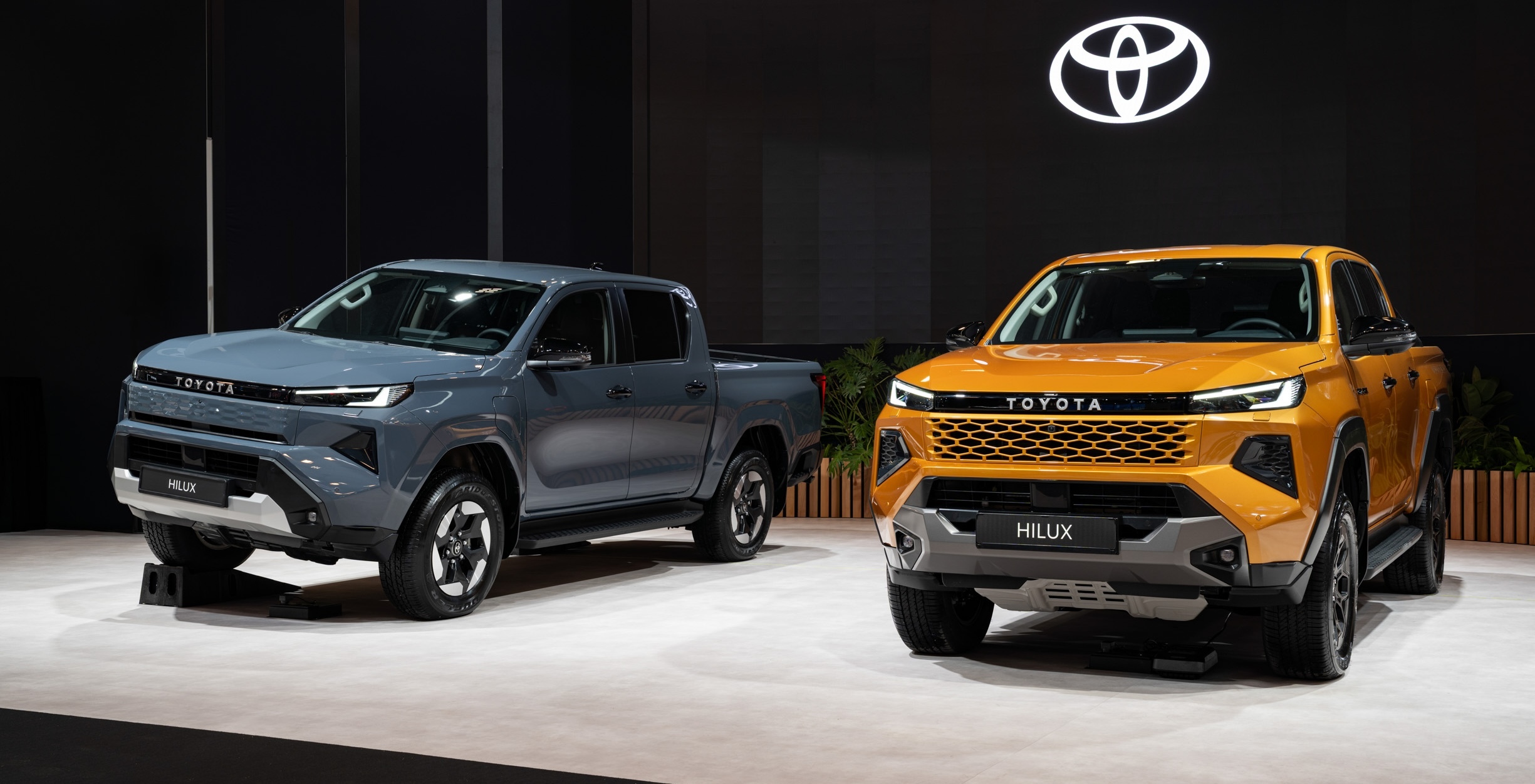
Both hybrid and BEV models adopt the same new Cyber Sumo design that was reportedly developed by Toyota’s Australian team. Characterized by stronger angles and flatter surfaces, it gives the Hilux and more modern, big-truck look, though it seems not everyone loves it. The EV is easily identified by its hole-free grille panel and (less obvious) re-shaped silver bumper insert.
Also: Toyota’s Most Expensive Supercar Has Something In Common With Lexus’ Cheapest Sedan
The modern makeover continues inside the crew cab-only interior where drivers and passengers are treated to a 12.3-inch digital gauge pack and same-sized tablet touchscreen, plus a steering wheel from the new Land Cruiser.


There are dual storage compartments on the passenger side, dashboard-mounted cupholders, and a full suite of electronic safety gadgets, but Toyota remembered to cram in plenty of physical switches for regularly-used functions.
UK sales start in June, Toyota says, and prices – guaranteed to be higher than for the outgoing truck – will be revealed within the next few months.


