








- Stellantis posts $26.3B net loss for FY 2025.
- Dividend suspended, $5.9B bonds issued.
- ICE and hybrid pivot lifts H2 shipments.
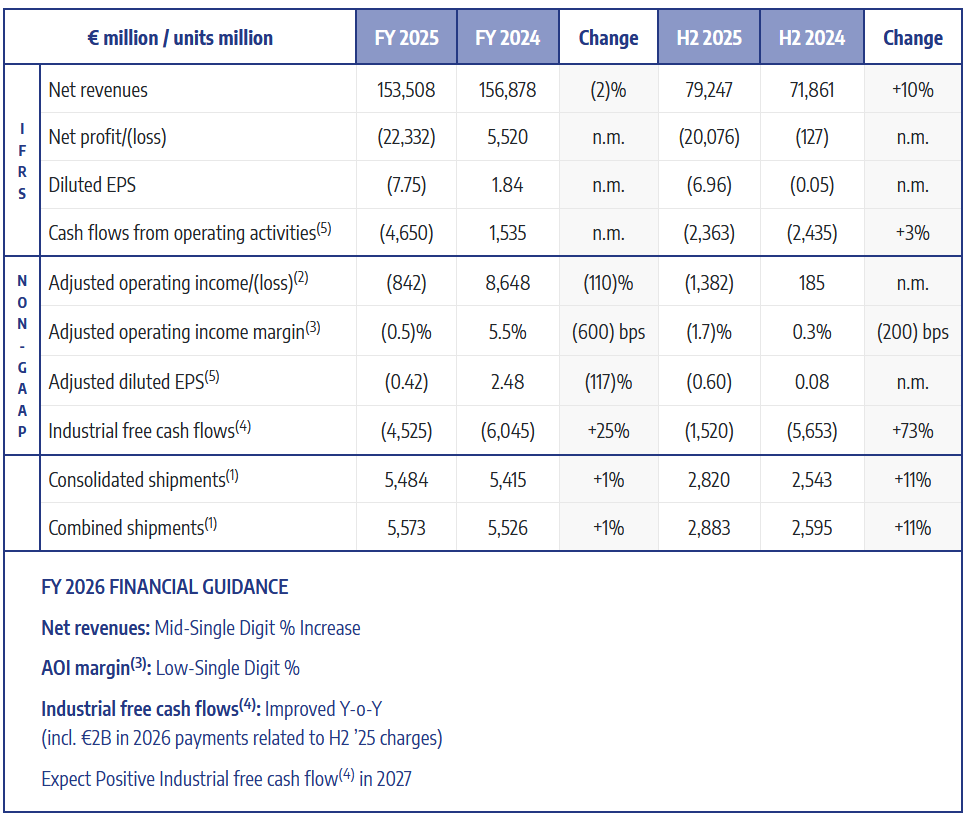
Stellantis has published its 2025 financial results, and they make for sobering reading. The headline figure is a €22.3 billion (equal to $26.3 billion at current rates) loss. That swing looks even worse when set against 2024’s €5.5 billion ($5.8 billion) profit, which itself was already down 70% compared to 2023.In the span of two years, the company has gone from profitable to deep in the red.
The group attributes the damage to €25.4 billion ($30 billion) in “unusual charges,” largely tied to what it calls a “profound strategic shift to meet customer preferences.” In plain terms, Stellantis overestimated how quickly the market would move toward electric mobility, and it is now paying to recalibrate.
That is only part of the story. It was not just a matter of customers being slow to embrace EVs. Several of Stellantis’ electric efforts, particularly in the US, struggled on their own terms. Models such as the Dodge Charger Daytona EV and the Jeep Wagoneer S with steep price tags yet failed to convincingly outperform established rivals.
More: Stellantis Bet Big On EVs, Now It’s Betting On The Engine Europe Wrote Off
Regardless, that recalibration means canceling several electric models that were in development, mainly for the US market, and putting new emphasis on high-margin combustion engines. The return of the HEMI V8 in North America is the obvious attention grabber.
In Europe, diesel and mild-hybrid gasoline options are being folded back into the lineup across several current and upcoming models, including the now-delayed Alfa Romeo Stelvio and Giulia replacements.
“Our 2025 full year results reflect the cost of over-estimating the pace of the energy transition and of the need to reset our business around our customers’ freedom to choose from the full range of electric, hybrid and internal combustion technologies,” said Stellantis CEO Antonio Filosa.
“In the second half of the year we began to see initial, positive signs of progress with the early results of our drive to improve quality, strong execution of the launches of our new product wave and a return to top line growth. In 2026 our focus will be on continuing to close the execution gaps of the past, adding further momentum to our return to profitable growth.”
How Does Stellantis Plug The Gap?
The financial strain has prompted the board to suspend the 2026 dividend and authorize up to €5 billion ($5.9 billion) in hybrid bonds to shore up liquidity. Industrial free cash flow remained firmly negative at €4.5 billion ($5.3 billion), although that represents a 25% improvement on the previous year.

Net revenue totaled €153.5 billion ($181.1 billion), down 2% year-on-year. The decline is attributed to exchange rate headwinds and net pricing drops in the first quarter of 2025, neither of which tends to flatter the bottom line.
More: Stellantis Adds A Third Shift Where You Least Expect It
The group posted an adjusted operating loss of €842 million ($993.5 million). Still, the second half of the year showed signs of stabilization. Revenues rose 10% and shipments climbed 11% as inventories normalized. Stellantis also highlighted that H2 2025 marked the first six months under its renewed leadership team, a detail clearly intended to signal that the worst may already be in the rearview mirror.
Shipments Went Up But Shares Go Down
Combined shipments for 2025 reached 5.573 million vehicles, up 1% year-on-year. That keeps Stellantis in fifth place globally by volume, behind Toyota (11.3 million), Volkswagen Group (8.98 million), Hyundai Motor Group (7.27 million), and General Motors (6.11 million).
Momentum was stronger in the second half, with 2.883 million shipments, up 11% over H2 2024. North America did most of the heavy lifting, posting a 39% H2 increase as inventories returned to more normal levels and demand improved.
Investors, however, appear less convinced. Reuters reports that Stellantis shares have fallen by more than 30% this year, sliding to their lowest level since the PSA-FCA merger in 2021.