











There’s a subculture in Southeast Asia that remains hidden from the mainstream. For many, pickups are the farmhand-like utilitarian tools they were designed to be. But for others, they remain tools of expression, with a huge modifying community backing them up.
We’re not just talking about the usual lift kit and chunky tires. We’re talking about air suspension or hydraulics, massive sound systems, and engines that are stretched to their limits with forged internals and turbos bigger than a child’s head. And one of the most popular platforms to do this with is the Isuzu D-Max.
Review: Nissan’s 2026 Frontier Pro-4X Costs Less Than A Loaded Tacoma And Doesn’t Feel Like It
So much so that Isuzu has embraced the aftermarket culture and created its own specialized creations, such as some crazy drag-based special editions. What we have here, though, is far from some highly-tuned nitrous-shooting custom creation. Instead, it’s the more basic, 3.0-liter flavored D-Max that has obviously built its fan base for a reason.
QUICK FACTS
If you’re unfamiliar with the Isuzu brand, we don’t blame you. The Japanese automaker pulled out of the American consumer market back in 2009, leaving behind little more than a faint memory of the Trooper and Rodeo from the ’90s. But walk into any dealership in Southeast Asia, Australia, or the UK, and Isuzu is a household name, particularly in the truck segment, where its reputation for diesel durability borders on legendary.
And that’s where the D-Max comes in. It’s the bread-and-butter model for Isuzu, and it’s a big part of their success. In fact, it’s literally the backbone of their passenger car lineup, with their only other offering, the MU-X, being an SUV adapation of the D-Max.
What Does The D-Max Bring To The Table?
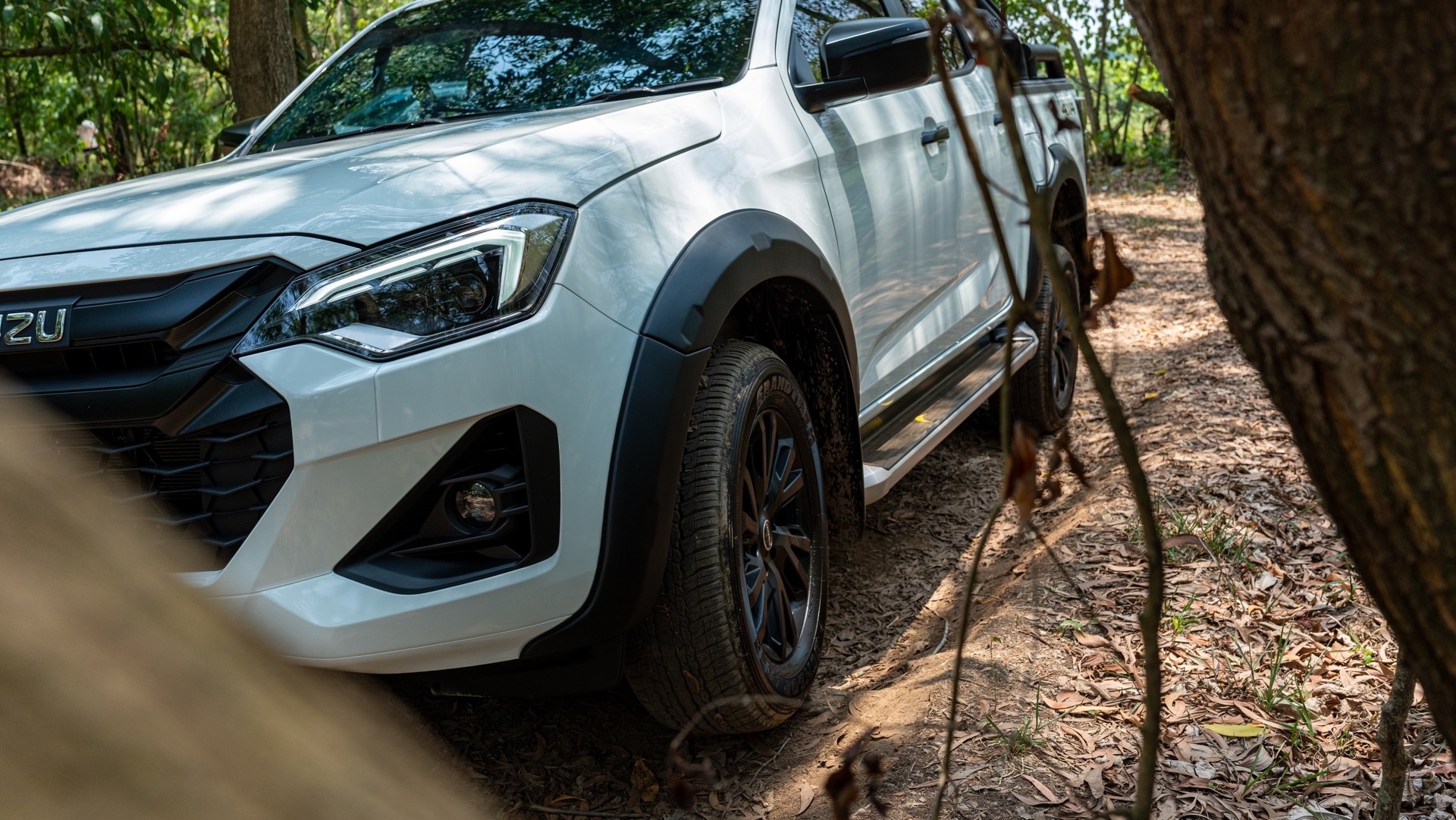
If you’re familiar with the other contenders in this class, such as the Toyota Hilux, Ford Ranger, and Mitsubishi Triton, then that’s exactly where it slots in. You get a ladder-on-frame chassis, a choice between single- and dual-cab options, and four-wheel drive.
Aside from the 3.0-liter unit you’ll find under the bonnet of this truck, there’s also a 1.9-liter diesel, as well as a 2.2-liter diesel. And that’s pretty much the Isuzu philosophy. Their expertise lies in diesel engines, and as such, if you’re looking for a gas alternative, well, you’re out of luck.
Read: Isuzu Bets Drivers Still Want Tough 4WDs In A World Of Soft SUVs
That 3-liter four-cylinder lump puts out 187 horsepower (190 PS / 139 kW) and 450 Nm (332 lb-ft) of torque, so it’s not quite class leading. The Ford Ranger, which is available with a 3.0-liter engine with two extra cylinders, manages 247 hp (250 PS / 184kW) and a substantial 600 Nm (443 lb-ft), the kind of number that will matter particularly for those who need to tow.
In fact, even the other four-cylinder options, the Hilux and Triton, still best it. The Toyota, with its 2.8-liter powerplant, can deliver 201 hp (204 PS / 150 kW) and 500 Nm (369 lb-ft) of torque (on the automatic), and the Mitsubishi still manages 201 hp (204 PS / 150 kW) and 470 Nm (347 lb-ft) of torque.
On paper, it doesn’t look good for the D-Max. But then numbers rarely tell the full story. The 4JJ3 engine is supposedly understressed and, if long-term ownership reviews are taken into account, it yields rewards in terms of reliability. And remember that tuning culture I mentioned earlier? This is the diesel equivalent of something like a 1JZ/2JZ with the amount of upgrades people have come up with to unlock its potential.
And yes, when behind the wheel, the D-Max doesn’t feel any less endowed than the competition. With some light off-road situations, torque is available low down, and consistent, without having to get the engine to break a sweat. To put it another way, at no point was I thinking, “Oh, I wish this had the 50Nm more torque a Hilux has.”
So, What Is It Like Off Road Then?



Photos Shan Mohamed / Carscoops
Well, approaching uneven ruts that would normally get pickups without a locking diff looking sweaty, turned out to be surprisingly light work for the D-Max. And yes, while a locking rear diff is an option, our tester wasn’t equipped with it. Instead, you get a “Rough Terrain” mode, which was added to the D-Max in the last round of updates.
What this does is use its brain to brake any wheel that it is less acquainted with terra firma, which would otherwise be spinning like an open torque vacuum. By doing so, the D-Max can shuffle its torque around — even in 2-wheel drive — and with the lightest of persuasions, continue to get moving. It isn’t a locking diff, don’t get us wrong, so when you’re presented with some slippery surfaces that would require something bigger and more heavy-duty, you’d likely want locked axles. But the new mode has its uses and performs exactly as intended on uneven ground.


Photos Isuzu Australia
And the controls are all very analog, tactile, and intuitive to use. The aforementioned mode is activated with just one push of a button. No need to dive into menus, interact with a touchscreen, or cycle through safety warnings. One button. The same can be said of the four-wheel-drive system control, which is operated via a chunky, easy-to-locate knob. You can switch from 2H to 4H on the fly (going into 4L requires a full stop) up to 100 km/h (62 mph).
However, it’s important to note that this is still a part-time four-wheel drive system. Meaning that you can only use it on unsealed surfaces. Unlike some competitors, the D-Max doesn’t feature a center diff, and therefore can’t offer any way to use all four wheels on sealed surfaces. So, if you’re looking for something that gives you a bit more confidence in the wet, the D-Max isn’t for you, I’m afraid.
Okay, What About The Grocery Getter Crowd?


Photos Shan Mohamed / Carscoops
Here’s where the D-Max starts to feel a little less suited for the task at hand. While it is a pickup truck with a ladder frame chassis and four wheel drive, there’s, of course, a segment of buyers who really do like to see their utes a bit more car-like. The D-Max isn’t.
The interior, although not offensive, just doesn’t have the same level of plushness as you get from something like a Ford Ranger or Kia Tasman. There are plenty of tough, hard-wearing plastics, big knobs, and chunky buttons that tell you exactly what this was built for: a more rough-and-ready use case.
You still get things like an electric driver’s seat, cruise control (not much in the way of ADAS for this South Asian-spec), and a decent stereo system. But making it car-like isn’t where the budget has been spent. As such, you’re stuck with a dated-looking infotainment system, which, although it features wired Android Auto and Apple CarPlay, feels a generation or two out of date. The screen is slow to respond, the graphics are barely better than what you’d find on Windows XP, and the overall vibe is more utilitarian than comfortable.
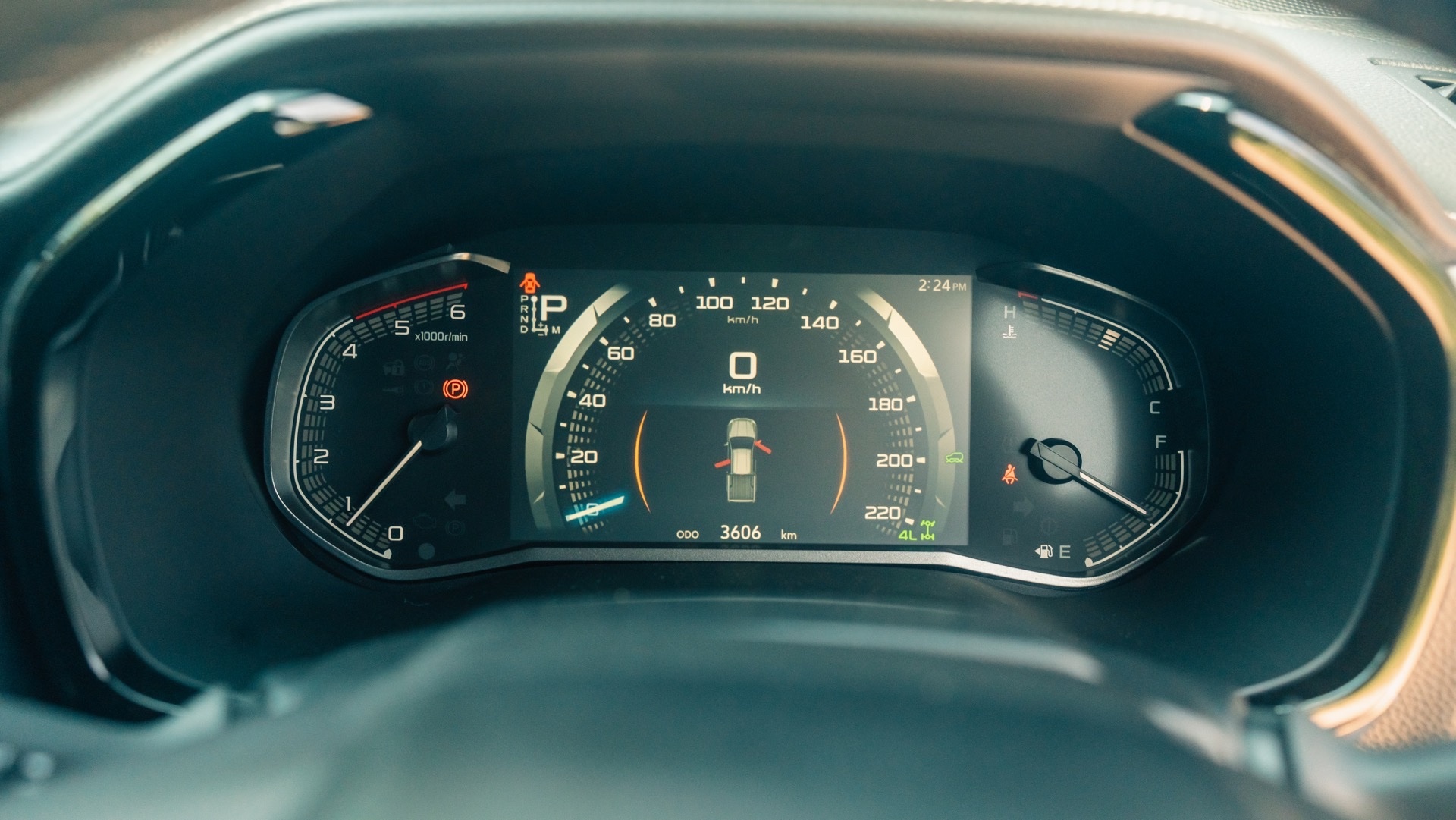
And there’s absolutely nothing wrong with any of those things. Well, maybe the screen could do with a bit higher resolution. But aside from that, I like the fact that the D-Max is built for purpose. There are plusher options from competitors. But this isn’t that, and nor does it try to be — something that I imagine a great deal of owners actually appreciate.
What could do with a bit of improvement is the experience on highways. The body roll and overall comfort are actually well handled on the road, and I prefer the D-Max’s approach to the softer (and, consequently, more rolly-polly) ways of its SUV cousin, the MU-X. But the steering feel is quite dead, the wind roar from highway driving is noticeable, and if you do end up raising the revs above 2,500 rpm, the diesel clatter is audible inside the cabin.
These are things that, if Isuzu could iron out, wouldn’t deter existing buyers, nor would it really impact its ability or durability. It would just bring the D-Max a little closer to the competition in terms of refinement.
Verdict And Pricing
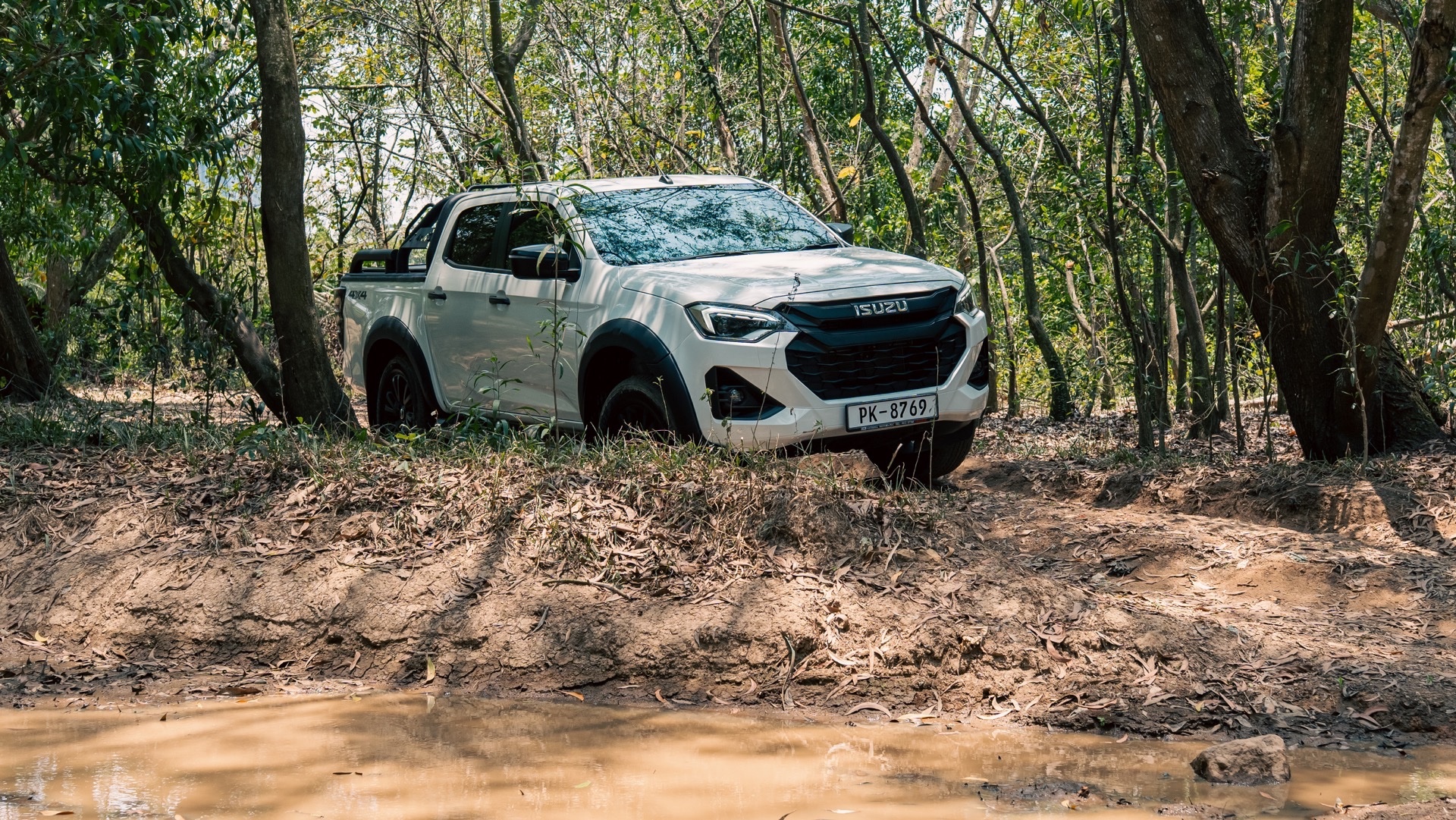
The Isuzu D-Max tested here was done so in Sri Lanka, where this, the 3.0-liter model, will retail for around LKR 23,000,000 (~$72,000). For context, an equivalent spec of the Toyota Hilux or Ford Ranger will set you back upwards of LKR 25,000,000, which is a significant difference. The story is the same in Australia, where the D-Max is one of the country’s best-selling vehicles, and the picture is similarly competitive.
The range opens at around AU$36,000 before on-roads for the base 2.2-liter single cab, while the 3.0-liter crew cab variants, the configuration most buyers actually want, sit between AU$55,000 and AU$70,500 for the range-topping X-Terrain. Generally speaking, the D-Max still sits below the Hilux and Ranger, pound for pound, in terms of price.
But where does the D-Max fit into the overall pickup landscape? For starters, it doesn’t try to be a lifestyle vehicle moonlighting as a workhorse. Instead, it’s a workhorse that happens to have enough polish to work as a daily driver. The 3.0-liter diesel is unhurried but deeply capable, and the four-wheel-drive system is honest and effective.
Is it the most powerful thing in its class? No. Does it have the most refined cabin or the flashiest infotainment? Also no. But the D-Max has always competed on a different axis: dependability, repairability, and a total cost of ownership that makes accountants and fleet managers quietly satisfied. And that’s where, I suspect, it’ll continue to win over hearts and wallets.