









- Establishing its own charging network will help BYD battle Tesla in Canada.
- Flash Charging tech can add 250 miles of range in as little as 5 minutes.
- BYD has already established more than 6,000 Flash Charging stations in China.
BYD hasn’t sold a single car in Canada yet, and it’s already laying the groundwork for its hyped Flash Charging network north of the border. The order of operations tells you how badly the Chinese giant wants a foothold in the country’s EV market.
The company’s 1,500 kW Flash Charging technology broke cover earlier this year. Cars running BYD’s second-generation Blade Battery and 1,000-volt architecture can pull 250 miles (400 km) of range from a 5-minute stop, which puts a full charge somewhere in the territory of a gas-station fill-up. This week the company posted a Toronto job listing for a Flash Charging Business Development Manager to steer the rollout.



Also: BYD Says Five-Minute Charging Adds 310 Miles, BMW Says Read The Fine Print
According to Electrek, he manager will be responsible for building cost and profit models for the Flash Charging technology locally and developing local partners for power grid upgrades to make the network possible. They will also need to oversee the stations’ operations with those partners.
Going Global
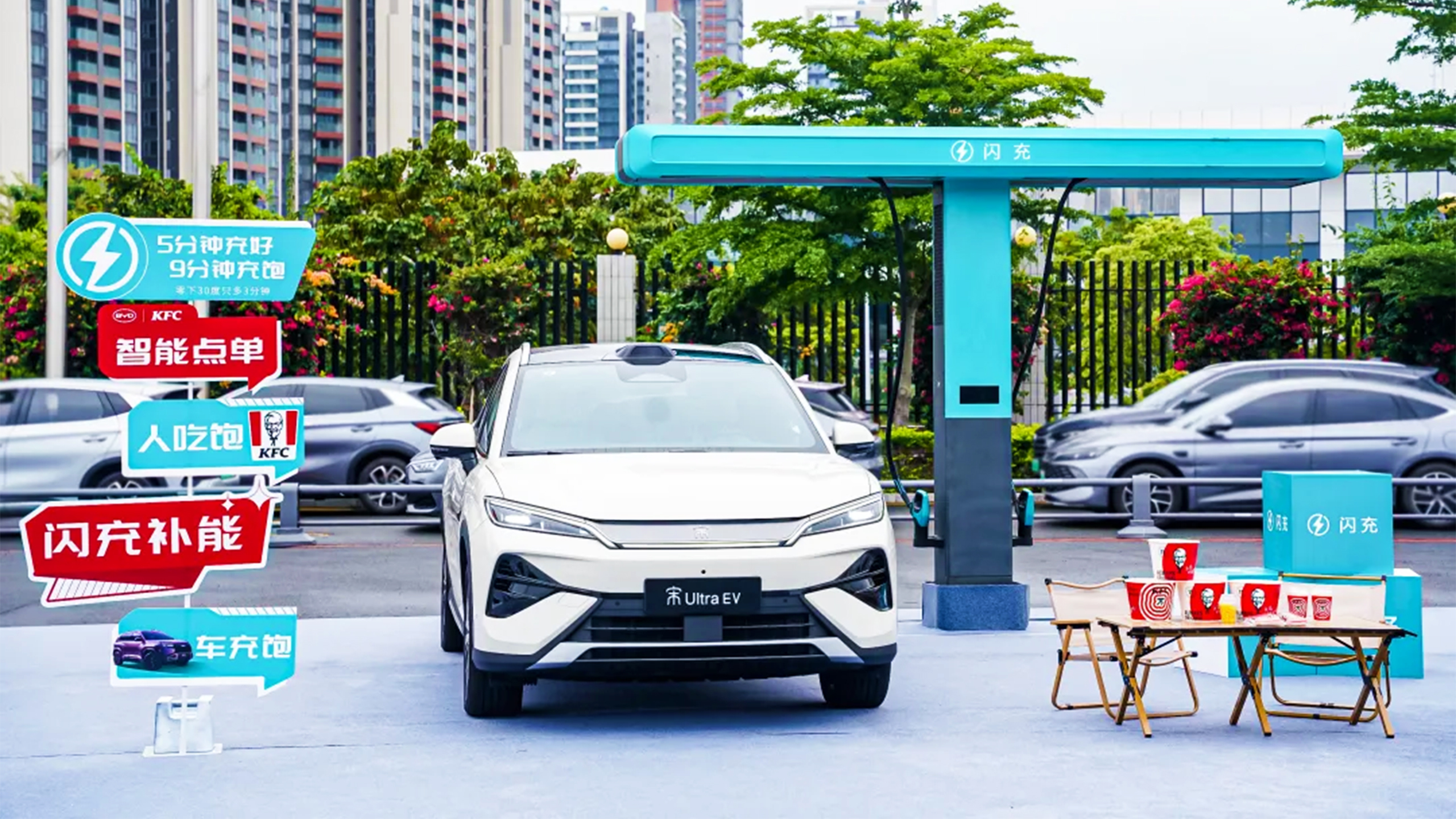
BYD has been extraordinarily quick to roll out its Flash Charging stations in China. In fact, there are thought to be more than 6,400 stations in operation spread across 319 cities in China. BYD also wants to introduce approximately 3,000 of these stations in Europe by the end of next year, each at an estimated cost of €580,000 ($670,000), for a total investment of about $2 billion. The Flash Charging network is also coming to Australia and New Zealand, with plans to also introduce it in Latin America, the Middle East, and Africa.
Read: BYD’s New EV Chargers Are So Fast They’re Arranged Like Gas Station Pumps
Not only do charging speeds like these mean that topping up an EV’s battery pack could be as quick as refueling an ICE-powered car, but they may also allow car manufacturers to build EVs with smaller battery packs. After all, if you can top up a battery in just minutes, there’s no need for a huge, heavy battery offering upwards of 400 miles of range.