


CONS ›› Boring, poor infotainment, bad regen
Not too long ago, Chery was an unfamiliar name to most car buyers outside of China. However, in recent years, the company has expanded overseas and grown its model portfolio, offering a range of powertrains, body styles, and designs.
One of the newer and most compelling of its brands is Jaecoo. Established in 2023, it sits alongside sister brand Omoda, but its vehicles are not sold in China. Instead, the focus is entirely on overseas markets, and the strategy is working, particularly in the UK, where one of its models recently topped the sales charts. That model is the Jaecoo 7, which resembles a Range Rover Evoque closely enough to have picked up the Temu Range Rover nickname in Britain.
Read: Chery Patents Reveal A Compact Pickup That Could Take The Ford Maverick Formula Global
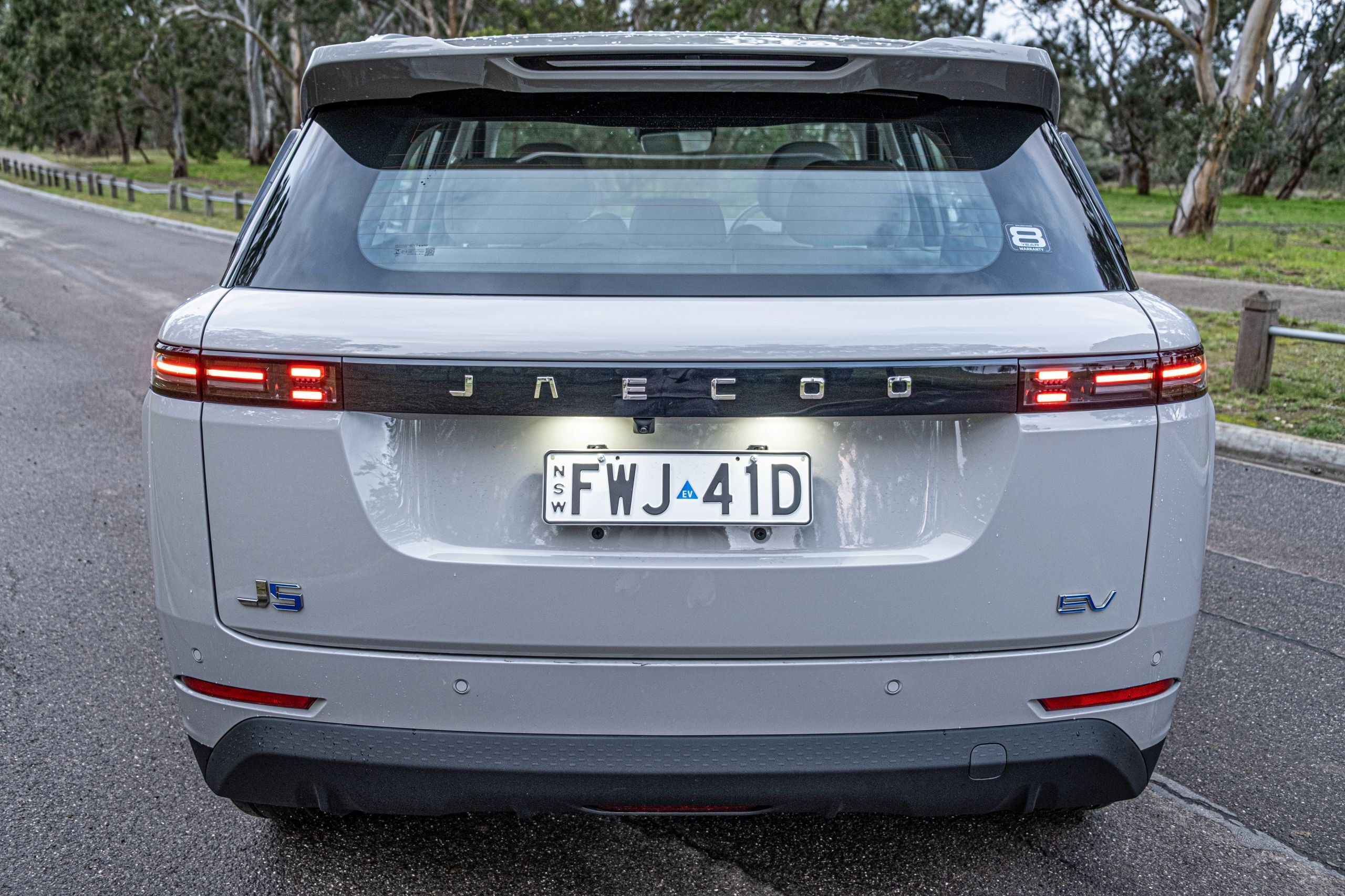
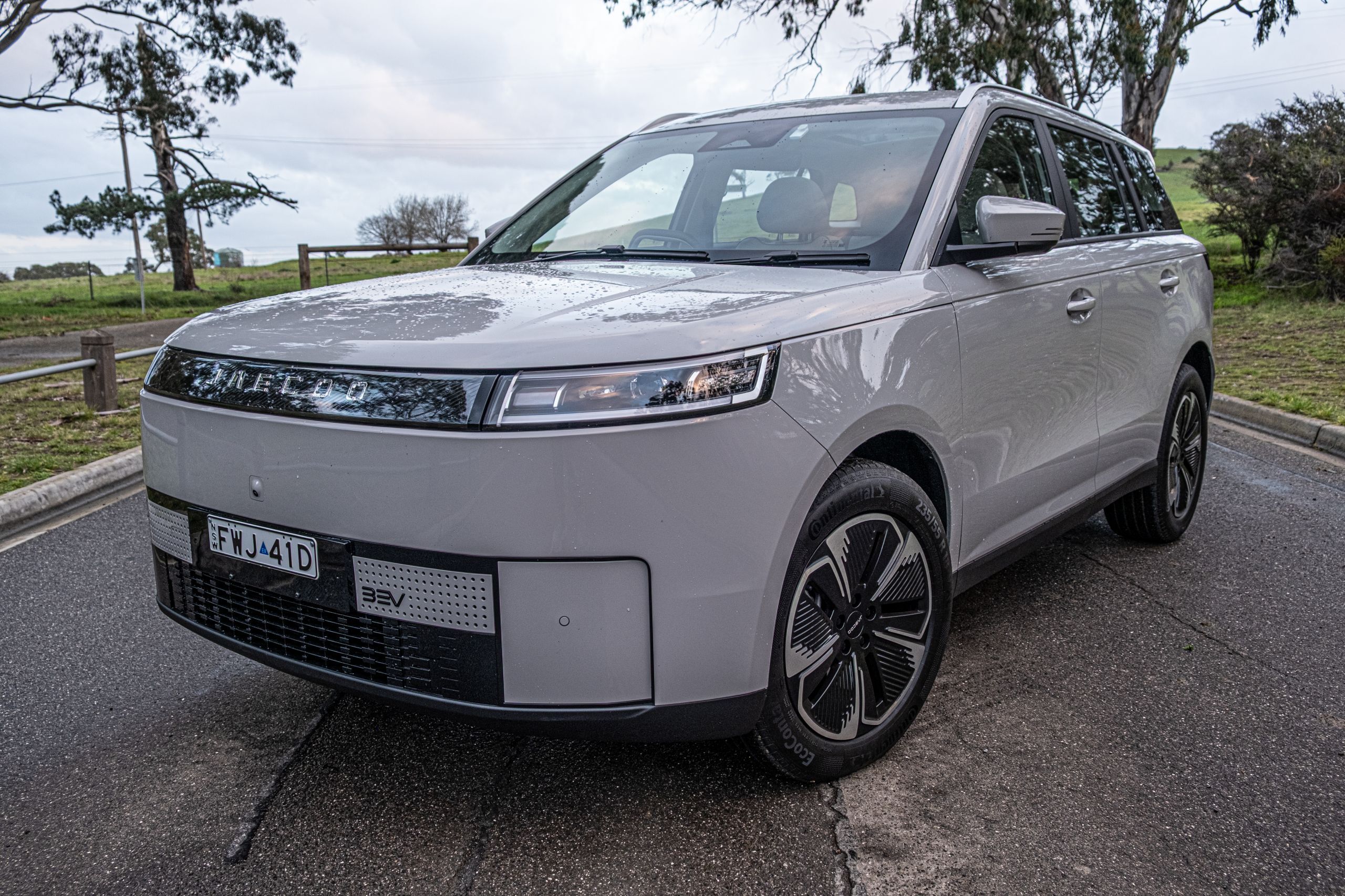
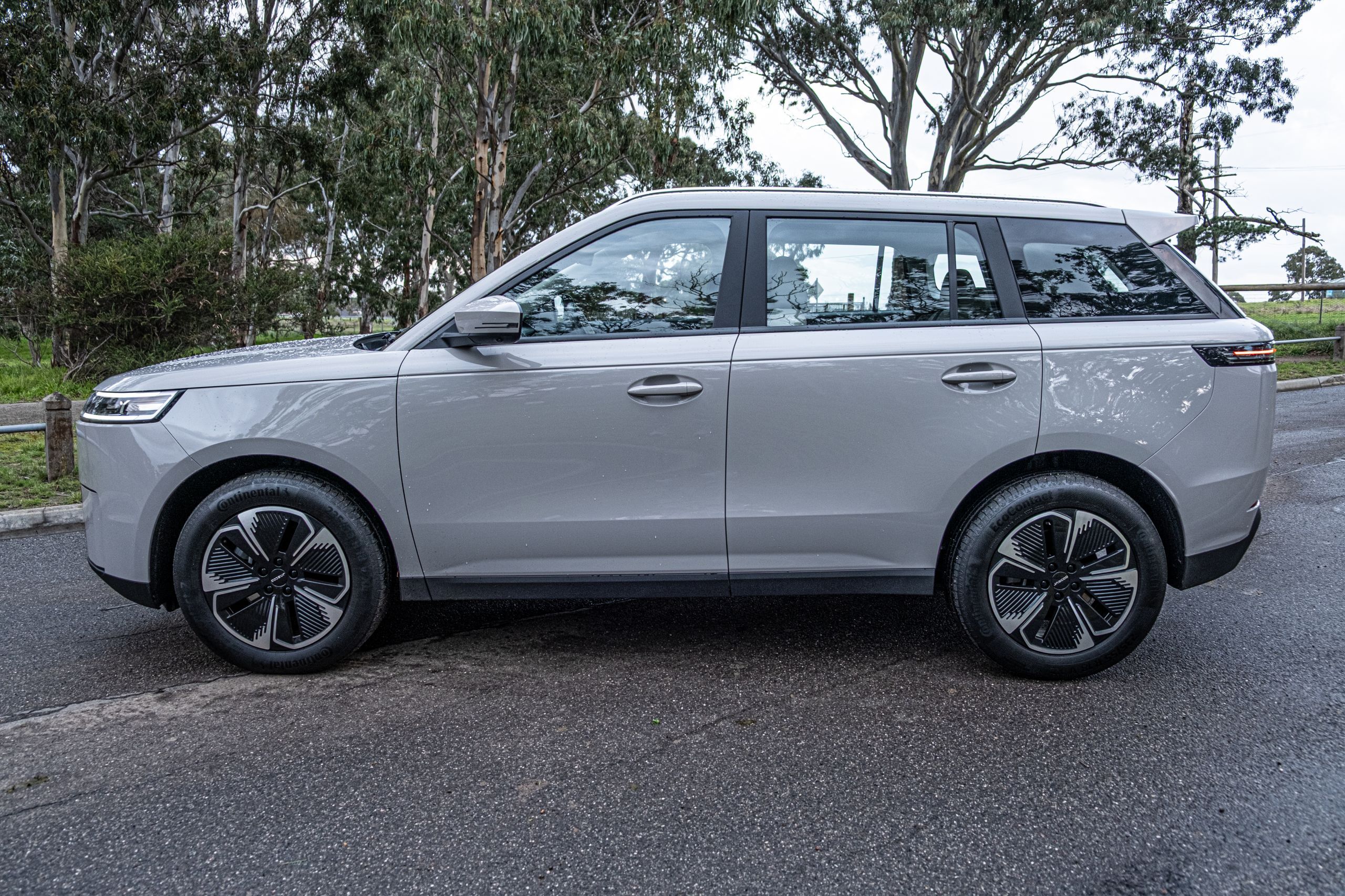
The 7 isn’t the only Jaecoo with a Land Rover fixation. There’s also the smaller J5 EV, an entry-level Mazda CX-30 rival that raids the same design cupboard, mostly around the profile and the rear end. That has earned it the “Baby Range Rover” tag alongside the Temu Range Rover one. As we recently discovered, it carries the sort of polish you’d expect from a brand with decades behind it rather than three years. The polish isn’t the issue. The flaws underneath it are, and in a segment this packed, they’re enough to make it hard to recommend.
QUICK FACTS



Photos Brad Anderson / Carscoops
In Australia, Jaecoo currently sells the J5 in Petrol and EV configurations. The ICE model starts at a measly AU$25,990 (US$18,300), making it a very compelling deal given its size and technology suite. Then there’s the J5 EV that we drove, priced from AU$36,990 ($26,000), including all on-road costs, making it one of the cheapest EVs currently on sale and the second cheapest SUV, only behind the BYD Atto 2. Soon, a hybrid model will be added to the range.
While the J5 EV is affordable, that doesn’t mean it’s devoid of any compelling features. Quite the opposite, in fact. In terms of power, there’s a single motor powering the front wheels and rated at 150 kW (201 hp) and 288 Nm (212 lb-ft) of torque, figures roughly on par with similarly-sized EVs, even more expensive ones like the Kia EV5 and Hyundai Elexio, the latter of which starts at almost AU$60,000 ($42,200).
Other key highlights of the J5 EV, which is sold in just a single configuration, include a glass roof with a powered sunshade, eight-speaker audio system, 18-inch wheels, seven airbags, and all the safety gizmos you’d expect of a modern EV. These include adaptive cruise control, traffic jam assist, blind-spot monitoring, and a surround-view camera.
Well-Finished, But Far From Perfect


Photos Brad Anderson / Carscoops
The interior of the J5 does not feel like something at this price point. It has an air of premiuness to it which many rivals from legacy brands are struggling to match for similar money.
Our tester was trimmed in a combination of cream and dark grey synthetic leather which is beautifully soft to the touch and oozes quality, even though it’s probably pretty cheap for Chery to source.


Photos Brad Anderson / Carscoops
Positioned behind the two-spoke steering wheel is a slim 8.9-inch digital instrument cluster, nicely incorporated into the dashboard. Also, unlike the vast majority of other EVs hitting the market, the J5 EV doesn’t have a landscape-oriented central infotainment screen, but rather a portrait display that curves neatly into the piano black center console, not dissimilar to recent Mercedes S-Class models.
Unfortunately, the software leaves a little to be desired. The J5 EV does include wireless Apple CarPlay and Android Auto, and both work well, but there’s an issue. Unlike so many other cars that house their climate control settings in a bar pinned to the base of the screen, even when using smartphone mirroring, the J5’s climate control taskbar is also accessible from the main menu. So, if you’re using CarPlay, you’ll have to exit out of the app to change the temperature or your fan speed. It’s a silly oversight.
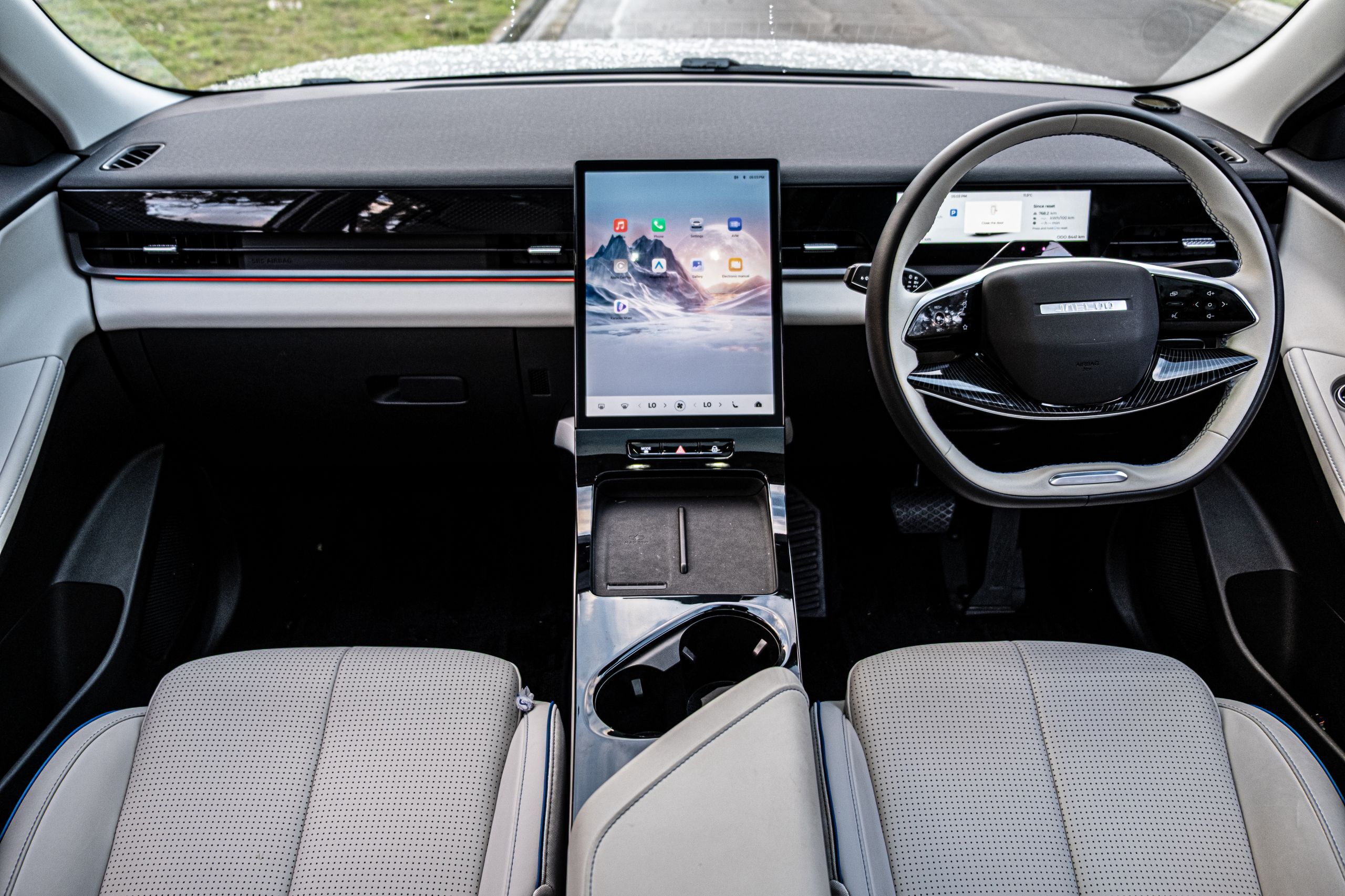
Additionally, the software itself is pretty basic, and there are hardly any interesting apps available, despite the screen offering plenty of real estate for them. Speaking of the screen itself, the angle at which it sits means it can suffer from quite a lot of sun glare.
Read: UK Buyers Now Love This ‘Temu Range Rover’ More Than The Real Thing
Plenty of storage is found in the J5 EV, including an area positioned below the floating center console and a deep storage bin. The driving position and overall comfort behind the steering wheel is good and feels more than premium enough.
The second row is nice, too, sporting a completely flat floor and enough room for adult passengers. During my week with the J5 EV, I just so happened to be moving house, and it worked quite well as a cargo carrier, thanks to the generous 480 liters (16.9 cubic feet) of capacity at the rear. Hidden beneath the false floor in the rear is an extra storage area, perfect for placing a home charging cable.
How Does It Drive?


Photos Brad Anderson / Carscoops
Obviously, the J5 EV isn’t going to win any awards for performance, but average SUV buyers coming from combustion models will be pleasantly surprised by the level of performance on offer.
The J5 EV can hit 100 km/h (62 mph) in around 7.7 seconds, which is decent enough for city driving and for highway overtakes. However, given that the J5 is front-wheel drive, it does suffer from a bit of torque steer, which is disappointing albeit not surprising and a common trait among plenty of other front-driven EVs. The torque steer is also nowhere near as obtrusive as it is in something like a Kia EV5.
While the acceleration is solid, the deceleration isn’t. You see, just like any other EV, the J5 EV includes adjustable regenerative braking. However, it’s been so poorly calibrated that it’s almost not worth using.
Three different levels of brake regen are available, all of which are hidden deep within the menu, so it’s hard to make changes on the fly. Worse still, in the most aggressive of the three settings, it’s impossible to modulate the level of braking using the throttle, as is the case with every other EV I’ve ever driven.
In the J5, if you touch the throttle even the slightest bit while slowing down using the regen, the car will jolt and begin coasting. This feeling was confirmed by the onboard power monitor, which, under regen braking, often says you’re recuperating around 20 percent power. Just look at the throttle and that changes to 0 percent. As such, using the highest regen setting is extremely frustrating. What’s more, the same feeling is replicated in the two other regen settings, albeit it’s not quite as annoying.


Photos Brad Anderson / Carscoops
I also found the electric power steering to be far too light. This is quite a common trait among many EVs, and while it’ll probably be enjoyed by many car buyers, it doesn’t give the J5 the kind of reactive or sporty feeling that we prefer.
On the plus side, the J5 EV does have a nicely tuned suspension setup, riding over bumps well and never feeling unsettled.
Overall efficiency is good. The J5 EV is equipped with a relatively small 58.9 kWh lithium-iron phosphate battery, and according to Jaecoo, averages 14.3 kWh/100 km over the combined cycle, giving it a driving range of up to 402 km (250 miles). I wasn’t quite able to match that figure, averaging 15.2 kWh/100 km. Importantly, this primarily consisted of highway driving and, given my qualms with the regenerative braking, I left it in the lowest setting for most of my time with the J5 EV, inevitably impacting efficiency.
Charging speeds are lacking, but to be fair, one can’t expect an EV that’s this cheap to charge at an absurd rate. The max AC charge rate sits at 10.3 kW, while the max DC charge rate is 130 kW. During the one time I had to use a public charger for the J5 EV, I topped up the battery with 16.55 kWh of juice in 14 minutes, enough to get me home during a long day of driving.
Verdict
The Jaecoo J5 EV is a solid product, and people unfamiliar with the smoothness of other EVs may find it quite enjoyable to drive and to live with. However, for those who expect more from their electric vehicles, the poor brake regen essentially makes it a non-starter in our eyes. If the regen alone was improved, the J5 EV would feel much more complete.
In addition, Jaecoo would be wise to invest more time into the SUV’s infotainment system, improving the software, adding some fun and interesting features, and making the climate control settings more accessible. Here’s hoping these changes can be made soon, perhaps through an over-the-air update.