


Shopping for a plug-in hybrid with three rows narrows your options fast. In Australia the field comes down to a handful of cars, the Mazda CX-80, the Chery Tiggo 9, and the new BYD Sealion 8 among them, and of that small group, the Kia Sorento PHEV is the one many buyers will look at first. It wears a badge people know, and in a segment this thin, that familiarity counts for a lot.
Kia has been building the fourth-generation Sorento since mid-2020, using the same N3 architecture as the Hyundai Santa Fe. However, whereas the related fourth-gen Santa Fe gave way for the fifth-gen model a couple of years ago, an all-new Sorento won’t launch until 2027 at the very earliest, if not later.
Review: The Kia Sorento X-Pro Is Everything Most Buyers Want
Compared to the Santa Fe, then, the existing Sorento is a little bit old, although it did undergo a facelift in 2024. One thing Kia’s SUV does have going for it is that it’s available with a plug-in hybrid powertrain, whereas the only electrified version of the current Santa Fe is a traditional hybrid without a plug. Does this make the Kia Sorento PHEV a smart buy then? Let’s find out.
QUICK FACTS



Photos Brad Anderson/Carscoops
In Australia, Kia sells no fewer than 12 different variations of the Sorento. Prices start at AU$58,340 ($41,800), including all on-road fees, for the entry-level S Diesel DCT. There are three other diesel models, topping out at AU$73,940 ($53,000), and eight hybrid models, priced from AU$59,490 ($42,600) to AU$84,600 ($60,600) for the GT-Line PHEV AWD that we recently lived with for a week.
There are a dizzying number of Sorentos available in the US as well. In terms of standard combustion models, shoppers have eight versions to choose from, while three hybrid versions, including the PHEV, are available from $48,290.
Powering the Sorento PHEV is a 1.6-liter turbocharged four-cylinder engine working alongside an electric motor integrated into the six-speed automatic transmission. There’s also a 14 kWh lithium-ion polymer battery, and total power sits at 195 kW (262 hp) and 350 Nm (258 lb-ft) of torque. To put that into perspective, the slightly more basic Santa Fe Hybrid has 172 kW (231 hp) and 367 Nm (271 lb-ft).
A Plush And Rugged Cabin


Photos Brad Anderson/Carscoops
We’ve always liked the cabin of this generation of Sorento, and we still like it, even though limited changes have been made since it was introduced.
As part of the SUV’s mid-life facelift, Kia ditched the individual cluster and infotainment displays in favor of twin screens housed within a single curved piece of glass. These screens are found across the Kia range and are superb, providing clear graphics and easy-to-understand menus. Both wireless Apple CarPlay and Android Auto are also fitted as standard.


Photos Brad Anderson/Carscoops
Kia has also made the HVAC controls a little classier with the Sorento’s facelift, shifting them slightly lower on the dash and moving from physical buttons and switches to a narrow touchscreen. Although I still prefer real buttons, this is a much better solution than putting all of the climate controls into the central touchscreen.
From behind the wheel, the Sorento retains the familiar chunky feel it’s had since the current-generation model was introduced. It has thick, bulky inner door and grab handles, and in GT-Line, a welcome amount of soft-touch surfaces.
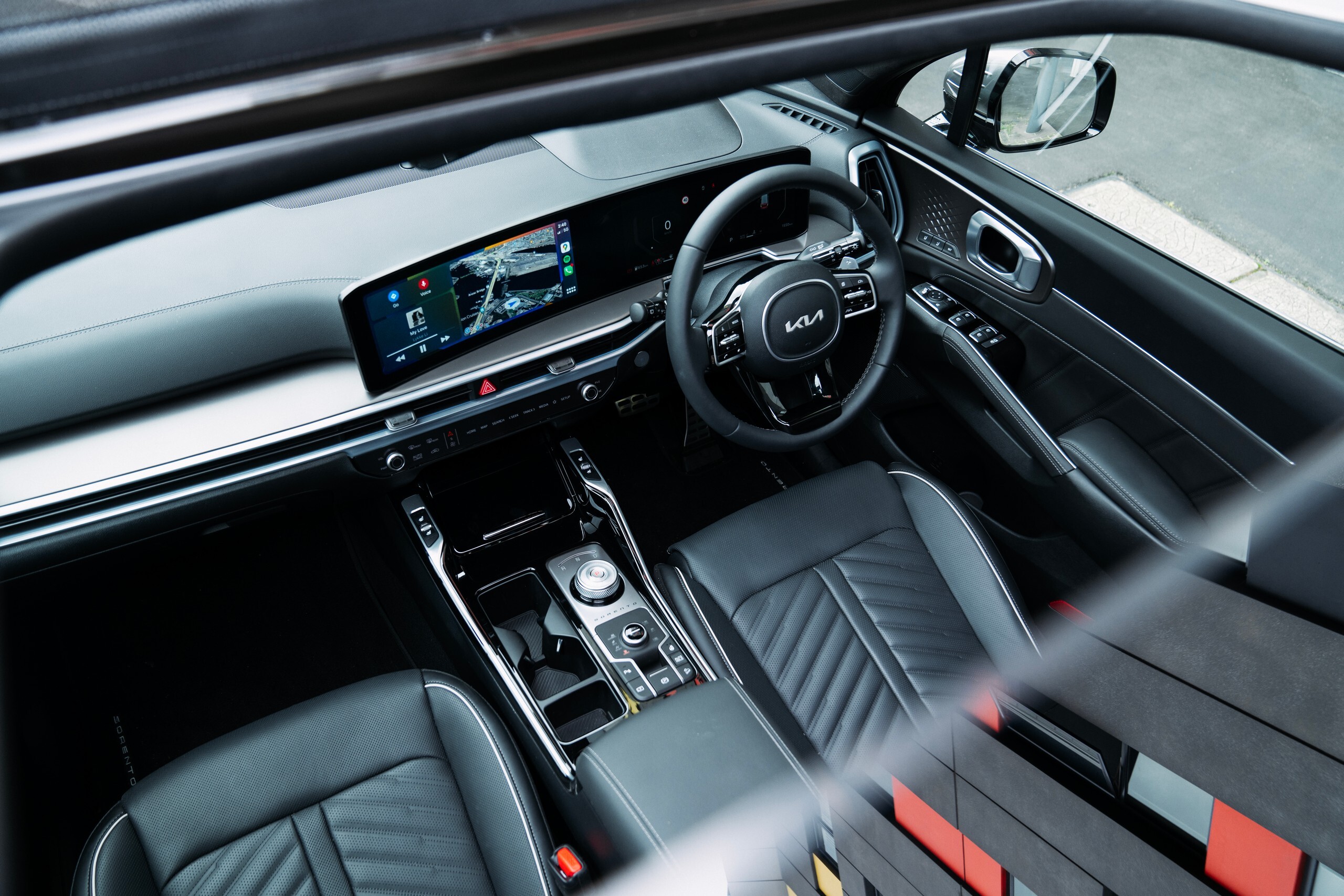
The tester’s cabin was bathed in supple black Nappa leather, with heated and ventilated front seats. Other welcome features include a wireless smartphone charging pad, ample storage, and a large panoramic glass roof. While the overall fit and finish and the quality of the materials are good, the Sorento’s cabin doesn’t seem quite as nice as the latest Santa Fe, which feels more luxurious.
Read: Kia Cut Navigation From 2026 Sorento S But Still Raised The Price
It’s also worth noting that while the Sorento offers three rows of seating, the third row is only suitable for kids, and maybe teenagers. It’s more compact back there than other Kia offerings like the larger EV9 and Telluride. If you have a family of more than four, those are better options, as is the Kia Carnival.
As Good As Ever, But What About The PHEV?


Photos Kia Australia
Spending a week living behind the wheel of the Sorento PHEV revealed it to be a solid overall performer, though the powertrain leaves a little to be desired.
In the Hyundai Santa Fe, for example, which also uses a compact 1.6-liter turbocharged four-cylinder, the engine remains quiet in all driving modes and is even surprisingly unintrusive when you hit the throttle. Things are a little different in the Sorento PHEV.
For whatever reason, the engine is quite loud and clattery in the Kia, and it’s almost easy to mistake it for a diesel. The harsh soundtrack is obviously most notable when accelerating hard, but even while cruising around town, it’s quite loud. This is a real shame, as it detracts from the vehicle’s overall sense of refinement.
What About Electric Driving?
Photos Kia Australia
Obviously, the positive of opting for the plug-in hybrid Sorento is the ability to drive solely on electric power. The SUV is equipped with a 14 kWh battery pack, and while that’s certainly not huge, it’s big enough to give a claimed electric driving range of 68 km (42 miles). Achieving that proved to be difficult, but it is quite easy to travel at least 50 km (31 miles) on electric power alone.
With a fully charged battery, the overall fuel efficiency is a claimed 1.6 l/100 km (147 US mpg). However, as with other plug-in hybrids, that efficiency figure is only relevant if the vehicle is operating on electric power alone for a solid portion of those 100 kilometers (62 miles). If the battery is drained, that figure will obviously rise as the vehicle leans on the combustion engine.
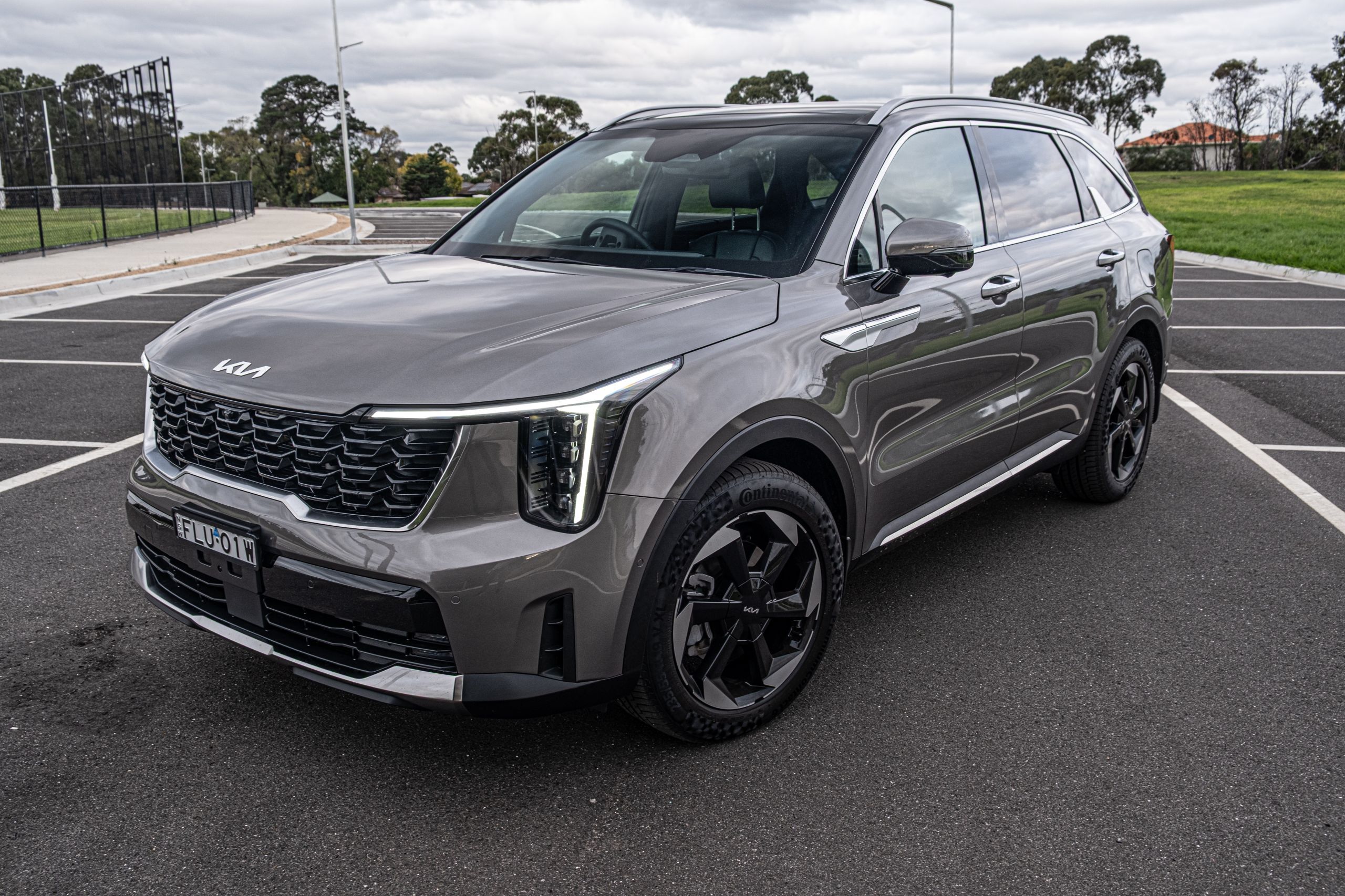
During my week with the car, I averaged 6.4 l/100 km (36.7 US mpg), and that was with the brake regeneration set to its highest level for most of the time. However, I did not charge the battery, which is why the consumption figure is much higher than Kia’s claim. Overall, that’s solid efficiency, but the basic diesel all-wheel-drive model has a quoted consumption of 6.0 l/100 km (39.2 US mpg). Those interested in buying the Sorento PHEV will need to ensure they actually charge it to get the most out of it. If not, you’d be better off getting the diesel.
Whereas other versions of the Sorento use an eight-speed transmission, the Sorento PHEV sticks with a slightly more traditional six-speed automatic. Although it has two fewer cogs, it works just as well as the eight-speed, delivering silky-smooth shifts like those in the Santa Fe. Admittedly, the shifts aren’t particularly fast, but that won’t be a concern to all that many buyers.
It’s also worth noting that because the electric motor is integrated within the transmission, the shifts can be a little loud. It’s not the end of the world, but it is something tempted buyers should be aware of, so we’d recommend arranging a test drive if you plan on buying a Sorento PHEV, rather than placing a blind order without getting behind the wheel first.
Photos Kia Australia
The ride is good and most of what you’d expect from a vehicle like this. Given that the Sorento PHEV weighs over 2,000 kg (4,409 lbs), it rides on the slightly firmer side but still does an excellent job of soaking up bumps and road imperfections. Does it have the same kind of plush ride as the Santa Fe? No.
As with the pre-facelift model, the updated Sorento retains the same Eco, Normal, and Sport driving modes, as well as Terrain modes with Snow, Mud, and Sand settings, selectable with a dial on the center console. In the limited amount of time we spent driving off-road, the Sorento felt sure-footed and surprisingly capable, intelligently managing traction and adjusting the transmission’s behavior.
On the road, I spent most of my time driving around in Eco mode. The available Sport mode will likely be used rarely by buyers, but it does a decent job of making the SUV feel a little sprightlier.
Photos Kia Australia
Verdict
The Kia Sorento remains a good choice for those in the market for a three-row SUV, although it is best used as a two-row vehicle. The cabin feels premium, and the overall build quality is excellent, as you’d expect from a Kia.
However, the plug-in hybrid version probably isn’t the model you should choose. Unless you can commit to charging it every night, the PHEV is no more efficient than the standard turbo-diesel, and doesn’t feel as refined either. Those who want to enjoy limited all-electric driving can also opt for the regular hybrid. Then there’s the current Santa Fe HEV, which, overall, feels like a better package than the Sorento. You’ll just have to forgive the Hyundai’s controversial design.