









- The solid-state battery kept 97.7% charge in ten days.
- Donut Lab faced claims its tech was just supercapacitors.
- Independent test conducted by Finnish Technical Research Centre.
Donut Lab, a small Finnish startup claiming to have developed the first solid-state battery for electric vehicles, has released results from a new test aimed at addressing doubts about its technology. The company says the data shows its battery retains 97.7 percent of its charged capacity after sitting idle for 10 days. Even so, skeptics may still need convincing.
Read: Donut Lab Claims It Verified A 7-Minute Solid-State EV Battery Charge
This third test follows Donut Lab’s recent demonstration of how quickly its solid-state cells can charge. It is intended to counter reports suggesting the company has not built a true battery at all, but rather a supercapacitor. To address those claims, Donut Lab worked with the Finnish Technical Research Centre (VTT) to measure how slowly the cell loses charge while idle.
Measuring Idle Voltage Loss
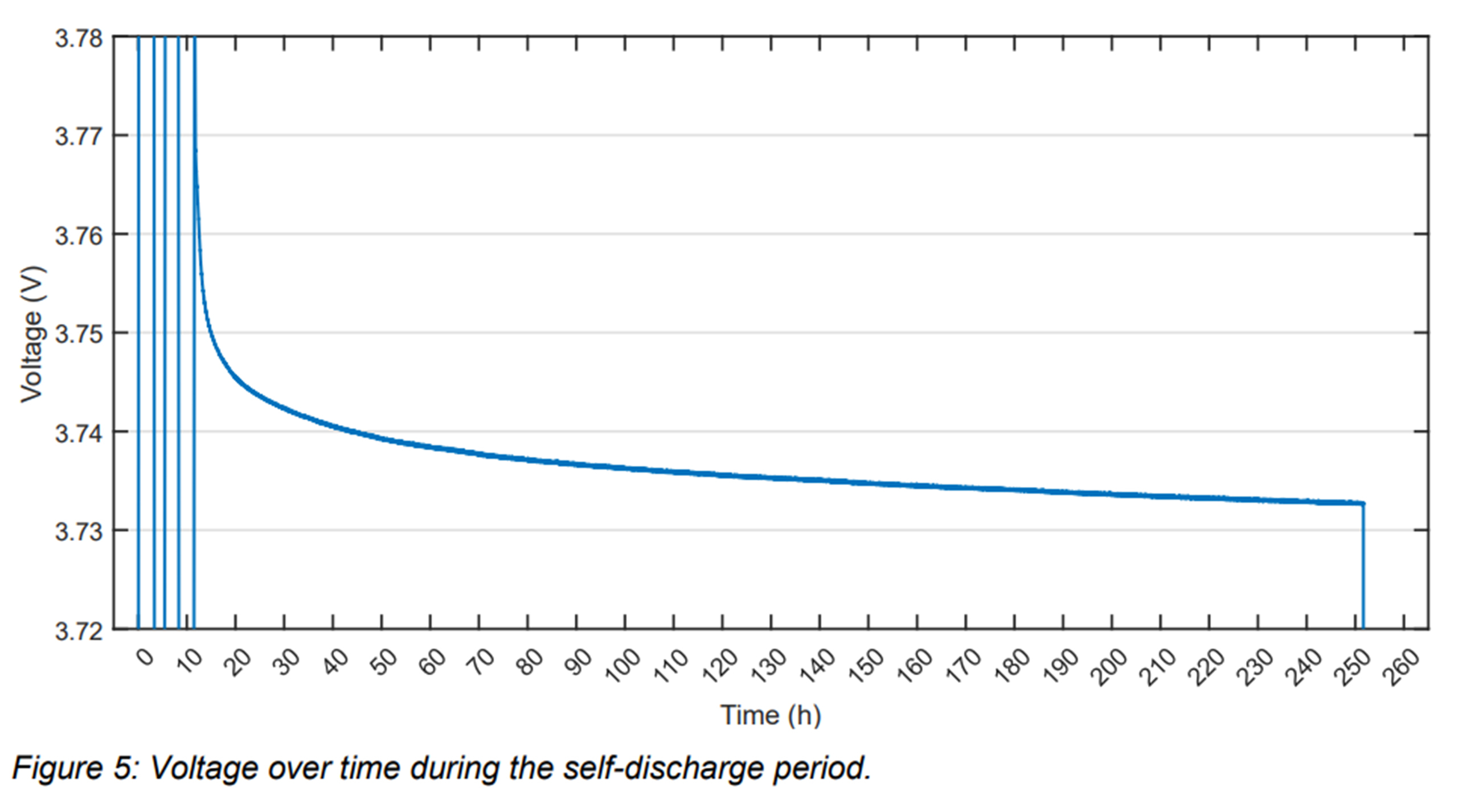
For the self-discharge test, a cell was charged to approximately 50 percent and then left idle for 240 hours. During the test, temperatures ranged between 22-28°C, and the cell’s voltage was recorded every 10 seconds.
The results are interesting. During the first hour, the battery’s voltage dropped by 103 mV, though the company says this is largely due to voltage relaxation rather than true self-discharge. By the end of the 240-hour test, the voltage had fallen by an additional 12 mV, representing a total loss of 2.3 percent over the 10-day period.
While this is a solid result, it’s not incredible. Typical lithium-ion battery cells can lose around 5 percent of their charge within the first 24 hours, after which the self-discharge rate typically slows to between 1-2 percent per month. Donut Lab argues the results still demonstrate that the technology is not a supercapacitor, which would normally lose far more charge when idle.
“Since we unveiled the Donut Battery, there has been a lot of speculation and theories about whether it is a supercapacitor,” Donut Lab chief technology officer Ville Piippo said. “In all its simplicity, this test proves that it is a battery. Supercapacitors charge and discharge quickly, but they also lose their charge quickly when not in use. The Donut Battery behaves like a battery and can maintain a charge for significantly longer.”