










- Porsche patent revives air cooling ideas for future mid- and rear-engined sports cars.
- New system could reduce curb weight, improve aerodynamics and simplify packaging.
- Reversible airflow even helps warm engines faster during cold starts, emissions testing.
Porsche may have stopped building air-cooled 911s nearly three decades ago, but it clearly hasn’t stopped thinking about them. A newly published German patent reveals a fascinating cooling concept that blends old school Porsche engineering with modern performance demands in a way we didn’t see coming.
The patent, unearthed by CarBuzz, was filed with Germany’s DPMA in 2025 and officially published on May 7 this year. Its title translates to “Motor Vehicle With An Air And Liquid Cooled Combustion Engine,” because the new system doesn’t rely on air-cooled technology alone.
Related: Porsche’s GT Boss Says Europe May Kill The NA GT3 Engine, America Still Gets To Keep It
Porsche appears to be developing a hybrid thermal management system for future high performance sports cars, especially rear and mid engined models, something not seen since the proto-hypercar 959, which featured an air-cooled crankcase and water-cooled heads.
The idea this time around combines a conventional liquid cooling setup with active airflow cooling around the engine itself. The engine still uses coolant channels, pumps, and a radiator, but Porsche adds a large fan driven airflow system that actively directs air around the engine block, turbocharger, and exhaust components.
Unlike on a normal modern sports car, the engine sits inside a mostly enclosed housing that works almost like a giant duct. Air gets pulled through a radiator first, then pushed around the engine before exiting through the rear of the car. It’s a setup that feels surprisingly close to classic air-cooled 911 thinking. Porsche even mentions cooling fins on the crankcase, one of the defining visual and engineering traits of older 911 engines.
Packaging Benefits
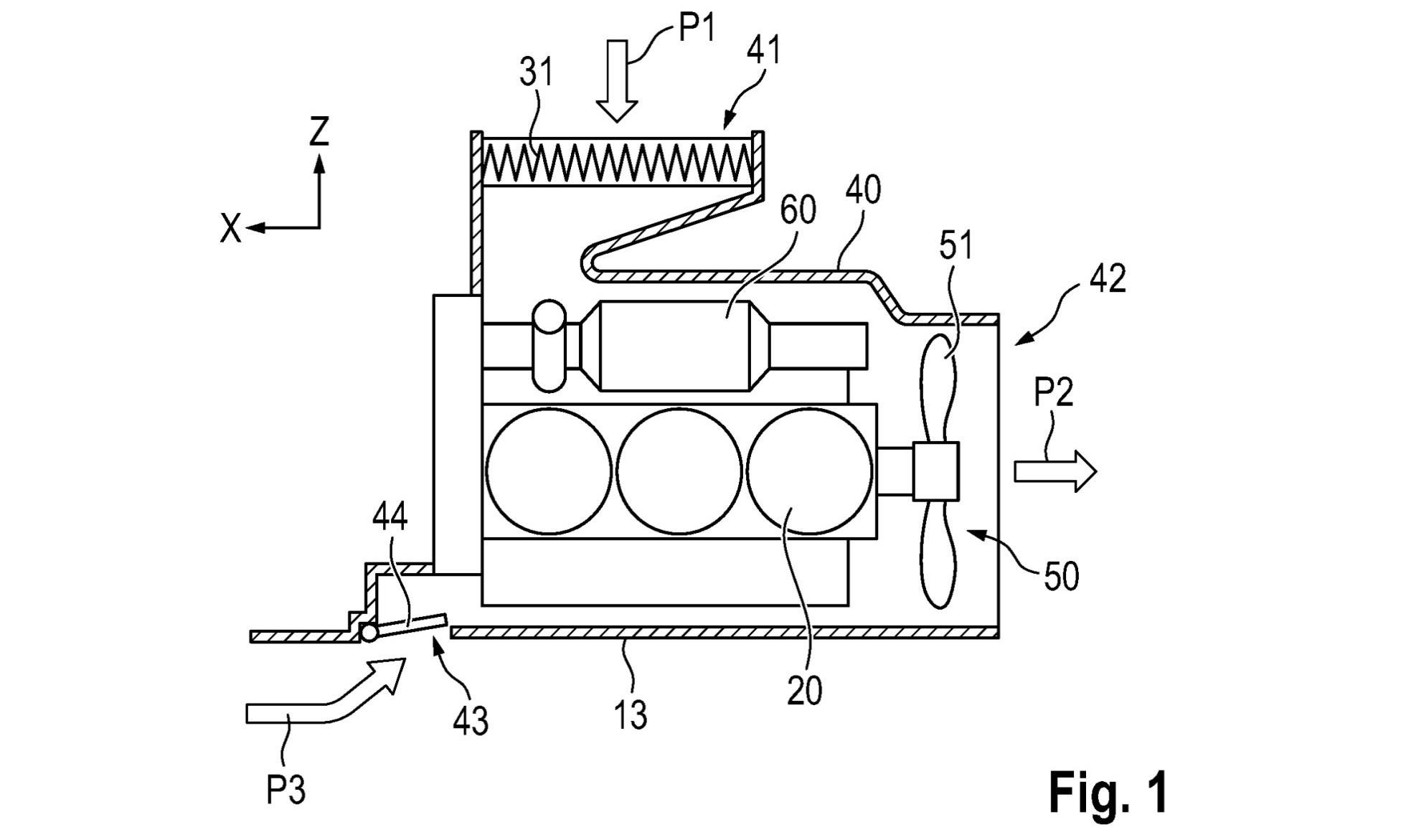
The patent suggests some major packaging advantages. Since the radiator sits close to the engine instead of up front, coolant lines can be shorter, lighter, and simpler. Porsche also says the layout could improve aerodynamics because the front end wouldn’t need massive cooling openings anymore.
But here’s where it gets really clever. The airflow can apparently reverse direction during cold starts, recirculating warm air and even exhaust heat to bring the engine up to operating temperature faster. Porsche even hints the system could help generate extra rear downforce, giving the whole thing serious GMA T.50 energy.
Whether this reaches production is anyone’s guess, and we’re curious to see how Porsche manages the fan noise that was one of the reasons the original air-cooled engine died with the 993. But if it does come through, Porsche fans might be in line for a future sports car that literally breathes a little like the old ones.