

A Slate Designer Spent His Spare Time Redrawing Volvo's Lost Wagon
One ex-Volvo pen imagined the minimal, functional wagon the brand stopped making, and it looks better than most things on sale
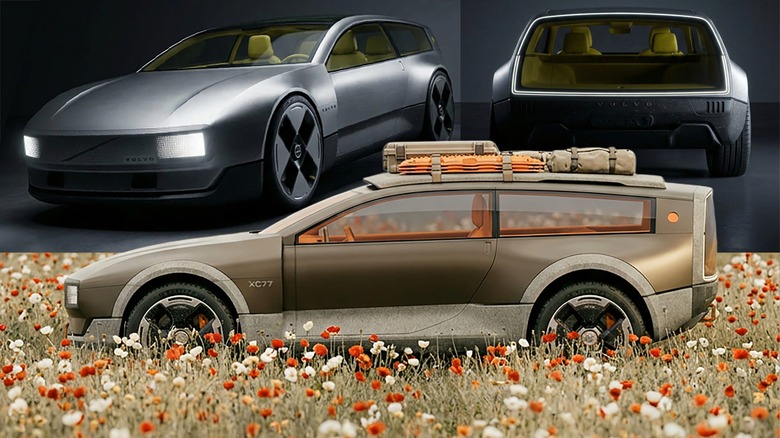
- A former Volvo designer revived the brand's lost wagon as a concept.
- The V77 and XC77 wear a three-door aerodynamic shooting brake body.
- Bauhaus thinking and Dieter Rams shape the studies' clean surfacing.
Volvo's current lineup leans hard on SUVs, but the brand built its reputation on wagons, and there's reason to believe it hasn't given up on them. Neither has at least one of the people who used to design its cars. A former Volvo designer set out to bring the old formula back with a pair of digital concepts, the V77 and XC77, each built around a mix of minimalism and sustainability.
The man behind them is Julien Fesquet, a Los Angeles-based professional designer currently working for Slate Auto. His resume reads like a grand tour of the industry, with stops at Volvo, Honda, Jaguar Land Rover, BMW, and Ferrari.
More: Volvo's Prettiest Wagon Returns, But Only A Lucky Few Will Own One
The V77 and XC77 are a personal project, drawing on Bauhaus principles and the work of Dieter Rams, the industrial designer whose thinking eventually shaped the look of Apple products. Both wear a three-door shooting brake body with a low nose and an aerodynamic roofline. Staying true to Volvo's playbook, the V77 is built for the road while the XC77 adds crossover cues and a lifted stance.


Beyond the compact footprint and genuinely handsome proportions, the concepts trade in clean surfacing and restraint. The low-mounted headlights fade into a covered grille via a digital gradient, and the Volvo emblem has been pared down to a single horizontal line.
More: Volvo 240R EV Study Throws A Brick At Electric Performance
The profile is distinguished by large alloy wheels, supercar-style creases on the front fenders, a flat beltline, and a bi-tone livery with a darker finish for the lower bodywork. The rear section is even more striking, with a glass tailgate surrounded by ultra-slim LEDs. The designer also placed emphasis on the Color, Materials, and Finish (CMF) strategy, proposing the use of recycled materials and an unpainted body for the V77.
Inside, we find two rows of seats and a rather large boot. The V77 adopts a Cream Yellow interior theme inspired by the Volvo 850 T-5R, while the XC77 gets an Orange interior that complements its earthy brown exterior panels.


Fesquet didn't list any specs, but the absence of cooling vents and tailpipes suggests the digital concepts were envisioned with a fully electric powertrain.
More: The EX30 Is Dead, But Volvo's Next Cheap EV Is Already On The Way To America
Fesquet told CarScoops: "Volvo is a brand with iconic station wagon, very minimal functional boxy designs in the past. It still has beautiful cars, but it tends to be oriented to more traditional automotive design. I thought it would be interesting to break the modern Volvo codes and imagine what it could look like if it was still a more minimal, functional, and industrial design. Something modern, sophisticated yet boxy, but without forgetting the need of aerodynamic performance. This led to this shooting brake silhouette with a low nose, sleek roof and low ground clearance."
What About Real Volvo Wagons?
Volvo has recently wound down production of the aging V60 and V90, along with the adventurous XC60 and XC90. Even so, wagon fans aren't completely out of luck.
Chief technology officer Anders Bell has said the new SPA3 architecture, which debuted underneath the EX60 SUV, can support a range of bodystyles, low-slung models included. Volvo hasn't confirmed any wagon yet, so the question comes down to whether demand will be there to justify the spend. For now, we wait.


